
Pull to refresh
Logo
University of Queensland sends a message through a wall using gravity

University of Queensland sends a message through a wall using gravity

New Capabilities

An elevator counterweight and a gravimeter carried one word through a brick wall, at one bit per minute.

Overview

Updated 1 hour ago

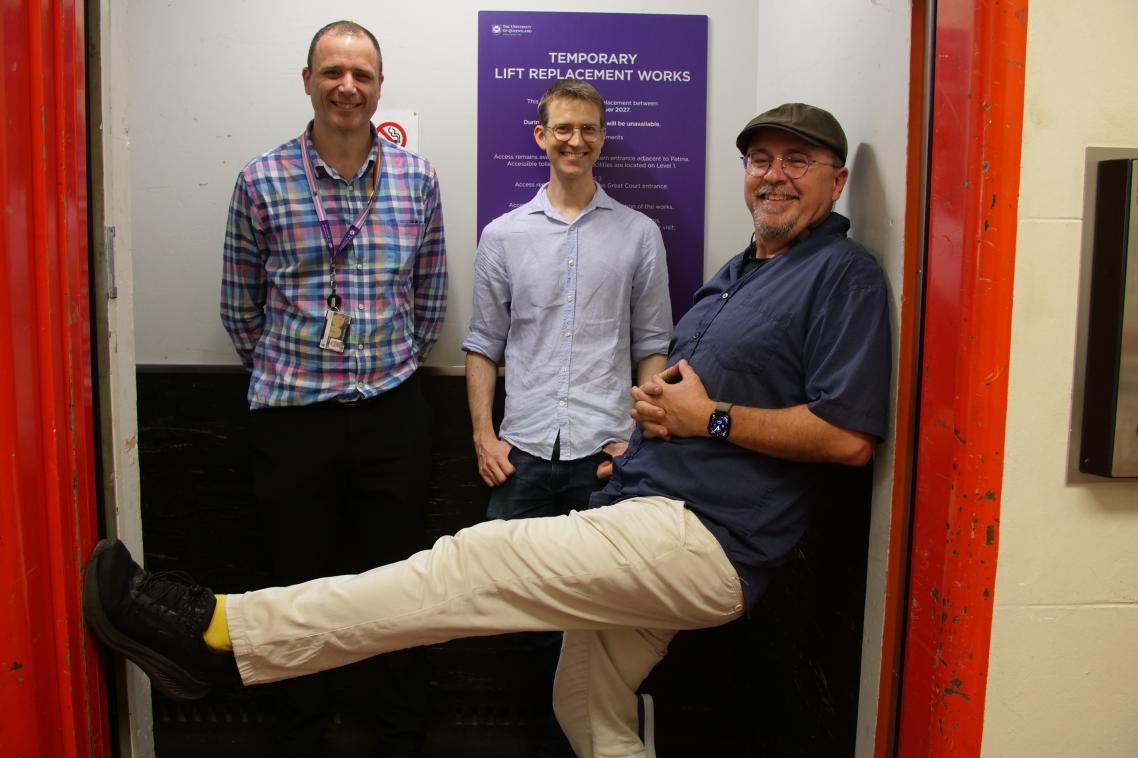
A 1950s elevator carried a 1.8-tonne counterweight up and down for an hour in a University of Queensland building. A detector in the next room, through a brick wall, read the motion as one word: 'Gravity'.

The team published the result in Science Advances and describes it as the first experimental demonstration that information can be encoded in a gravitational field and recovered at the other end. The receiver was a gravimeter, an instrument that measures tiny changes in local gravity. Ordinary matter cannot screen gravity the way a metal box blocks radio, so a message sent this way cannot be jammed by putting a wall in the path.

The cost is speed. The link moved one bit per minute over 0.7 metres. The team's modelling puts the ceiling at roughly 15 bits per minute and about 500 metres, and only with hardware nobody has built yet.

Why it matters

Walls and tunnels block radio but not gravity. The open question is whether a gravity channel can be made fast enough to use.

Questions about this story

Free account needed to ask — your question is kept and asked for you right after sign-up. Answers are public.

No questions yet — be the first to ask.

Key Indicators

1 bit/min
Data rate achieved
Measured rate of the working link through a brick wall.
0.7 m
Transmission distance
Elevator to a gravimeter in an adjacent bathroom.
1.8 t
Counterweight mass
Moved between two floors to encode binary ones and zeros.
~500 m
Projected maximum range
Modelling only, assuming better sensors and a 75-tonne mass.
~15 bit/min
Projected data rate
With a modern elevator and a newer gravimeter than the one used.

Voices

Curated perspectives — historical figures and your fellow readers.

Sign up to generate historical perspectives on this story.

People Involved

Organizations Involved

Timeline

1 event Latest: 4 days ago
  1. Gravity-encoded message crosses a brick wall

    Latest Research

    University of Queensland reports sending one word, 'Gravity', 0.7 metres through a wall at one bit per minute.

Scenarios

1

Quantum gravimeters push gravity messaging past 100 metres

Possible Resolves by End of 2030

Discussed by: University of Queensland modelling in Science Advances

The paper lists the levers: a more compact mass, a heavier mass, a quieter detector, and a willingness to trade signal-to-noise for distance. Combined, they project a range increase of about 700 times, to roughly 500 metres. The first real test would be a link built with a superconducting or cold-atom gravimeter instead of the commercial unit used in Brisbane.

2

Gravity messaging stays a one-off lab demonstration

Likely Resolves by End of 2029

Discussed by: Matthew Davis in Guardian Australia; SciTechDaily

Davis said practical use is hard to imagine at present, and coverage noted that the 500-metre and 15-bit figures are projections rather than results. At one bit per minute, with a detector that filters over 40 seconds, the scheme compares badly with any cable or radio link that is not physically blocked. Without a user who genuinely needs a sealed room, follow-up work may not arrive.

3

A sealed facility becomes the first customer

Unlikely Resolves by Q2 2031

Discussed by: Science Advances paper and the Science podcast interview with the authors

The paper names the use case: messages from inside secure facilities, bunkers or radiation-hardened rooms where radio, light and wiring are blocked or forbidden. Gravimeters can in principle be built without electronics, which the authors note would make the link radiation-proof. A defence ministry or nuclear operator funding a trial would move the technology out of the physics building.

Historical Context

3 moments from history that rhyme with this story — and how they unfolded.

March 2012

Neutrino messaging at Fermilab (2012)

Physicists on Fermilab's MINERvA experiment used the NuMI neutrino beam to spell out the word 'neutrino' through about 240 metres of rock. Neutrinos interact with matter so rarely that almost nothing stops them, which is exactly what makes them attractive as a carrier.

Then

The message arrived at roughly one bit every ten seconds, far too slow for anything beyond a demonstration.

Now

No practical neutrino communication system followed, because the detector mass needed grows with distance.

Why this matters now

Gravity messaging faces the same bargain: an unblockable channel is easy to describe and hard to make fast.

1960s-2004

Extremely low frequency radio for submarines (Cold War to 2004)

Seawater blocks ordinary radio, so navies built transmitters using extremely low frequency waves, with antennas tens of kilometres long, to reach submerged submarines. The price was bandwidth: messages arrived at a few characters per minute.

Then

The system worked well enough to order submarines to surface and take conventional traffic.

Now

The US transmitter shut down in 2004 as other methods took over, but the penetration-versus-bandwidth trade-off never disappeared.

Why this matters now

Gravity communication sits at the far end of that trade-off: completely unblockable, and considerably slower.

May 1844

The first telegraph line (1844)

Samuel Morse sent the message 'What hath God wrought' from Washington to Baltimore over a line running roughly 60 kilometres along a railroad right of way. It was the first commercial electrical message network.

Then

Telegraphy spread along rail lines within a decade and displaced horse-borne mail for urgent traffic.

Now

It took more than a century for that infrastructure to evolve into mobile telephony.

Why this matters now

Andrew White uses this gap to argue that a slow first demonstration says little about where the technology ends up.

Sources

(4)