Pull to refresh
Logo
Daily Brief
Following
Why Ranks Sign Up
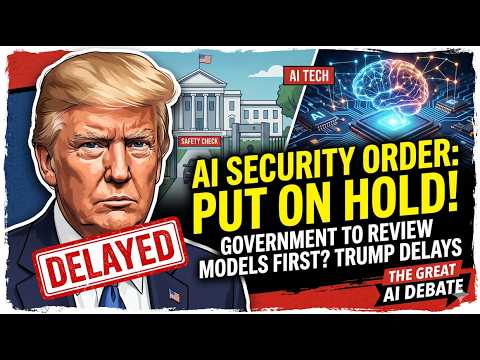
Trump signs voluntary federal review of frontier AI models

Trump signs voluntary federal review of frontier AI models

Rule Changes

Executive order asks top US labs to share their most powerful systems with national security agencies up to 30 days before public release

August 1st, 2026: Frontier-model benchmark due

Overview

For about three years, the question of who gets to look inside the most powerful US AI systems before they ship has bounced between two answers: nobody, or the government, by force. On June 2, 2026, President Trump signed a third one. Frontier labs can hand their newest models to federal security agencies for up to 30 days before public release. They are asked to. They are not required to.

The voluntary framework is narrower than the 90-day window the White House drafted last month. It is also narrower than the mandatory reporting regime President Biden built in 2023 and Trump rescinded on his first day back in office. Anthropic, OpenAI and Google are the labs the order has in mind, and all of them have signaled they will play along. The teeth of the policy, if any develop, will come from a classified benchmark the National Security Agency has 60 days to design.

Why it matters

The federal government can now see the most powerful US AI systems before the public does, but only when the labs that build them choose to show.

Questions about this story

No questions yet — be the first to ask.

Key Indicators

30 days
Maximum pre-release review window
Time the federal government may study a frontier model before its public release under the voluntary framework.
Voluntary
Lab participation requirement
Frontier labs may opt in or out. Nothing in the order compels disclosure.
Cut from 90
Window in earlier draft
The version the White House planned to sign May 21 gave the government 90 days. Industry pushback shortened it.
3
Labs named as frontier developers
Anthropic, OpenAI and Google are the firms the order treats as primary participants.
60 days
Deadline to define a frontier model
Treasury, the NSA, CISA, NIST and White House officials must finish a classified benchmark before any review begins.

Voices

Curated perspectives — historical figures and your fellow readers.

Ever wondered what historical figures would say about today's headlines?

Sign up to generate historical perspectives on this story.

Play

Exploring all sides of a story is often best achieved with Play.

Log in to play. Track your picks, climb the leaderboards. Log in Sign Up
Predict 4 ways this could play out. Contrarian picks score more — points lock when the scenario resolves. Log in to play
Higher or Lower Two numbers from this story. Guess which is bigger. 5 rounds to set a streak. Log in to play
Timeline Five events from this story — drag them oldest to newest. Log in to play
Connections Sixteen names from the news. Find the four hidden groups of four. Log in to play

People Involved

Organizations Involved

Timeline

October 2023 August 2026

9 events Latest: August 1st, 2026
Tap a bar to jump to that date
  1. Frontier-model benchmark due

    Latest Implementation deadline

    Treasury, NSA, CISA, NIST and White House officials must finish the classified benchmark that defines a 'covered frontier model.'

  2. AI cybersecurity clearinghouse due

    Implementation deadline

    Treasury must form a clearinghouse to coordinate AI software vulnerability scanning with industry and critical-infrastructure operators.

  3. Trump signs scaled-back AI review order

    Policy

    Order asks frontier labs to share models with the federal government for up to 30 days pre-release on a voluntary basis. NSA gets 60 days to set a classified threshold.

  4. Trump postpones AI signing ceremony

    Policy

    Hours before a planned ceremony with tech CEOs, Trump scraps the signing after calls from Musk, Zuckerberg and Sacks objecting to the 90-day review window.

  5. Sacks exits White House AI czar role

    Personnel

    David Sacks steps down as AI czar and moves to PCAST, where he keeps shaping frontier-model policy from outside the building.

  6. AI Safety Institute renamed

    Institutional

    Commerce rebrands the institute as the Center for AI Standards and Innovation, shifting its stated mission from safety to foreign-threat review.

  7. Trump rescinds Biden's AI order

    Policy

    Hours after inauguration, Trump signs EO 14179 'Removing Barriers to American Leadership in Artificial Intelligence,' killing Biden's mandatory reporting regime.

  8. US AI Safety Institute established

    Institutional

    Commerce sets up the AI Safety Institute inside NIST to evaluate frontier models and coordinate with industry.

  9. Biden signs mandatory frontier-AI reporting order

    Policy

    Executive Order 14110 requires top labs to share safety-test results and dual-use research with the federal government.

Historical Context

3 moments from history that rhyme with this story — and how they unfolded.

October 2023 – January 2025

Biden's frontier-AI reporting order (2023)

On October 30, 2023, President Biden signed Executive Order 14110, the first federal rule requiring top AI labs to share safety-test results and dual-use research with the government. It used the Defense Production Act to make reporting mandatory above set compute thresholds.

Then

Major labs began submitting reports and signing voluntary cooperation agreements with the new AI Safety Institute.

Now

Trump rescinded the order on his first day back in office in January 2025, ending mandatory reporting and leaving a 17-month gap before the June 2026 voluntary framework.

Why this matters now

The 2023 order set the policy reference point the new one is measured against. Biden made disclosure mandatory; Trump has made it optional. The same labs, same models, same risks, two different legal regimes.

June 2025

AI Safety Institute renamed to CAISI (2025)

Commerce Secretary Howard Lutnick renamed the AI Safety Institute as the Center for AI Standards and Innovation. The center's mandate was rewritten to focus on foreign AI threats, backdoors in adversary models and resistance to 'regulatory overreach.'

Then

Safety-focused staff left or were reassigned. Industry kept its existing cooperation agreements but with a less independent counterpart.

Now

By June 2026 CAISI was the technical body the new order had to lean on, but its independent evaluation capacity was thinner than it was under Biden.

Why this matters now

The CAISI rebrand showed which way the administration was pulling on frontier-AI oversight before the new order existed. Safety advocates argue it weakens the body now charged with executing the voluntary review.

2019 – 2024

CFIUS review of TikTok (2019-2024)

The Committee on Foreign Investment in the United States ran a multi-year national security review of TikTok's US operations, ultimately producing a forced-divestiture bill that passed Congress in April 2024.

Then

TikTok continued operating under negotiated security commitments while the review dragged on.

Now

Voluntary cooperation eventually gave way to a statutory mandate when Congress decided the executive branch tools were not enough.

Why this matters now

CFIUS shows how a voluntary or executive-only national security review of a tech product can run for years before Congress writes it into law. The same dynamic could play out with frontier AI.

Sources

(11)