

Pull to refresh
Logo
Daily Brief
Following
Why Sign Up
SpaceX launches final ViaSat-3 satellite, completing global broadband constellation

SpaceX launches final ViaSat-3 satellite, completing global broadband constellation

Built World
By Newzino Staff |

Three satellites, three years, one $420 million failure — Viasat finally has a unified worldwide network

Today: Falcon Heavy launches ViaSat-3 F3

Overview

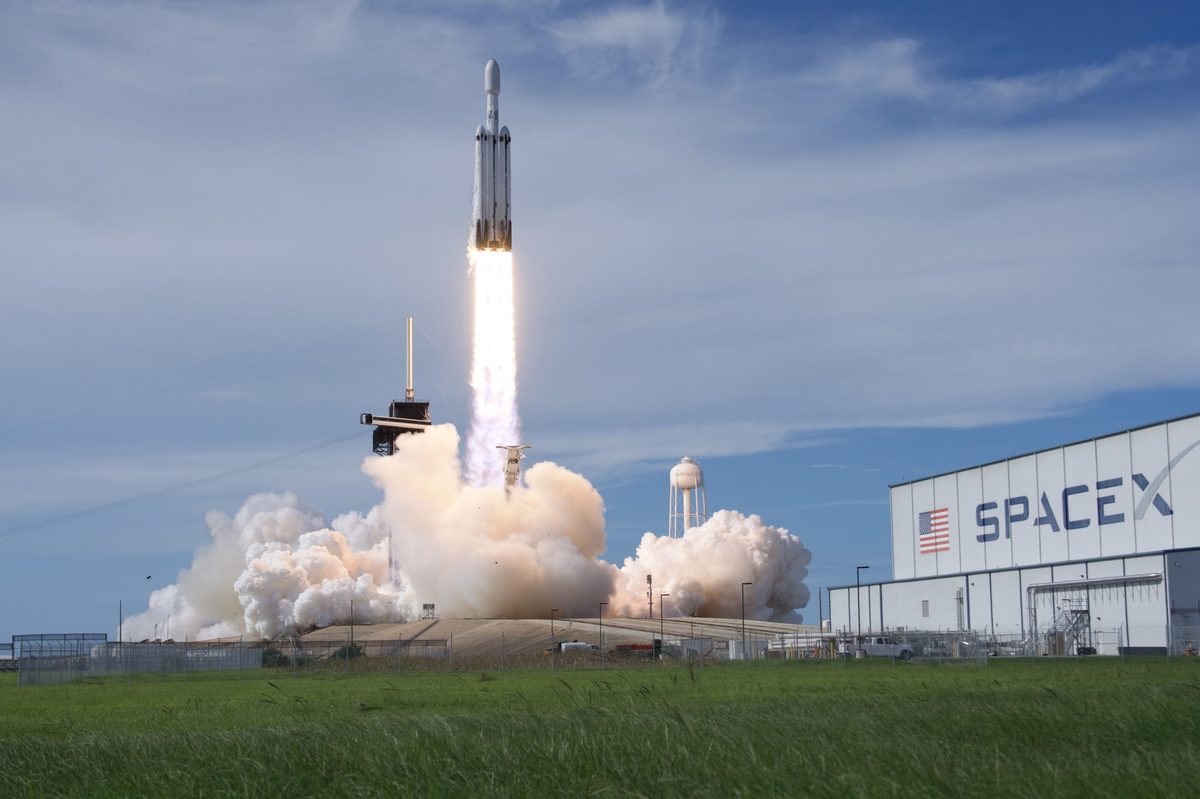
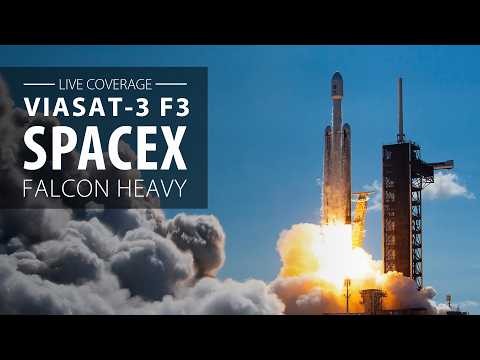
A SpaceX Falcon Heavy lifted off from Kennedy Space Center on Monday morning carrying the third and final ViaSat-3 satellite — completing a global broadband network nearly a decade in the making. It was Falcon Heavy's first flight in 18 months. Once the new satellite reaches its orbital slot and finishes testing in late summer 2026, Viasat will operate a unified high-capacity network spanning the Americas, Europe, and Asia-Pacific.

Why it matters

Global aviation, shipping, and military networks gain a fully unified high-capacity geostationary alternative to Starlink — the only competing worldwide satellite broadband system outside low Earth orbit.

Key Indicators

1+ Tbps
Asia-Pacific capacity added
Each ViaSat-3 satellite delivers more than one terabit per second of throughput.
18 months
Since last Falcon Heavy flight
SpaceX's heavy-lift rocket had not flown since the Europa Clipper mission in October 2024.
$420M
Insurance claim on first satellite
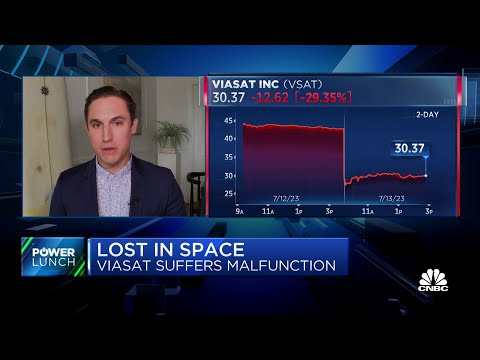
The F1 satellite's antenna failed to deploy properly in 2023, severely degrading its capacity.
6.6 tons
Satellite mass
Among the heaviest commercial communications satellites ever launched.
3 of 3
Constellation now complete
Coverage spans the Americas (F1, degraded), EMEA (F2), and Asia-Pacific (F3).

Interactive

Exploring all sides of a story is often best achieved with Play.

Ever wondered what historical figures would say about today's headlines?

Sign up to generate historical perspectives on this story.

Sign Up

Debate Arena

Two rounds, two personas, one winner. You set the crossfire.

People Involved

Organizations Involved

Timeline

  1. Falcon Heavy launches ViaSat-3 F3

    Launch

    SpaceX returns its heavy-lift rocket to flight after an 18-month gap, sending the third and final ViaSat-3 satellite toward geostationary transfer orbit on a roughly five-hour deployment sequence.

  2. ViaSat-3 F2 launches on Atlas V

    Launch

    United Launch Alliance flies the EMEA-coverage satellite from Cape Canaveral after two earlier scrubs caused by an Atlas liquid oxygen vent valve issue.

  3. Insurers face $420 million claim

    Financial

    Underwriters describe the loss as a 'market-changing event' for satellite insurance, helping push premiums sharply higher across the industry.

  4. Viasat discloses F1 antenna failure

    Incident

    An anomaly during deployment of the satellite's large mesh reflector, built by Northrop Grumman, severely impairs the spacecraft's broadband capacity.

  5. Viasat closes $7.3 billion Inmarsat acquisition

    Corporate

    UK and EU regulators clear the merger after determining Starlink would constrain the combined company's market power, particularly in inflight connectivity.

  6. ViaSat-3 F1 launches on Falcon Heavy

    Launch

    The first ViaSat-3 satellite, covering the Americas, reaches near-geosynchronous orbit at roughly 34,600 kilometers altitude.

  7. Viasat unveils ViaSat-3 program

    Announcement

    Viasat announces a three-satellite global constellation targeting terabit-class throughput per spacecraft, with launches initially planned between 2020 and 2022.

Scenarios

1

Viasat captures premium aviation and maritime market by 2027

Discussed by: Viasat management; analysts cited in StockStory and Via Satellite earnings coverage

F3 enters service on schedule in late summer 2026 and the unified network gives Viasat enough capacity to compete head-to-head with Starlink on long-haul flights and ocean routes, where geostationary coverage is reliable and bandwidth needs are predictable. Backed by long-term Inmarsat-era contracts with airlines and shippers, Viasat retains and expands its premium mobility business even as Starlink dominates consumer broadband.

2

Starlink keeps winning, ViaSat-3 finds a defense niche

Discussed by: S&P Global satellite connectivity analysts; IEEE ComSoc commentary

Latency-sensitive customers continue migrating to Starlink, leaving Viasat to lean on its government, defense, and resilient-communications business — particularly for sovereign and US military customers wary of relying on a single commercial low-orbit network. The constellation pays off as critical national-security infrastructure rather than a mass commercial product.

3

Viasat splits commercial and government businesses

Discussed by: Viasat management on Q4 FY26 earnings call; financial analysts

Following completion of the constellation, the board approves a separation of the defense and advanced technologies arm from the commercial broadband business. Each unit pursues its own strategy and capital structure, with the commercial side potentially seeking a partner for low-orbit capacity while the government side trades on its classified contracts and cybersecurity portfolio.

4

Multi-orbit partnership lands a credible LEO complement

Discussed by: Mark Dankberg in Via Satellite interviews; broadband industry press

Viasat secures a wholesale or joint-venture relationship with an emerging low-orbit operator — Eutelsat OneWeb, Telesat Lightspeed, or a yet-to-launch player — to bolt low-latency service onto its geostationary backbone. The combined offering becomes the only credible global alternative to Starlink for enterprise and government users.

Historical Context

Iridium constellation completion (1998)

May-November 1998

What Happened

Motorola spinoff Iridium completed a 66-satellite low-orbit network for global satellite phones at a cost of roughly $5 billion. Service launched in November 1998 with bulky handsets and high per-minute pricing.

Outcome

Short Term

The company filed for Chapter 11 bankruptcy in August 1999, less than a year after service began, after enrolling only a fraction of projected subscribers.

Long Term

Assets were sold for $25 million in 2001 and the network was rescued for defense customers. A re-capitalized Iridium has since flown a successor constellation and remains the dominant satellite phone provider.

Why It's Relevant Today

A cautionary tale about completing an expensive global constellation just as the underlying market shifts. Viasat is finishing its geostationary system in an era when Starlink has already redefined what consumers expect from satellite broadband.

Inmarsat Global Xpress completion (2017)

August 2017

What Happened

Inmarsat completed its four-satellite Global Xpress network, the first commercial high-throughput Ka-band system to span the entire planet, after launching the first I-5 satellite in 2013. The constellation cost roughly $1.6 billion.

Outcome

Short Term

Global Xpress quickly became the connectivity backbone for thousands of ships, business aircraft, and military customers, and was central to Inmarsat's value proposition through the late 2010s.

Long Term

Inmarsat was acquired by Viasat in 2023 for $7.3 billion, in part because Global Xpress's Ka-band fleet complemented the in-development ViaSat-3 satellites.

Why It's Relevant Today

The most direct prior parallel: a global Ka-band geostationary broadband constellation completed by the company Viasat now owns. Sets the template for the customer base and use cases ViaSat-3 will serve.

O3b mPower partial launch and software issues (2022-2024)

December 2022-April 2024

What Happened

SES launched the first batches of its medium-Earth-orbit O3b mPower constellation starting in December 2022. Power-control software problems on early satellites forced the operator to limit capacity and add four more spacecraft to the design.

Outcome

Short Term

SES took a multi-hundred-million-dollar impairment and delayed full service entry by more than a year while it integrated additional satellites into the network.

Long Term

The constellation eventually entered commercial service but lost early-mover advantage in non-geostationary broadband to faster-deploying low-orbit competitors.

Why It's Relevant Today

Another recent example of a major broadband constellation losing time and money to spacecraft anomalies — exactly the dynamic Viasat experienced with the F1 antenna failure. Also illustrates how on-orbit setbacks compound when low-orbit rivals are gaining users every quarter.

Sources

(10)