

Pull to refresh
Logo
Daily Brief
Following
Why Sign Up
How NASA outsourced space trucking and built an industry that may outlive the station itself

How NASA outsourced space trucking and built an industry that may outlive the station itself

New Capabilities
By Newzino Staff |

Northrop Grumman's Cygnus XL delivers 11,000 pounds of science cargo to the ISS as the clock ticks toward the station's 2030 retirement

Today: CRS-24 launches second Cygnus XL to ISS

Overview

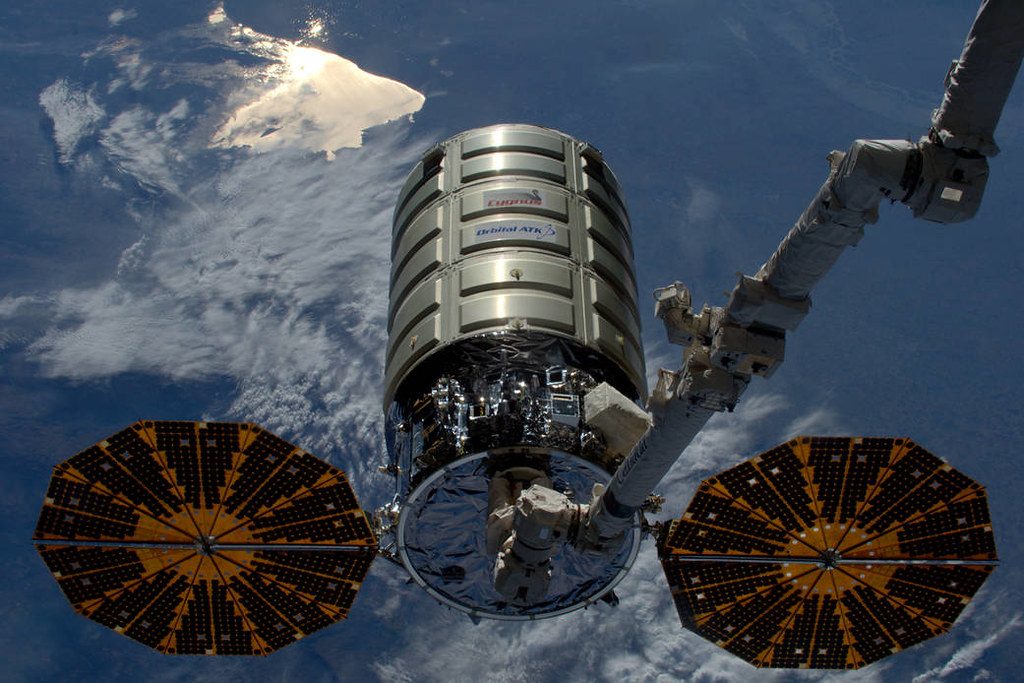
For more than a decade, NASA has relied on private companies to haul groceries, lab equipment, and experiments to the International Space Station — a deliberate bet that commercial logistics would be cheaper and more reliable than government-built rockets. On April 11, 2026, Northrop Grumman's enlarged Cygnus XL spacecraft launched atop a SpaceX Falcon 9, delivering roughly 11,000 pounds of science cargo to the station, including hardware for quantum physics research and therapeutic stem cell production.

Why it matters

The companies hauling cargo to the ISS today are building the logistics backbone for whatever replaces it after 2030.

Key Indicators

~11,000 lbs
Cargo delivered on CRS-24
Approximately 5,000 kilograms of science experiments, crew supplies, and equipment aboard the Cygnus XL.
33%
Cygnus XL cargo capacity increase
The XL variant is 1.6 meters longer than the standard Cygnus, adding roughly 2,600 pounds of capacity per flight.
50+
Total CRS missions flown
Combined SpaceX Dragon and Northrop Grumman Cygnus cargo flights to the ISS since 2012.
2030
ISS planned retirement year
NASA plans controlled deorbit of the station, with SpaceX building the deorbit vehicle under an $843 million contract.

Interactive

Exploring all sides of a story is often best achieved with Play.

Ever wondered what historical figures would say about today's headlines?

Sign up to generate historical perspectives on this story.

Sign Up

Debate Arena

Two rounds, two personas, one winner. You set the crossfire.

People Involved

Organizations Involved

Timeline

  1. CRS-24 launches second Cygnus XL to ISS

    Launch

    The S.S. Steven R. Nagel launches on a Falcon 9 from Cape Canaveral, carrying approximately 11,000 pounds of science experiments and supplies. Astronauts Jack Hathaway and Chris Williams are scheduled to capture it with Canadarm2 on April 13.

  2. SpaceX CRS-33 Dragon splashes down

    Mission

    Cargo Dragon returns from a 185-day ISS stay, bringing back more than 55 research investigations. The mission included multiple station reboost maneuvers.

  3. Dream Chaser contract modified — no ISS docking

    Contract

    NASA and Sierra Space agree that Dream Chaser's first flight will be a free-flying demonstration without visiting the station. NASA drops its obligation to purchase specific cargo missions.

  4. First Cygnus XL launches on Falcon 9

    Milestone

    Northrop Grumman debuts the larger Cygnus XL variant on the NG-23 mission. A software safeguard triggers early engine shutdowns during orbital maneuvers, delaying ISS arrival by one day.

  5. SpaceX wins $843M ISS deorbit vehicle contract

    Contract

    NASA selects SpaceX to build the U.S. Deorbit Vehicle, a modified Dragon-derived spacecraft that will guide the ISS to a controlled reentry over the South Pacific around 2030.

  6. Final Antares launch with Russian and Ukrainian parts

    Transition

    Northrop Grumman flies the last Antares 230+ rocket, ending its dependence on Russian RD-181 engines and Ukrainian-built structures cut off by the war in Ukraine.

  7. CRS-2 contracts add Sierra Nevada as third provider

    Contract

    NASA awards second-phase cargo contracts to SpaceX, Orbital ATK, and Sierra Nevada Corporation's Dream Chaser, each guaranteed a minimum of six flights.

  8. SpaceX CRS-7 lost in Falcon 9 breakup

    Failure

    A failed strut inside the Falcon 9 second stage causes the rocket to disintegrate during ascent, destroying the Dragon capsule and its ISS cargo.

  9. Antares rocket explodes on launch

    Failure

    An Antares rocket carrying the Cygnus Orb-3 mission suffers a catastrophic engine failure seconds after liftoff from Wallops Island, Virginia, destroying the vehicle and payload.

  10. First Cygnus reaches the ISS

    Milestone

    Orbital Sciences' Cygnus spacecraft completes its demonstration flight, giving NASA a second commercial cargo provider.

  11. First Dragon reaches the ISS

    Milestone

    SpaceX's Dragon capsule becomes the first commercial spacecraft to berth with the ISS on the COTS Demo Flight 2 mission, proving private cargo delivery is viable.

  12. CRS-1 contracts awarded to SpaceX and Orbital Sciences

    Contract

    NASA awards $1.6 billion to SpaceX for 12 Dragon flights and $1.9 billion to Orbital Sciences for 8 Cygnus flights, creating a two-provider commercial cargo system.

  13. NASA launches COTS program

    Program

    NASA announces the Commercial Orbital Transportation Services program, inviting private companies to develop cargo vehicles for the ISS — a radical departure from government-built spacecraft.

Scenarios

1

Commercial cargo providers transition smoothly to post-ISS stations

Discussed by: NASA's ISS Transition Plan documents and Commercial LEO Destinations program analysts

NASA's CLD program produces at least one operational commercial station by 2030, and existing CRS providers — SpaceX and Northrop Grumman — pivot their cargo vehicles to serve those new destinations. The logistics infrastructure built for ISS outlives the station itself, validating two decades of commercial partnership. This scenario depends on Axiom Space, Vast, or Starlab Space launching functional hardware on schedule.

2

Gap between ISS retirement and commercial station readiness

Discussed by: SpaceNews, NASASpaceFlight.com analysts, and Government Accountability Office reports

No commercial station reaches full operational capability before the ISS deorbits, leaving NASA without a continuous human presence in low Earth orbit for the first time since 2000. CRS providers face a period with no customer, potentially losing institutional knowledge and supply chain continuity. This scenario grows more likely if CLD Phase 2 certification slips past mid-2026.

3

Antares 330 returns Cygnus to a dedicated rocket

Discussed by: Northrop Grumman, Firefly Aerospace, and SpaceNews

Northrop Grumman and Firefly Aerospace complete the all-American Antares 330 rocket, ending Cygnus's dependence on SpaceX Falcon 9 for launch services. The NG-25 mission is tentatively planned as the first Antares 330 flight. Success would give Northrop Grumman an independent launch capability again, while also serving as a stepping stone to the larger Eclipse medium-lift vehicle the two companies are co-developing.

4

Dream Chaser enters cargo service before ISS retirement

Discussed by: Sierra Space, NASA CRS program managers

Sierra Space's Dream Chaser completes its free-flight demonstration in late 2026 and NASA orders operational cargo missions to the ISS before its 2030 retirement. This would give NASA a third active cargo provider and prove the concept of a runway-landing reusable cargo vehicle. However, the modified contract means NASA is no longer obligated to buy flights, and the window is shrinking.

Historical Context

NASA's Commercial Orbital Transportation Services (COTS) program (2006–2013)

January 2006 – September 2013

What Happened

NASA Administrator Mike Griffin launched COTS as a public-private partnership, offering $500 million in milestone-based payments to companies that could develop cargo vehicles for the ISS. SpaceX and Rocketplane Kistler won initial awards; Kistler defaulted and was replaced by Orbital Sciences. Both remaining companies successfully demonstrated cargo delivery by 2013.

Outcome

Short Term

NASA gained two independent commercial cargo providers at a fraction of the cost of developing a government vehicle, with SpaceX's Dragon reaching the ISS in May 2012 and Orbital's Cygnus following in September 2013.

Long Term

COTS became the template for NASA's commercial partnerships, directly leading to the Commercial Crew Program that now flies astronauts on SpaceX Crew Dragon. The model proved that fixed-price, milestone-based contracts could deliver spaceflight capability faster and cheaper than traditional cost-plus procurement.

Why It's Relevant Today

CRS-24 is a direct descendant of COTS — the same Cygnus vehicle lineage, now enlarged to XL size and flying on a different rocket, continuing a supply chain that COTS created 20 years ago.

Antares Orb-3 and CRS-7 failures (2014–2015)

October 2014 – June 2015

What Happened

Within eight months, both of NASA's commercial cargo providers suffered catastrophic launch failures. An Antares rocket exploded seconds after liftoff from Wallops Island in October 2014 due to a turbopump failure in the Russian-built AJ-26 engine. In June 2015, a SpaceX Falcon 9 broke apart during ascent when a strut holding a helium bottle failed, destroying the Dragon capsule.

Outcome

Short Term

The ISS briefly faced supply constraints, with crew food reserves drawing down. Russia's Progress and Japan's HTV vehicles filled some gaps. Both companies stood down for months to investigate and fix root causes.

Long Term

Both providers returned with improved vehicles and stronger safety records. The dual-provider strategy proved its value — when one failed, the other (and international partners) kept the station supplied. The experience reinforced NASA's commitment to maintaining multiple independent cargo sources.

Why It's Relevant Today

The back-to-back failures tested the commercial resupply model under stress and proved its resilience. Today's CRS-24 mission flies on the same Falcon 9 platform that was redesigned after the CRS-7 failure, and Northrop Grumman's Antares rocket evolution — from the failed AJ-26 engines to Russian RD-181s to now Falcon 9 and eventually Antares 330 — traces a continuous thread of adaptation.

Russia-Ukraine conflict disrupts Antares supply chain (2022–2023)

February 2022 – August 2023

What Happened

Russia's invasion of Ukraine in February 2022 severed Northrop Grumman's access to both the Russian RD-181 engines powering the Antares first stage and the Ukrainian-manufactured rocket structures built by Yuzhmash. Northrop Grumman flew its remaining inventory of Russian-component Antares rockets through August 2023, then pivoted to purchasing Falcon 9 launches from SpaceX while co-developing the all-American Antares 330 with Firefly Aerospace.

Outcome

Short Term

Cygnus missions continued without interruption by switching to Falcon 9, though the arrangement created the unusual dynamic of Northrop Grumman paying its competitor to launch its spacecraft.

Long Term

The supply chain disruption accelerated Northrop Grumman's partnership with Firefly Aerospace and the development of domestically sourced alternatives. It also demonstrated the Falcon 9's role as a de facto national utility — even competitors rely on it when their own rockets are unavailable.

Why It's Relevant Today

CRS-24 launches on a Falcon 9 precisely because of this geopolitical disruption. The mission illustrates how the commercial cargo ecosystem adapted to a supply chain shock that would have grounded a government-only program.

Sources

(10)