
Pull to refresh
Logo
Amyloid-binding PET tracer diagnoses cardiac amyloidosis in 170-patient trial

Amyloid-binding PET tracer diagnoses cardiac amyloidosis in 170-patient trial

New Capabilities

Iodine-124 evuzamitide flagged both transthyretin and light-chain disease, where the standard nuclear scan only sees one

Overview

Updated 1 hour ago

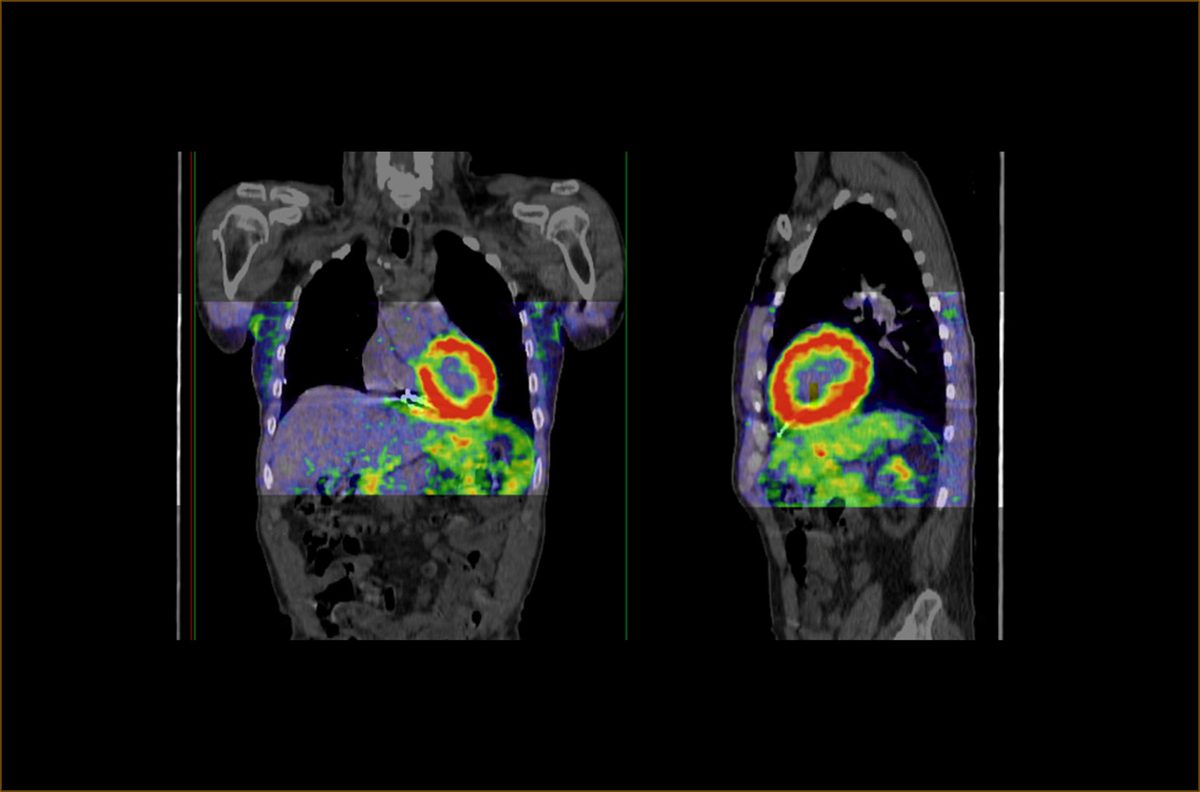
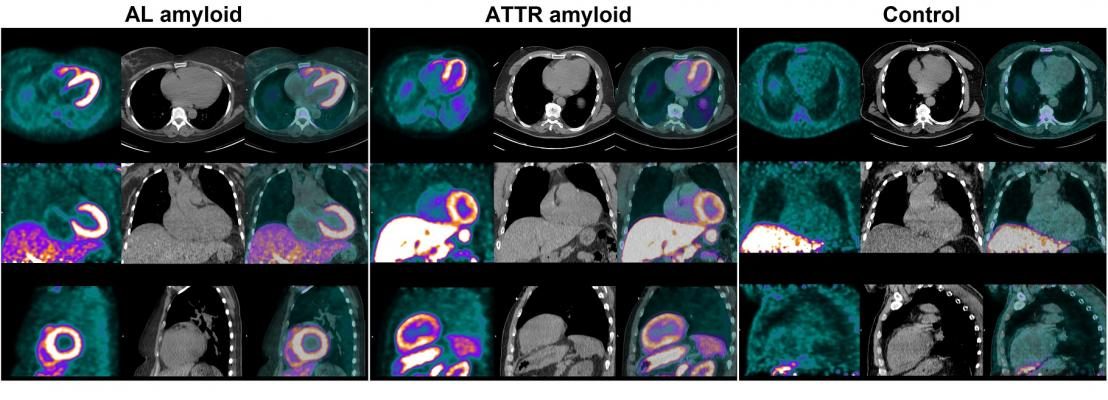
Cardiac amyloidosis has no single confirmatory test short of a heart biopsy. The nuclear scans used today detect only transthyretin amyloidosis, one of its two main types, and doctors must first rule out the other with blood tests. The REVEAL trial tested an agent that binds amyloid fibrils directly, whatever protein built them.

The results ran in the November 24 print issue of the Journal of the American Medical Association, after online publication on August 30. Against blinded expert adjudication, the iodine-124 labeled tracer read by majority of three reviewers hit 94% sensitivity and 86% specificity across 170 patients. It performed about as well in both subtypes.

Why it matters

One scan for both main types of cardiac amyloidosis would replace a patchwork of blood tests, echo, MRI and sometimes biopsy.

Questions about this story

Free account needed to ask — your question is kept and asked for you right after sign-up. Answers are public.

No questions yet — be the first to ask.

Key Indicators

94%
Sensitivity
Majority read of three blinded reviewers; 95% CI 85% to 98%.
86%
Specificity
Majority read; 95% CI 77% to 92%.
94%
Negative predictive value
A clean scan was a reliable way to rule the disease out; 95% CI 87% to 98%.
85%
Positive predictive value
A positive scan was less certain than a negative one; 95% CI 75% to 92%.
170
Patients in the analysis
Drawn from 195 adults enrolled with suspected cardiac amyloidosis.
18
US trial sites
Multicenter, open-label, single-group design.
6.5%
Serious adverse events, none tied to the tracer
11 of 170 patients; the only event attributed to evuzamitide was fatigue.

Voices

Curated perspectives — historical figures and your fellow readers.

Sign up to generate historical perspectives on this story.

People Involved

Organizations Involved

Timeline

January 2025 November 2026

5 events Latest: 3 days ago
Tap a bar to jump to that date
  1. Results run in JAMA's November 24 print issue

    Latest Publication

    The journal carries the trial in its current issue, nearly three months after online release.

  2. Northwestern cardiologist says the tracer fits equivocal cases

    Commentary

    Weinberg says the test could most help patients whose standard workup left the diagnosis unclear.

  3. JAMA publishes the trial online; Bayer presents it at ESC

    Publication

    Sensitivity of 94% and specificity of 86% on the majority read; Bayer calls the primary endpoints met.

  4. Enrollment and 60-day follow-up close

    Trial

    The study period ends with 195 enrolled; 170 are included in the final analysis.

  5. REVEAL begins enrolling at 18 US centers

    Trial

    Adults with suspected cardiac amyloidosis are enrolled; people already diagnosed with cardiac or systemic amyloidosis are excluded.

Scenarios

1

FDA approves evuzamitide for imaging suspected cardiac amyloidosis

Likely Resolves by End of 2027

Discussed by: Bayer, which says it plans to discuss the data with the FDA

The trial hit both primary endpoints, and the safety record was clean: one adverse event, fatigue, attributed to the tracer. A company holding Orphan Drug status in both subtypes, with a 170-patient multicenter study behind it, would normally file and expect a decision within a year. Approval would let hospitals order one scan instead of a sequence of tests.

2

Regulators ask for more data and the filing slips

Possible Resolves by Q2 2028

Discussed by: Trial commentators noting the single-arm design and absence of an independent critique

REVEAL had no control arm. Its accuracy was measured against three expert physicians adjudicating from standard-of-care workups, not against biopsy in every patient. Regulators could ask for a confirmatory study, a reader-training protocol or more data in light-chain disease, where only a small number of patients contributed to the subtype result.

3

Approved, but guidelines keep it as a tiebreaker

Possible Resolves by End of 2028

Discussed by: Northwestern Medicine cardiologist Weinberg, who framed it around equivocal cases

If approval comes, the tracer's clinical role depends on professional societies. Groups like the American Society of Nuclear Cardiology and the European Society of Cardiology write the diagnostic algorithms, and they may place a costly PET agent after echocardiography, MRI and the existing technetium scan rather than in front of them. In that outcome the test helps the ambiguous cases and leaves routine workups unchanged.

Historical Context

3 moments from history that rhyme with this story — and how they unfolded.

2016

Technetium pyrophosphate scanning for ATTR (2016)

Researchers showed that a bone-scan tracer already in wide use, technetium-99m pyrophosphate, lit up transthyretin amyloid in the heart. Combined with blood and urine tests that excluded light-chain disease, grade 2 or 3 cardiac uptake was specific enough to stand in for a biopsy.

Then

The scan spread quickly through cardiology and cut the number of biopsies ordered for suspected ATTR.

Now

It became the standard noninvasive route to a transthyretin diagnosis. It never worked for light-chain amyloidosis, which still needed tissue or a combination of other findings.

Why this matters now

Evuzamitide's selling point is covering the subtype the pyrophosphate scan cannot see, using one tracer that binds the fibril itself.

2019

Tafamidis approval for ATTR cardiomyopathy (2019)

The ATTR-ACT trial showed that tafamidis, a drug that stabilizes the transthyretin protein, reduced deaths and cardiovascular hospitalizations in transthyretin cardiomyopathy. The FDA approved it that May.

Then

For the first time, a common form of cardiac amyloidosis had a disease-modifying treatment, and referral volumes rose.

Now

Treatment created a reason to diagnose earlier and to separate ATTR from light-chain disease accurately, since the therapies are entirely different.

Why this matters now

A reliable one-step diagnostic matters more once a positive result changes what drug a patient gets.

2012

Amyloid PET enters the brain clinic (2012)

The FDA approved florbetapir, an amyloid-binding PET tracer, for estimating amyloid plaque in patients being evaluated for Alzheimer's disease. It proved that a radiolabeled molecule could bind amyloid deposits tightly enough to image them in living patients.

Then

Brain amyloid imaging entered neurology practice, with debate over how much the images changed care.

Now

The tracer chemistry became a template. Cardiac researchers tested similar amyloid-binding compounds in the heart, where blood pool and moving muscle made imaging harder.

Why this matters now

Evuzamitide is the cardiac version of that idea, engineered to bind fibrils of any protein type rather than a single one.

Sources

(7)