
Pull to refresh
Logo
FDA clears AI aneurysm detection software for routine radiology reads

FDA clears AI aneurysm detection software for routine radiology reads

New Capabilities

Bracco and Avicenna.AI's UPTUNITY flags suspected brain aneurysms over 3 mm on head CT angiography and measures known ones against prior scans

Overview

Updated 1 hour ago

About one in 50 U.S. adults has an unruptured brain aneurysm. Most cause no symptoms until the wall gives way, and roughly half of ruptures are fatal.

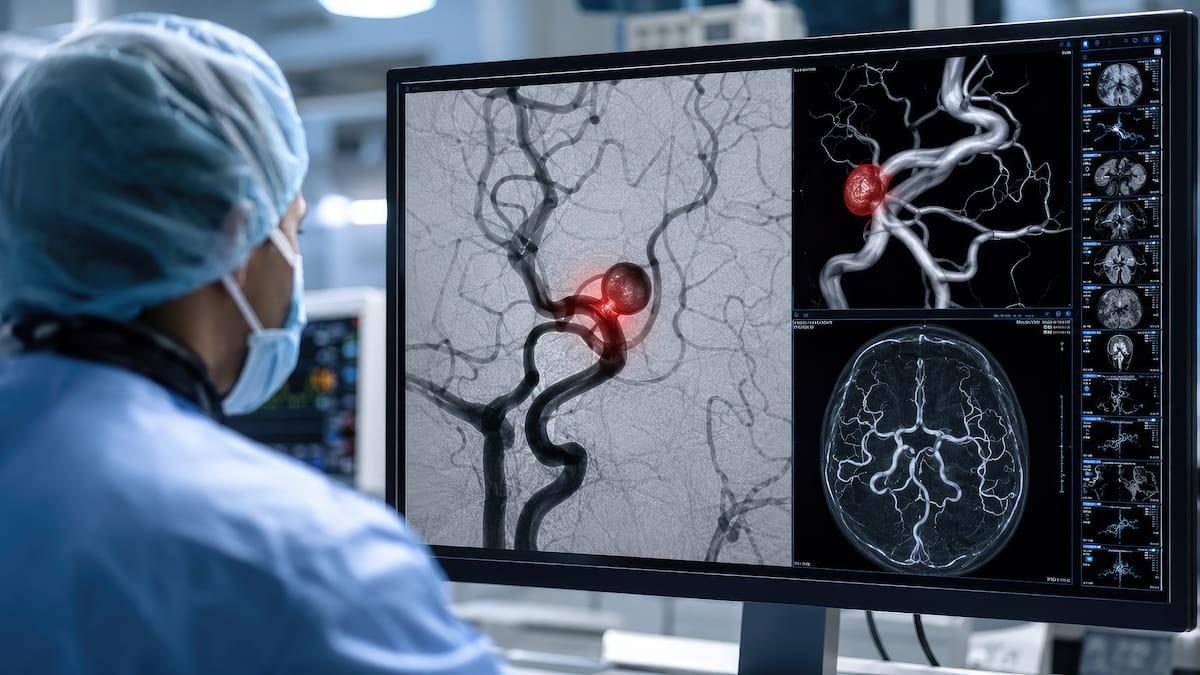
On November 13, the Food and Drug Administration cleared UPTUNITY | Aneurysm, software from Bracco and Avicenna.AI that flags suspected saccular aneurysms larger than 3 millimeters on head CT angiography and measures known ones against earlier scans. It runs inside the reading software a radiologist already uses, so the finding arrives during the read rather than in a separate queue.

Why it matters

A radiologist reading a stroke scan now gets an automated second pass for aneurysms, a finding that often sits unnoticed in the image.

Questions about this story

Free account needed to ask — your question is kept and asked for you right after sign-up. Answers are public.

No questions yet — be the first to ask.

Key Indicators

94.4%
Patient-level sensitivity
Standalone study of 423 cases across four CT scanner vendors, run by the developers.
91.7%
Specificity
Share of patients without a flagged aneurysm that the software correctly left alone, same study.
96.2%
Reader sensitivity with AI
Eight-reader study of 230 cases; the same readers scored 92.2% without the software.
3 mm
Smallest aneurysm flagged
Below this size the software's developers say detection becomes unreliable on standard slice thickness.
2
FDA clearances granted
Detection under K262062, sold as CINA-Aneurysm; management and follow-up under K262147, sold as CINA-Aneurysm+.
1 in 50
U.S. adults with an unruptured aneurysm
Most are asymptomatic and found incidentally on scans ordered for other reasons.

Voices

Curated perspectives — historical figures and your fellow readers.

Sign up to generate historical perspectives on this story.

People Involved

Organizations Involved

Timeline

March 2026 November 2026

2 events Latest: 2 days ago
  1. FDA clears UPTUNITY aneurysm detection and follow-up

    Latest Regulatory

    Clearance covers a detection module for aneurysms over 3 mm and a management module that compares exams over time.

  2. Bracco and Avicenna.AI form imaging AI partnership

    Partnership

    The two companies agree to develop AI applications for contrast-enhanced CT, with Avicenna.AI holding the software side.

Scenarios

1

UPTUNITY Aneurysm lands its first named U.S. hospital customer

Likely Resolves by Q2 2027

Discussed by: Bracco's commercial announcement and Avicenna.AI's stated role leading U.S. distribution

Avicenna.AI says it will lead promotion and distribution in the United States. If a health system buys in, the announcement would name it, the way radiology AI vendors usually publicize first installations. A quiet launch, with no named customer, would leave the product's real demand unclear.

2

Bracco adds a second product to the UPTUNITY portfolio

Possible Resolves by End of 2027

Discussed by: Bracco, which called the aneurysm software the first offering in the portfolio

UPTUNITY is presented as a lineup, not a single device. A second cleared product, for another body region or imaging task, would show the portfolio is a plan rather than a label on one tool.

3

European regulators clear the aneurysm software

Possible Resolves by Q2 2028

Discussed by: Bracco's own statement that the device is not CE marked

The clearance announcement states plainly that UPTUNITY is not CE marked and not for sale in the European Union. A CE mark would open a second market and test whether the same evidence satisfies European regulators.

4

An independent study tests the vendor's sensitivity figures

Uncertain Resolves by Q2 2028

Discussed by: No one yet; the published numbers come from the developers' own studies

The 94.4% sensitivity figure comes from a study the developers ran. Independent validation is the step that either confirms a radiology AI tool or finds the gap between a controlled study and a busy hospital's scans.

Historical Context

2 moments from history that rhyme with this story — and how they unfolded.

1998

Computer-aided detection in mammography (1998)

The FDA cleared the first computer-aided detection system for screening mammography, software that circled suspicious spots on a mammogram before a radiologist read it. Within a decade it was routine at U.S. screening sites.

Then

CAD became a standard line item in mammography and a reimbursable add-on.

Now

A large 2015 study of screening mammograms found CAD did not improve cancer detection and was associated with more recalls. Its use declined.

Why this matters now

UPTUNITY rests on developer-run studies, the same footing mammography CAD had at clearance. The mammography case shows a cleared second-reader can spread faster than evidence that it helps.

February 2018

Stroke triage AI reaches U.S. hospitals (2018)

Viz.ai won FDA clearance for software that scans head CT angiography for a large vessel occlusion and alerts the stroke team, a routing tool rather than a diagnostic one.

Then

Hospitals adopted it to speed transfers between emergency rooms and stroke centers.

Now

Triage and notification became the dominant model for radiology AI, with Medicare later creating an add-on payment for such tools.

Why this matters now

Triage tools work outside the read, pushing urgent cases to the top of a list. UPTUNITY sits inside the read, aiming at the incidental finding nobody was looking for.

Sources

(10)