

Pull to refresh
Logo
Room-temperature supersolid observed in a light-matter condensate

Room-temperature supersolid observed in a light-matter condensate

New Capabilities

A Warsaw-led team combined liquid crystals and an organic semiconductor to make a supersolid that runs near 60°C

Overview

Updated 6 hours ago

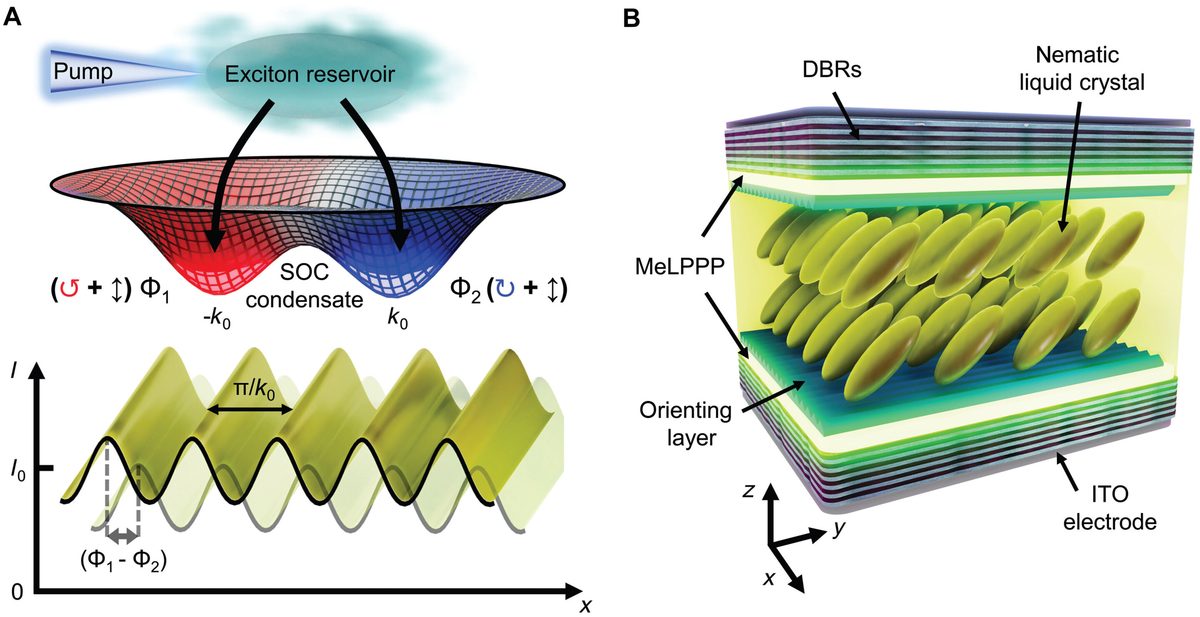
Supersolids flow without friction yet hold a crystal-like pattern. Since they were first made in 2017, they have existed only near absolute zero. A consortium led by the University of Warsaw has now produced one in a light-matter condensate at room temperature.

The device is a liquid-crystal microcavity filled with an organic semiconductor, and its optical properties can be tuned with voltage. That makes it the first electrically adjustable platform for studying supersolid exciton-polariton condensates.

Why it matters

Quantum phases that once required near-absolute-zero cooling may now be studied, and eventually used, in room-temperature photonic devices.

Questions about this story

Free account needed to ask — your question is kept and asked for you right after sign-up. Answers are public.

No questions yet — be the first to ask.

Key Indicators

60°C
Operating temperature ceiling
The liquid-crystal microcavity can operate at temperatures approaching 60°C, per the Military University of Technology team.
3.33 µm
Stripe spacing
Measured period of the density modulation, close to the predicted 3.46 micrometres.
1.0121
Zero-delay correlation
Correlation between light from the two counter-propagating modes, near 1, the signature of coherence.
15.89 µJ/cm²
Supersolid onset threshold
Excitation level at which light appeared in the two counter-propagating modes.

Voices

Curated perspectives — historical figures and your fellow readers.

Sign up to generate historical perspectives on this story.

People Involved

Organizations Involved

Timeline

October 2026 November 2026

2 events Latest: 2 days ago
  1. University of Warsaw announces the result

    Latest Announcement

    The university publicizes the room-temperature supersolid, describing the liquid-crystal microcavity and its voltage tunability.

  2. Supersolid results published in Science Advances

    Publication

    The Warsaw-led consortium reports a supersolid phase in a spin-orbit coupled exciton-polariton condensate at room temperature.

Scenarios

1

Independent group replicates a room-temperature polariton supersolid

Possible Resolves by End of 2027

Discussed by: The Warsaw-led authors, who present the result as a general platform rather than a one-off

The claim rests on one sample type and one material combination. If other groups reproduce a supersolid phase in exciton-polariton condensates above 0°C, the result becomes a platform. If not, it stays a single-lab curiosity.

2

Voltage tuning of the supersolid is demonstrated

Possible Resolves by End of 2027

Discussed by: The authors, who call the liquid-crystal cavity the first electrically tunable supersolid platform

The paper argues the cavity's optical properties can be controlled with an external voltage. A published demonstration of switching the supersolid phase on or off electrically would move the work from a static observation to a controllable device.

3

Supersolid platform yields a working photonic device

Unlikely Resolves by End of 2029

Discussed by: The authors, who cite ultrafast photonic devices, neuromorphic computing and optical sensors as possible uses

The proposed applications are speculative. A functional device that relies on the supersolid phase, rather than on ordinary polariton condensation, would be the first practical payoff.

Historical Context

2 moments from history that rhyme with this story — and how they unfolded.

2017

Supersolidity in ultracold atoms (2017)

Physicists predicted in the 1960s that a superfluid could also form a periodic crystal-like structure. The first experimental observations came in 2017, in ultracold atomic Bose-Einstein condensates held near absolute zero.

Then

Supersolidity moved from theory to a measured phase, but only in cryogenic atomic systems.

Now

The result set the benchmark: a supersolid was real, but required extreme cooling and complex atomic apparatus.

Why this matters now

The new work keeps the same phase but swaps ultracold atoms for light-matter quasiparticles that survive only picoseconds, and does it at room temperature.

March 2026

Room-temperature supersolid in nanostructures (2026)

A separate team reported a room-temperature supersolid in a nanostructured device, published in Nature Nanotechnology. That result also framed room-temperature operation as the long-standing barrier to practical use.

Then

It showed that more than one approach could reach a supersolid without cryogenics.

Now

Whether these platforms converge or stay separate depends on replication and on which is easier to control.

Why this matters now

The Warsaw result is a second, independent route to room-temperature supersolidity, using a liquid-crystal cavity rather than a nanostructured device.

Sources

(4)