


Pull to refresh
Logo
Physicists entangle levitating glass nanosphere with light at room temperature

Physicists entangle levitating glass nanosphere with light at room temperature

New Capabilities

A 100-nanometer glass sphere shares persistent quantum correlations with escaping light, with no cryogenic cooling

2 days ago: Room-temperature entanglement of levitated nanosphere demonstrated

Overview

Updated 1 hour ago

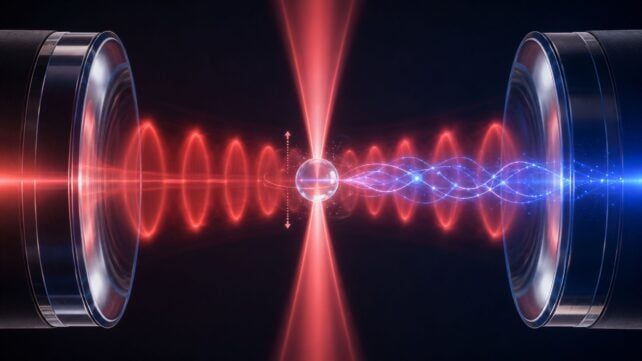
A glass sphere about 100 nanometers wide, held aloft by laser light, has been quantum-entangled with the light that escapes its trap. The University of Florence team showed the sphere's motion and the outgoing light shared correlations that beat the limits any classical system could produce.

Earlier optomechanical entanglement required chilling the entire apparatus to near absolute zero. This experiment only cools the sphere's motion, leaving the lab at room temperature. That removes a major practical barrier to building quantum networks and to testing whether gravity itself is a quantum force.

Why it matters

Room-temperature entanglement of a macroscopic object with escaping light opens a practical route to quantum communication without cryogenic hardware.

Questions about this story

Free account needed to ask — your question is kept and asked for you right after sign-up. Answers are public.

No questions yet — be the first to ask.

Key Indicators

100 nm
Diameter of the levitating nanosphere
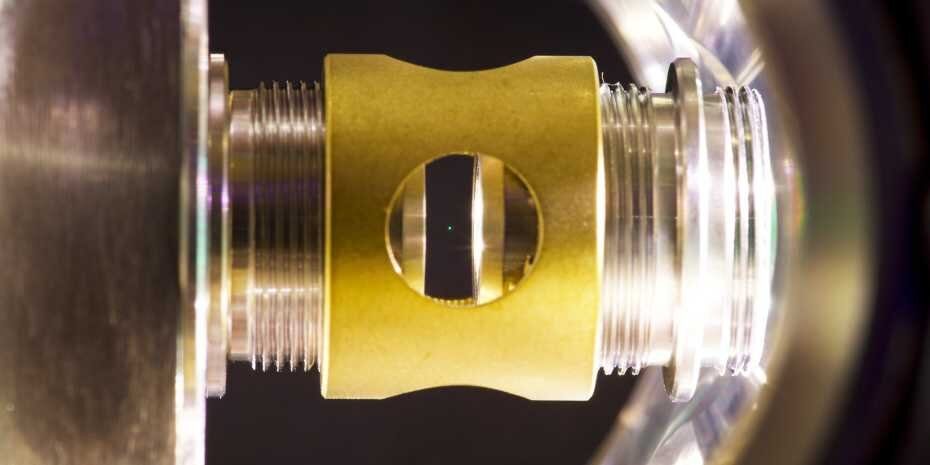
A glass bead held in an optical tweezer inside a cavity.
>40 kHz
Detuning range where entanglement persists
The entanglement held across the cavity linewidth, so it needs no fine tuning.
1
First persistent room-temperature optomechanical entanglement
First demonstration of stationary entanglement between a levitated object's motion and a propagating optical field.

Voices

Curated perspectives — historical figures and your fellow readers.

Ever wondered what historical figures would say about today's headlines?

Sign up to generate historical perspectives on this story.

People Involved

Organizations Involved

Timeline

1 event Latest: 2 days ago
  1. Room-temperature entanglement of levitated nanosphere demonstrated

    Latest Scientific result

    A University of Florence team used a two-color optical tweezer to entangle a levitated nanosphere's center-of-mass motion with escaping light, violating classical separability bounds.

Scenarios

1

Nanosphere network entangles multiple levitated objects

Possible Resolves by End of 2028

Discussed by: The research team's stated roadmap in the ScienceAlert coverage

Marin's group wants to connect several nanospheres in different optical tweezers into a larger quantum system. If the approach scales, multipartite entanglement mediated by a shared optical field would follow, giving a room-temperature platform for distributed quantum information.

2

Levitating nanosphere becomes a reworkable quantum memory

Possible Resolves by End of 2028

Discussed by: Marin in the published coverage

The stationary entanglement needs to become dynamic: researchers must strengthen it and learn to control it rather than observe it. That would let quantum information be written to, stored in, and retrieved from the sphere's mechanical motion, turning the interface into a usable device.

3

Room-temperature quantum link moves information to a receiver

Uncertain Resolves by End of 2028

Discussed by: The paper's stated implications for quantum communication

The escaping light is a traveling quantum system that can in principle be transmitted over an optical network or made to interact with another quantum device. A demonstration would position levitated nanospheres as room-temperature interfaces for continuous-variable quantum communication, without ultra-cryogenic environments.

Historical Context

3 moments from history that rhyme with this story — and how they unfolded.

November 1935

Schrödinger's cat thought experiment (1935)

Erwin Schrödinger proposed a scenario in which a cat inside a sealed box is both alive and dead until observed, a critique of applying quantum superposition to everyday objects.

Then

The paradox became the standard illustration of the strangeness of quantum measurement.

Now

It framed the 90-year question of whether macroscopic objects can hold genuine quantum states.

Why this matters now

This experiment puts real quantum entanglement, the phenomenon at the heart of the paradox, into a visible glass sphere at room temperature, eroding the boundary between quantum and classical scales.

March 2010

First mechanical resonator cooled to its quantum ground state (2010)

A.D. O'Connell and colleagues at the University of California, Santa Barbara cooled a thin aluminum drum vibrating at 6 gigahertz into its quantum ground state, the first time a macroscopic mechanical object reached that regime.

Then

The result proved macroscopic motion could occupy a single quantum state.

Now

It required a dilution refrigerator holding the apparatus near 20 millikelvin, setting the cryogenic template for later optomechanics.

Why this matters now

This 2026 result achieves the same quantum regime in a mechanical object but at room temperature, because levitation and vacuum isolate the sphere so only its motion needs cooling.

February 2016

LIGO detects gravitational waves (2016)

The Laser Interferometer Gravitational-Wave Observatory announced the first detection of ripples in spacetime from two merging black holes, using kilometer-scale interferometers with heavy test masses.

Then

The detection confirmed gravitational waves and opened gravitational-wave astronomy.

Now

It showed precision light-matter measurement at the largest scale could probe the deepest physics, and LIGO later used squeezed light to push past the standard quantum limit.

Why this matters now

The nanosphere experiment is the quantum-sector counterpart: using light to exploit genuine quantum correlations in a mechanical system, just as LIGO uses light to read tiny mechanical displacements.

Sources

(6)