

Pull to refresh
Logo
Snowflake launches autonomous data engineering with CoCo cloud agents

Snowflake launches autonomous data engineering with CoCo cloud agents

New Capabilities

Coding agents get a schedule, a sandbox, and a review gate over production data pipelines

Overview

Updated 1 hour ago

A pipeline breaks at 2 a.m. Someone gets paged, reads logs for an hour, writes a fix, and opens a pull request. Snowflake said on November 3, 2026 that it will sell software that runs most of that loop itself, then hands the proposed fix to an engineer to approve.

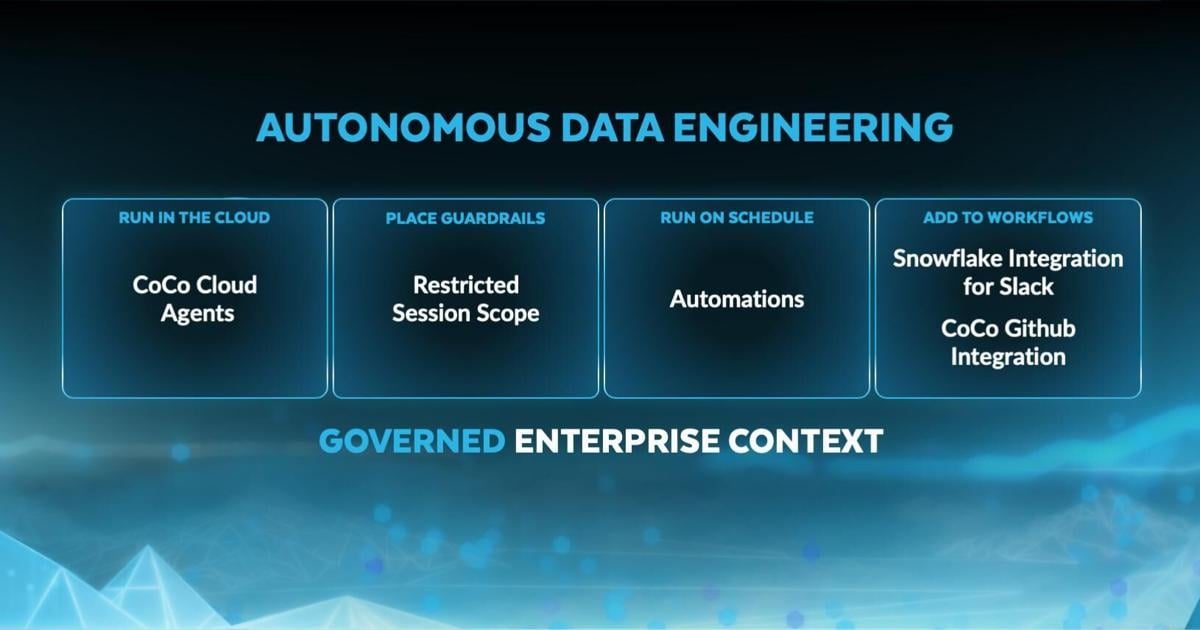
The agents run inside Snowflake's cloud rather than on a laptop. That lets them read the catalog, lineage records, and access rules that describe how a company's data connects. A general coding assistant can write a patch. It cannot know which table feeds the finance dashboard or who is allowed to touch it.

Why it matters

If agents take over pipeline repair, the scarce skill stops being keeping data flowing and becomes deciding what is allowed to change.

Questions about this story

Free account needed to ask — your question is kept and asked for you right after sign-up. Answers are public.

No questions yet — be the first to ask.

Key Indicators

16
Minutes from failure detection to pull request
Average time for Snowflake's own internal pipeline-repair agent, reported in October 2026.
500+
Pipelines improved by the internal agent
Count Snowflake reported across the managed pipelines its internal team owns.
Hundreds
Pull requests merged from agent proposals
Each one reviewed by an engineer before merging.

Voices

Curated perspectives — historical figures and your fellow readers.

Sign up to generate historical perspectives on this story.

People Involved

Organizations Involved

Timeline

October 2026 November 2026

2 events Latest: Yesterday
  1. Expedition 2026 launches Cloud Agents and scheduled Automations

    Latest Product launch

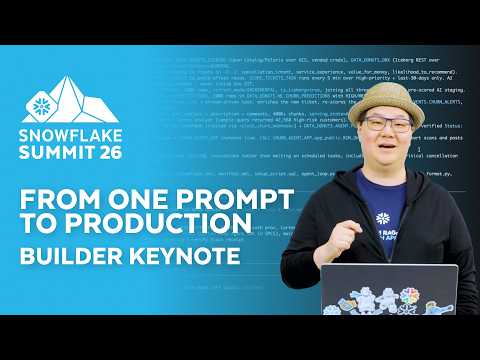
    Snowflake announced cloud-hosted coding agents with restricted session scopes, scheduling for recurring tasks, a Slack integration, and GitHub pull-request flow. It also updated Pipeline Builder.

  2. Snowflake's internal agent goes from failure to pull request in 16 minutes

    Internal deployment

    The company's data team published results from five months of running an agent that investigates pipeline failures and proposes fixes. It reported hundreds of merged pull requests and 500+ pipelines improved.

Scenarios

1

Microsoft or Databricks ships matching autonomous pipeline repair

Likely Resolves by Nov 3, 2027

Discussed by: Vendor roadmaps and trade coverage of the data platform market

Snowflake's advantage here is context, not code generation. Microsoft and Databricks sell into the same data estates and run their own agent programs, so a matching feature is a question of when rather than whether. The signal to watch is a general-availability announcement rather than a preview.

2

Snowflake adds an unattended merge path for low-risk pipeline fixes

Possible Resolves by Nov 3, 2027

Discussed by: Enterprise data platform buyers and Snowflake's own product framing

Today's design keeps a person between the agent and production. If customers ask for routine fixes to land without a per-change review, Snowflake has to choose between shipping that mode and holding the gate. A documented auto-merge path with a named customer using it would mark the boundary moving.

3

An agent-caused data incident tightens default permissions

Possible Resolves by Nov 3, 2027

Discussed by: Analysts quoted in TechTarget's coverage, who said the new controls need production validation

Every autonomous system gets tested by its first bad change. A CoCo run that corrupts a table or deploys a faulty fix would likely produce narrower default scopes and more approval steps. That would slow adoption without stopping it, and it would hand Snowflake's critics the production evidence they say is missing.

Historical Context

2 moments from history that rhyme with this story — and how they unfolded.

2001

IBM's autonomic computing initiative (2001)

IBM researchers published a manifesto arguing that computing systems had become too complex for humans to manage by hand, and that machines should configure, heal, and tune themselves. It became a company-wide research agenda and a standard talking point for the industry.

Then

Produced research programs and incremental self-tuning features in databases and servers rather than self-managing systems.

Now

Automation arrived piece by piece, in query optimizers and autoscaling, while most operational judgment stayed with people.

Why this matters now

Snowflake's promise is a narrower version of the same idea: self-repairing pipelines, with a human approving changes rather than operating the system.

2021-2022

GitHub Copilot and the AI coding assistant wave (2021-2022)

GitHub previewed Copilot in 2021 and made it generally available in 2022, putting a code-completion model inside the editor. It changed how quickly individual developers could write code.

Then

Adoption spread fast among individual developers, and code review stayed a human task.

Now

Assistants became standard tooling but stayed blind to a company's specific systems, permissions, and data relationships.

Why this matters now

Snowflake's sales pitch is built on that gap. The difference it claims is context from the catalog and governance layer, plus a place to keep working after the engineer closes the laptop.

Sources

(8)