

PROTEINA and Twist Bioscience partner to speed AI antibody validation
New CapabilitiesDeal targets the bottleneck between AI-designed antibodies and physical testing
Today: PROTEINA and Twist Bioscience sign validation MOUNew here? Follow stories to track developments over time. Create a free account to get updates when stories you care about change.
Overview
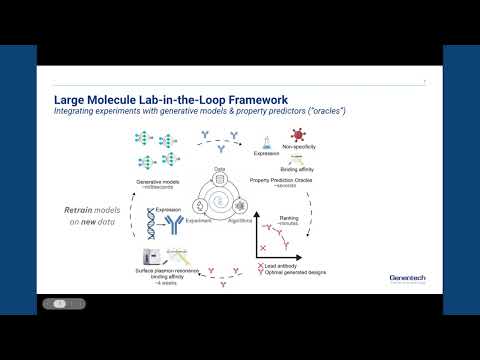
Updated 56 minutes agoArtificial intelligence can design tens of thousands of antibody candidates in days. Turning those digital sequences into physical molecules for testing still takes months. PROTEINA and Twist Bioscience announced a partnership on August 27, 2026, to collapse that gap.
The deal pairs Twist's large-scale DNA synthesis and antibody expression with PROTEINA's high-speed experimental validation. PROTEINA plans to expand its data production from 40,000 to 1 million antigen-antibody interaction measurements per month by 2028, a 25-fold increase.
Why it matters
AI designs antibodies in hours; physical testing takes months. This partnership targets the bottleneck deciding whether AI drug discovery becomes commercially viable.
Questions about this story
Free account needed to ask — your question is kept and asked for you right after sign-up. Answers are public.
No questions yet — be the first to ask.
Key Indicators
Voices
Curated perspectives — historical figures and your fellow readers.
Play
Exploring all sides of a story is often best achieved with Play.
Higher or Lower
A number from this story, against one from elsewhere in the news — guess which is bigger, then keep the chain going. 5 rounds, 3 strikes; a miss costs a strike and resets your streak.
Keyboard: ↓/L lower · ↑/H higher
0 points — sign up to put that on the leaderboard.
Timeline
Order five events from this story, oldest at top. Each in the right slot scores 1 — neighbours within one slot count too. Your previous result — green ✓ for exact slots, yellow ~ for off by one. Cards now in true chronological order.
Sign up to save your score and track a streak across stories.
Connections
Sixteen names from the news. Find the four hidden groups of four. Four mistakes max.
Sign up to keep a daily streak — a new puzzle lands every day.
Exit debate?
Your progress in this debate will be lost.
- 1 Two AI personas square off on this story.
- 2 You predict who'll win each round — correct picks earn XP.
- 3 One crossfire question is yours to fire. Pick it carefully.
Couldn't generate a topic
Select Your Champions
Choose one persona for each side of the debate
DEBATE TOPIC
Choose personas with different perspectives for a more dynamic debate.
Select debater for this side:
No debate personas available right now.
Select debater for this side:
No debate personas available right now.
Who's Got This Round?
Make your prediction before the referee scores
The referee scores both sides on
Round Results
Set the Crossfire
Pick the question both personas must answer in the final round
Debate Oracle! You called every round!
Sharp Instincts! You know your debaters!
The Coin Flip Strategist! Perfectly balanced!
The Contrarian! Bold predictions!
Inverse Genius! Try betting the opposite next time!
XP Breakdown
Prediction History
People Involved
Organizations Involved
Korean AI drug discovery firm that builds both antibody design models and high-throughput wet-lab validation platforms.
US company producing synthetic DNA on silicon chips, now expanding into high-throughput antibody services for AI drug developers.
Korean biopharma co-developing AI-designed antibody drugs with PROTEINA, handling preclinical work and commercialization.
Startup devoted to commercializing AI-based de novo antibody design, established with PROTEINA's 3.4 billion won investment.
Timeline
January 2024 August 2026
-
PROTEINA and Twist Bioscience sign validation MOU
Today PartnershipThe companies agree to combine Twist's synthesis and expression capacity with PROTEINA's validation platform, targeting the wet-lab bottleneck in AI drug discovery.
-
PROTEINA invests in ABX Biosciences
InvestmentPROTEINA puts 3.4 billion won into ABX to become its largest shareholder and commercialize AI-based de novo antibody design.
-
Samsung Bioepis and PROTEINA sign option agreement
PartnershipThe two companies agree to co-develop AI-designed antibody candidates by 2027, with Samsung Bioepis holding an option to license results.
-
Health ministry commits 470 billion won
FundingSouth Korea's health ministry launches a larger program for AI-designed antibody biopharmaceuticals with PROTEINA and Baek's team.
-
Science ministry funds AbGPT-3D project
FundingSouth Korea's science ministry commits 150 billion won to AI antibody design and validation research led by Professor Baek Min-kyung's team and PROTEINA.
Historical Context
2 moments from history that rhyme with this story — and how they unfolded.
DNA synthesis cost collapse (2007-2015)
Next-generation sequencing and silicon-based DNA synthesis drove the cost of reading and writing DNA down by orders of magnitude. Companies like Twist Bioscience built business models around cheap, high-volume synthetic DNA.
Whole-genome sequencing became affordable for research labs.
Low-cost synthesis made large-scale protein and antibody production feasible, enabling the AI-driven pipeline now emerging.
The Twist-PROTEINA deal depends on the cost curve that made it economical to physically validate thousands of AI-designed antibody candidates.
Fabless semiconductor model (1980s-1990s)
Chip design tools advanced faster than chip manufacturing. Companies like Qualcomm and Nvidia designed chips without owning factories, and Taiwan Semiconductor Manufacturing Company built the foundry model to manufacture their designs.
Design-focused firms grew rapidly without capital-intensive fabs.
Specialized foundries became essential infrastructure, splitting design from production permanently.
AI antibody design now outpaces physical synthesis and testing, creating a market for specialized validation partners like Twist that fill the same role as chip foundries.
