



Pull to refresh
Logo
DaltonTx launches AI antibody platform that folds millions of structures per hour

DaltonTx launches AI antibody platform that folds millions of structures per hour

New Capabilities

London startup's Dalton platform combines design, structure prediction and validation to help labs pick which antibodies to actually build

Yesterday: Dalton platform launches with antibody discovery capabilities

Overview

Updated Yesterday

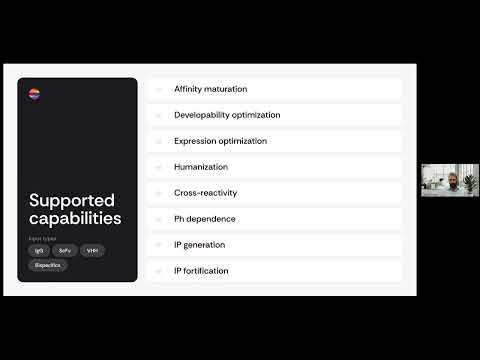
Antibody discovery has long been a matter of trial and error: sequence millions of candidates, sort them by rough sequence similarity, then pay to test the most plausible few in the lab. On October 1, DaltonTx launched a platform called Dalton that tries to collapse that funnel. It folds antibody structures at a rate of 87,000 per hour—recently folding all 2.6 million paired antibody sequences in the OAS database—so researchers can compare candidates by actual 3D shape rather than amino-acid sequence alone.

Dalton runs through an AI chat interface that records the reasoning behind every candidate kept or discarded. The company says that turns a discovery campaign into an accumulating knowledge base: when teams change or projects hand over, the logic behind each decision survives. DaltonTx's first paying customers, contract research firm Sygnature Discovery and biotech Bonito Biosciences, are already testing whether the platform can cut the number of compounds that need to be synthesized and screened.

Why it matters

If structural screening at this speed holds up, labs can prioritize antibody candidates by 3D shape instead of sequence similarity, cutting the experimental work needed to find a viable drug.

Questions about this story

Free account needed to ask — your question is kept and asked for you right after sign-up. Answers are public.

No questions yet — be the first to ask.

Key Indicators

87,000
Antibody structures folded per hour
Throughput achieved when Dalton folded the full 2.6 million paired OAS antibody space.
2.6 million
Paired antibody sequences folded
Entire Observed Antibody Space dataset folded in hours, not days or weeks.
2
Launch customers announced
Sygnature Discovery and Bonito Biosciences signed on to use Dalton for drug discovery programs.

Voices

Curated perspectives — historical figures and your fellow readers.

Ever wondered what historical figures would say about today's headlines?

Sign up to generate historical perspectives on this story.

People Involved

Organizations Involved

Timeline

January 2025 October 2026

3 events Latest: Yesterday
  1. Dalton platform launches with antibody discovery capabilities

    Latest Launch

    DaltonTx launches integrated antibody design, structure prediction and validation workflow; folds 2.6 million paired OAS sequences at 87,000 structures per hour. Sygnature Discovery and Bonito Biosciences announced as customers.

  2. FlashABB antibody structure model announced

    Product

    University of Oxford-developed FlashABB structure prediction model announced, generating hundreds of thousands of structures per hour.

  3. DaltonTx emerges from stealth

    Founding

    Company launches with mission to build adaptive AI drug discovery platforms, led by Garry Pairaudeau and Charlotte Deane.

Scenarios

1

Dalton's structural screening becomes standard practice in antibody discovery

Possible Resolves by Oct 1, 2027

Discussed by: DaltonTx leadership; Sygnature Discovery collaboration

If the Sygnature retrospective evaluation shows Dalton could have reached candidate selection with meaningfully fewer compounds synthesized, other CROs and pharma companies may adopt the platform. DaltonTx's position as a neutral tool provider—not a drug developer—would help it integrate into existing workflows rather than compete with them. The company's claim that data and models stay compartmentalized per program addresses a real industry concern about proprietary data use in AI environments.

2

Dalton remains a niche tool adopted by a handful of early customers

Possible Resolves by Oct 1, 2027

Discussed by: Pharmaphorum market analysis

The AI drug discovery field is crowded. Rivals like Recursion Pharma, Insilico Medicine and Schrödinger, plus tech giants such as NVIDIA and Alphabet's Isomorphic Labs, all offer competing toolkits. Dalton's differentiation rests on its decision-logging interface and structural-throughput claims. If early results are mixed or customers keep results private, the platform may not gain enough traction to move beyond its initial users.

3

FlashABB and structural convergence become an academic standard

Possible Resolves by Jan 1, 2028

Discussed by: University of Oxford researchers; structural biology community

FlashABB's open integration into Dalton could also push structural convergence—comparing candidates by 3D paratope shape rather than sequence identity—into wider academic use. Charlotte Deane's lab remains connected to Oxford and continues evaluating emerging antibody modeling approaches. If the method's results get published in peer-reviewed venues and adopted by other groups, Dalton could benefit from academic validation even if commercial adoption lags.

Historical Context

2 moments from history that rhyme with this story — and how they unfolded.

November-December 2020

AlphaFold2 (2020)

DeepMind's AlphaFold2 won the CASP14 protein structure prediction competition, accurately predicting protein 3D structures from amino acid sequences for the first time at scale. The system's accuracy was a leap over prior methods, which had plateaued for decades.

Then

The protein structure prediction field was transformed; DeepMind released the AlphaFold Protein Structure Database covering nearly all known proteins.

Now

Structure prediction became a routine computational step in biology, and a generation of faster, more specialized models followed, including antibody-specific ones like FlashABB.

Why this matters now

Dalton's speed advantage—87,000 structures per hour for antibodies specifically—extends the AlphaFold trajectory from predicting single proteins to screening entire repertoires in hours, making shape-based selection practical for the first time.

January 2020

Exscientia's AI-designed drug enters trials (2020)

Exscientia and Sumitomo Dainippon Pharma announced the first AI-designed drug candidate to enter human clinical trials, an obsessive-compulsive disorder treatment called DSP-1181. Exscientia's systems designed the molecule after roughly 12 months of work, a fraction of the typical 4-5 years.

Then

The announcement validated that AI could meaningfully accelerate the design phase of drug discovery, attracting investment and attention to the field.

Now

Exscientia later merged with Recursion Pharmaceuticals in 2024. Garry Pairaudeau, DaltonTx's co-founder and CEO, was Exscientia's CTO before the merger.

Why this matters now

DaltonTx is the next step in the same thesis Pairaudeau pursued at Exscientia: instead of just generating candidates faster, Dalton tries to make the decision process itself faster and more transparent.

Sources

(6)