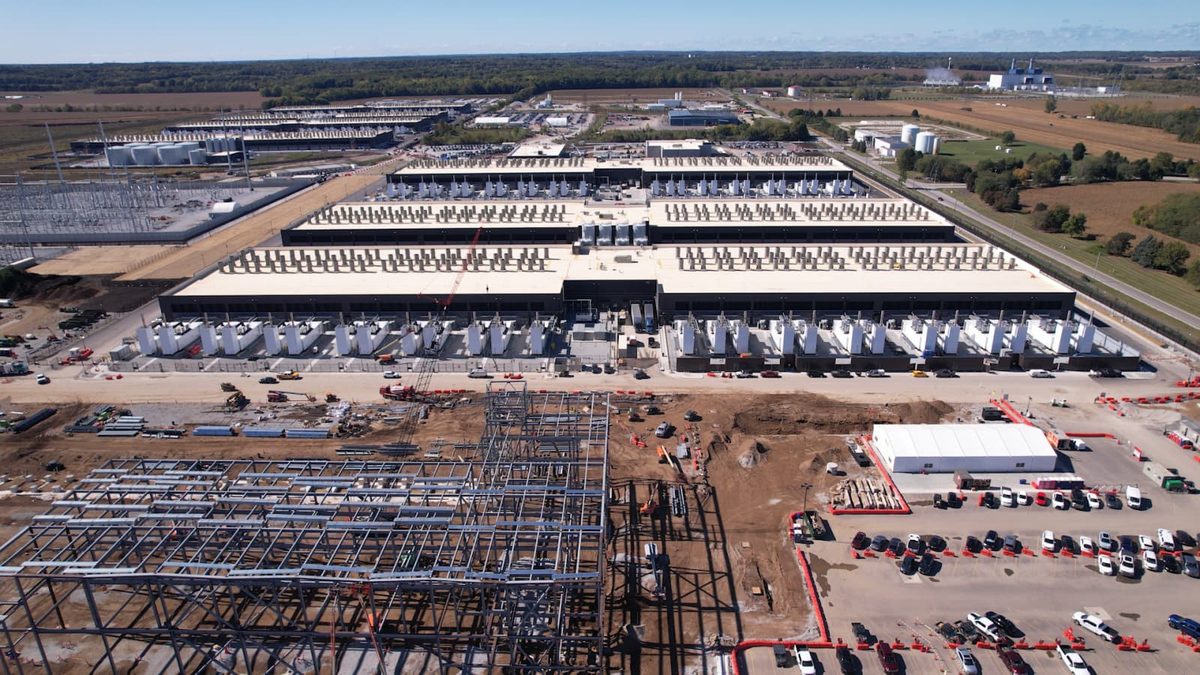
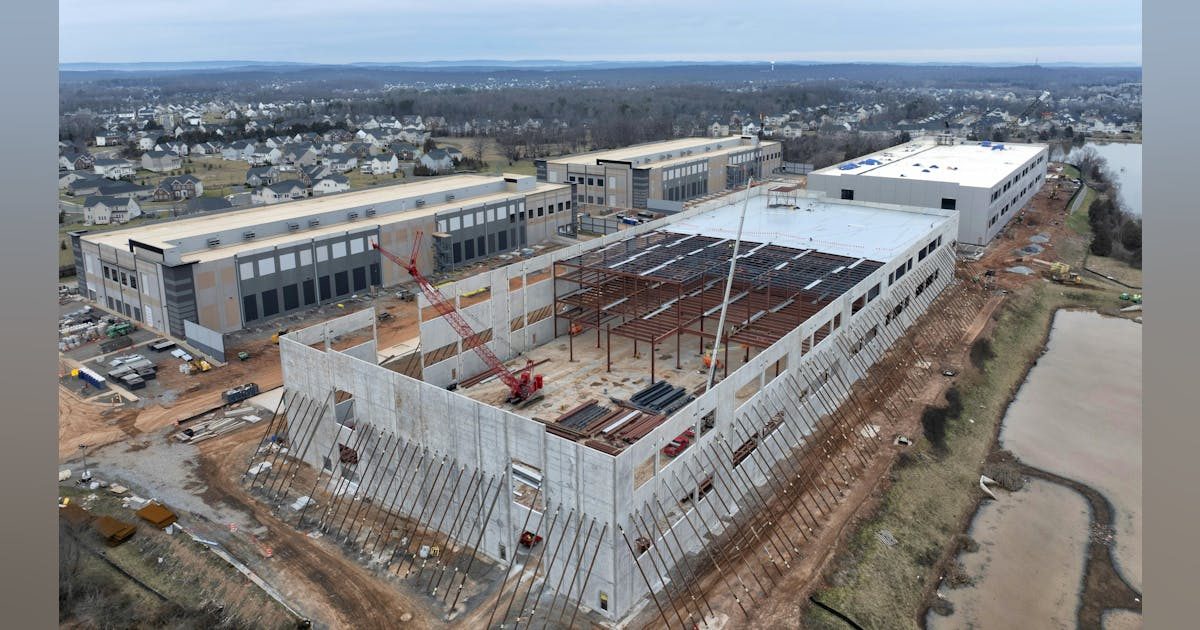
ChatGPT's November 2022 launch triggered the fastest infrastructure buildout in tech history. Hyperscalers are now on track to spend over $1 trillion in 2026, exceeding the GDP of all but 10 countries.
Datacenter construction spending tripled from $15 billion to $45 billion annually in just two years. Hyperscalers are racing to secure power, land, and cooling systems before rivals. Alphabet shocked markets on February 4, 2026 with guidance of $175-185 billion in 2026 capex, 55-65% above Wall Street estimates of $119.5 billion.
Amazon escalated the spending war on February 5 with $200 billion 2026 capex guidance after reporting Q4 revenue of $213.4 billion and AWS growth of 24% to $35.6 billion. Microsoft reported $37.5 billion in capex for Q2 FY2026 (just one quarter).
Meta committed $6 billion to Corning for fiber-optic cables in late January and secured 6.6 gigawatts of nuclear power through three partnerships announced in early January 2026. It confirmed a multi-billion Nvidia chip deal and announced a $60-100 billion, 6-gigawatt AMD GPU deal on February 24.
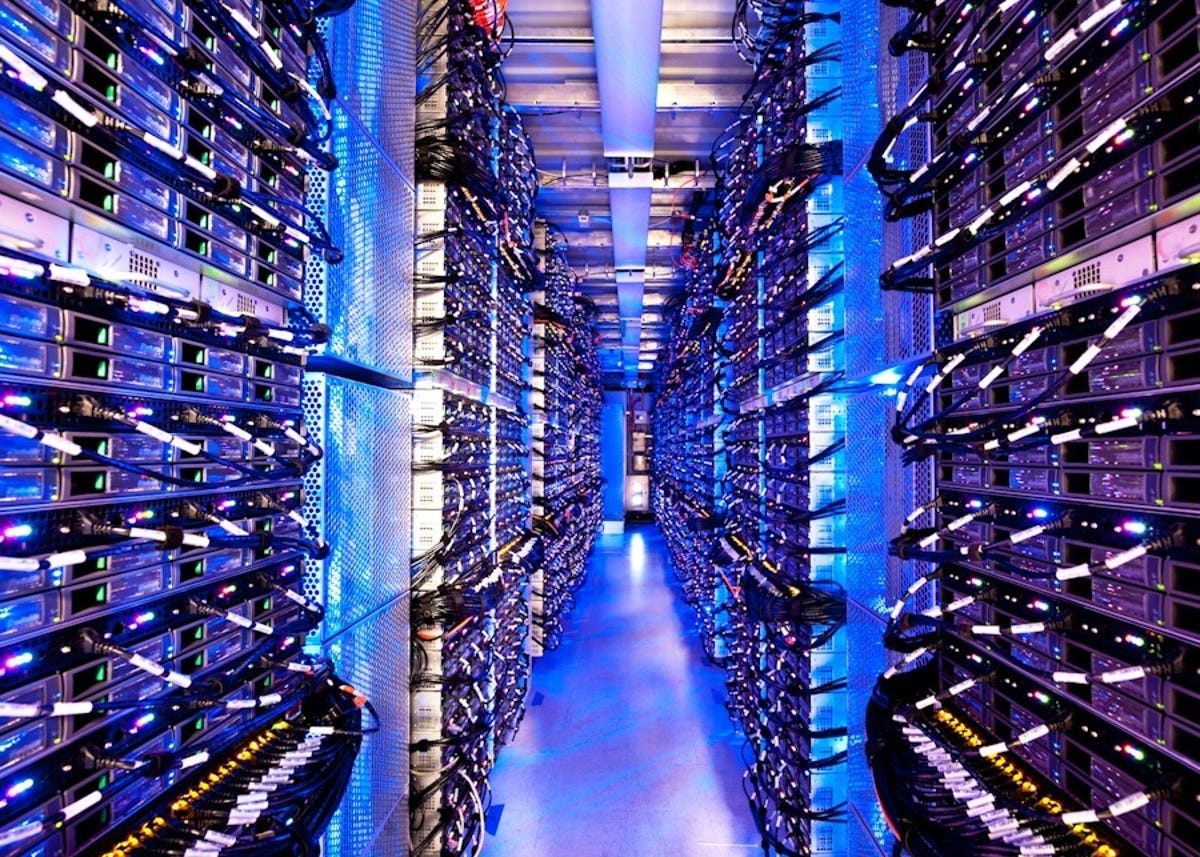
The bottleneck is no longer money or chips—it's physics and politics. AI training clusters demand 100-200 kilowatts per rack versus 10-20 for traditional servers, overwhelming air cooling and straining electrical grids built decades ago.
North America datacenter vacancy rates hit a record low 1.6% in H1 2025, with 74.3% of under-construction capacity already preleased through 2027. The average wait time for grid connection across the US is now four years.
Nvidia's Vera Rubin platform announced at CES 2026 uses warm water cooling (45°C) to eliminate chillers. New initiatives like INL-Nvidia's PROMETHEUS AI project, announced February 17, aim to halve nuclear deployment timelines and cut costs by 50% for datacenter power.
Political opposition is building. Both Bernie Sanders and Ron DeSantis have spoken out against the datacenter boom's impact on electricity prices.
Yet tech giants continue accelerating. Oracle raised $25 billion in bonds in early February 2026 to fund Stargate expansion targeting 7 gigawatts of capacity, while DG Matrix raised $60M to enable solid-state transformers for managing gigawatt-scale datacenter loads. Approximately 75% of the $1 trillion+ hyperscaler spending will directly fund AI infrastructure.
Power shortages and community opposition delayed up to 50% of global projects, according to March 2026 reports. Tech giants are responding with international expansion: Adani's $100B India plan, NTT's Thailand site, and new facilities in Sweden.
Questions about this story
Free account needed to ask — your question is kept and asked for you right after sign-up. Answers are public.
No questions yet — be the first to ask.
Key Indicators
$1T+
Hyperscaler capex projected for 2026
Amazon $200B, Alphabet $175-185B, Microsoft ~$150B annualized, Meta $135B+ (Nvidia + $60-100B AMD), Oracle - exceeds prior $800B estimates by 25%
$18.7B
Micron Q2 FY2026 revenue (Mar 18)
Record quarter driven by AI high-bandwidth memory demand for datacenters
50%
Global datacenter projects facing delays (Mar 2026)
Power shortages, grid limits, and community resistance stall up to 11 GW announced capacity
$60-100B
Meta-AMD GPU deal (Feb 24)
6GW deployment using AMD MI450 architecture; first gigawatt H2 2026; diversifies Meta from Nvidia dependency
Images from Openverse under Creative Commons licenses.
Videos from YouTube.
Voices
Curated perspectives — historical figures and your fellow readers.
Cornelius Vanderbilt
(1794-1877) ·Gilded Age · industry
Fictional AI pastiche — not real quote.
"These modern railroad men finally understand what I knew in the 1860s—the man who controls the power supply controls the commerce. They're spending like drunken sailors on shore leave, but at least they've learned that infrastructure, not fancy machinery, wins empires. The fools who waited for cheaper land will be begging for scraps at my table—or rather, at Zuckerberg's."
100% found this insightful
Andrew Carnegie
(1835-1919) ·Gilded Age · industry
Fictional AI pastiche — not real quote.
"Aye, they've learned my lesson well—he who controls the infrastructure controls the age! But mark my words: when these captains of computation finish amassing their fortunes from this thinking machinery, I expect to see libraries and universities funded at a scale that would make my own gifts look like pocket change. After all, what good is artificial intelligence if the common man lacks the real kind?"
100% found this insightful
Ever wondered what historical figures would say about today's headlines?
Sign up to generate historical perspectives on this story.
38 events
Latest: March 18th, 2026 · 7 months ago
Showing 8 of 38
JK to step
Tap a bar to jump to that date
Jump to
March 2026
Micron Reports Record Q2 FY2026 Revenue of $18.7B on AI Memory Demand
LatestEarnings
Micron Technology achieves record fiscal Q2 revenue driven by high-bandwidth memory for AI datacenters, up sharply from prior quarter amid surging infrastructure demand.
February 2026
Meta Signs $60-100B AMD Deal for 6 Gigawatts of AI GPUs
Investment
Meta Platforms announces expanded strategic partnership with AMD to deploy up to 6GW of Instinct GPUs across data centers, valued at $60-100B over five years. First 1GW using custom MI450 architecture ships H2 2026. AMD issues Meta performance warrants for up to 160M shares. Deal positions AMD as Meta's second major AI supplier alongside Nvidia.
INL Partners with Nvidia on PROMETHEUS AI for Nuclear Deployment
Energy
Idaho National Laboratory announces collaboration with Nvidia to use AI and supercomputing to accelerate nuclear reactor design, licensing, and operations—targeting 2x faster timelines and 50% cost reductions to meet AI datacenter power demands.
DG Matrix Raises $60M for Solid-State Transformers Targeting AI Datacenters
Investment
DG Matrix closes $60M Series A led by Engine Ventures to scale manufacturing of Interpore solid-state transformers, enabling hyperscalers to manage 2.4MW+ power loads per unit for high-density AI racks amid grid constraints.
Amazon Reports Q4 Revenue Record $213.4B, Guides $200B 2026 Capex
Investment
Amazon announces Q4 FY2025 revenue of $213.4 billion (up 14% YoY) beating estimates, with AWS surging 24% to $35.6 billion. Shocks markets with $200 billion 2026 capex guidance—60% above 2025 spend—predominantly for AI infrastructure, pushing total hyperscaler spending projections over $800 billion. Stock slides 7-9% on capex magnitude despite strong AWS re-acceleration.
Alphabet releases Q4 2025 earnings with revenue of $113.83B (up 18% YoY) and announces 2026 capex guidance of $175-185 billion, 55-65% above Wall Street estimates of $119.5 billion and more than double its 2025 spend of $91.45B. Google Cloud revenue hits $17.7B (up 48% YoY). Spending targets AI compute capacity for DeepMind, cloud customer demand, and strategic investments. Stock whipsaws after-hours on massive spending projection.
Oracle Raises $25 Billion in Bond Sale for Stargate Expansion
Investment
Oracle launches 8-part dollar bond sale garnering record demand, raising approximately $25 billion in debt financing for AI datacenter infrastructure. Company also announces plans to raise $25 billion in equity, totaling $50 billion in new capital to fund Stargate project expansion. Stargate now targets nearly 7 gigawatts of capacity across six sites (including flagship Abilene, Texas campus) with over $400 billion projected investment over next three years.
January 2026
Microsoft Reports Record Q2 FY2026 Results, $37.5B Quarterly Capex
Investment
Microsoft announces Q2 FY2026 revenue of $81.3 billion (up 17% YoY) with Azure growing 39% (38% constant currency). Intelligent Cloud segment reaches $32.9 billion, up 29%. Quarterly capex hits $37.5 billion, predominantly for AI infrastructure. Commercial remaining performance obligation doubles to $625 billion, with 45% from OpenAI. Stock falls 7% on concerns about Azure growth deceleration and capacity constraints, though Q3 guidance projects 37-38% Azure growth.
Meta Signs $6 Billion Fiber-Optic Agreement with Corning
Infrastructure
Meta announces up to $6 billion multiyear deal with Corning for advanced optical fiber, cable, and connectivity solutions to accelerate US datacenter buildout. Corning will expand its Hickory, North Carolina cable manufacturing facility, increasing state employment by 15-20% to over 5,000 workers. Meta's Louisiana datacenter alone will require 8 million miles of fiber.
Meta Signs Up to $6 Billion Fiber-Optic Deal with Corning Through 2030
Infrastructure
Meta and Corning announce multiyear agreement worth up to $6 billion for advanced optical fiber, cable, and connectivity solutions to accelerate US datacenter buildout through 2030. Corning will expand Hickory, North Carolina cable manufacturing facility where Meta serves as anchor customer, increasing state employment 15-20% to over 5,000 workers. Deal supports Meta's Prometheus (1 GW, New Albany, Ohio) and Hyperion (5 GW, Richland Parish, Louisiana) datacenter projects. Corning stock surges 16% on announcement.
NTT DATA Named IDC MarketScape Leader for Fourth Time
Recognition
NTT DATA recognized as Leader in IDC MarketScape: Worldwide Datacenter Colocation Services 2025, highlighting global footprint, cooling innovations, and AI-ready infrastructure.
Meta Secures 6.6 GW Nuclear Power Through Three Partnerships
Energy
Meta announces landmark nuclear energy agreements with TerraPower, Oklo, and Vistra capable of delivering up to 6.6 GW by 2035. TerraPower partnership supports two Natrium units (690 MW) by 2032 with potential for six more projects. Oklo agreement establishes 1.2 GW nuclear campus in Pike County, Ohio with first phase targeted for 2030. Power will support Meta's Prometheus AI supercluster in New Albany, Ohio. Makes Meta one of largest corporate nuclear purchasers in American history.
Meta Secures 6.6 GW Nuclear Power from Three Providers
Energy
Meta announces nuclear energy agreements with TerraPower, Oklo, and Vistra delivering up to 6.6 GW by 2035. Vistra provides immediate access to 2.1 GW from Perry and Davis-Besse plants (Ohio) plus 433 MW upgrades at Beaver Valley (Pennsylvania) in early 2030s. Oklo commits to 1.2 GW nuclear campus in Pike County, Ohio with first phase targeted for 2030 and pre-construction beginning 2026. TerraPower partnership supports two 345 MW sodium fast reactors operational by 2032. Power supports Meta's Prometheus AI supercluster in New Albany, Ohio.
Constellation Completes $26.6B Calpine Acquisition for Datacenter Power
Energy
Constellation Energy completes acquisition of Calpine Corporation from Energy Capital Partners, creating nation's largest electricity producer with 55 GW combined capacity. Transaction explicitly driven by datacenter demand—combining Constellation's zero-emission nuclear fleet with Calpine's natural gas and geothermal generation to power AI-era datacenters. Acquisition will be accretive to EPS in 2026 by over 20% and add $2+ billion in annual free cash flow. CEO cited Microsoft's $80 billion FY2025 datacenter investment as key driver.
Nvidia Unveils Vera Rubin Platform at CES 2026
Technology Launch
Jensen Huang announces Vera Rubin NVL72 in full production with revolutionary 100% liquid-cooled architecture—fanless, tubeless, cableless design. Platform delivers up to 5x performance improvement over Blackwell in some workloads, featuring 288GB HBM4 memory. Announcement triggers datacenter cooling stock selloff as traditional air cooling becomes obsolete for next-gen AI.
Nvidia Announces Warm Water Cooling for Vera Rubin at CES 2026
Technology Launch
Jensen Huang reveals Vera Rubin supercomputers can be cooled using 45°C (113°F) water, eliminating need for water chillers in datacenters. Announcement triggers selloff in datacenter cooling stocks—Johnson Controls falls 6.2%, Modine Manufacturing drops 7.5%—as traditional cooling infrastructure faces obsolescence. Warm water cooling represents major cost and energy reduction for AI infrastructure. Direct-to-chip cooling maintains 65-70% market share in liquid cooling segment as chips reach ~1,800W per GPU.
Wall Street consensus revises 2026 capex estimates upward to $600B+ for top five hyperscalers (Amazon, Microsoft, Google, Meta, Oracle), representing 36% increase over 2025. Individual guidance: Meta signals spending 'notably larger' than 2025's $72B, possibly reaching $100B; Amazon expects 2026 increase beyond 2025's $125B; Google forecasts further increase beyond revised 2025 estimate of $91-93B. Approximately $450B (75%) directly tied to AI infrastructure.
Datacenter Liquid Cooling Market Projected to Reach $10.7B by 2030
Technology Launch
Industry reports show datacenter liquid cooling market valued at $870 million in 2024 is projected to reach $10.7 billion by 2030 (CAGR 51.93%). Direct-to-chip cooling dominates with 68% revenue share. Dell, Lenovo, and HPE now offer liquid-cooled servers as standard options. US and China lead adoption in greenfield datacenters. Power densities pushing 80-120 kW in AI clusters drive transition from air cooling.
China Confirms Linglong One SMR Commercial Operation for H1 2026
Energy
China National Nuclear Corporation confirms Linglong One small modular reactor in Hainan Province will begin commercial operation in first half of 2026, becoming world's first commercial onshore SMR. Construction started July 2021 with 58-month timeline. Cold-function tests completed October 2025. China leads global SMR race, years ahead of US projects still in early phases. Reactor targets electricity demand in areas with weaker grid infrastructure.
Political Opposition Emerges to Datacenter Electricity Demands
Market Trend
Bipartisan political concerns surface over AI datacenter impact on electricity prices and grid stability. Bernie Sanders and Ron DeSantis both speak out against datacenter boom's effects on consumers. Opposition reflects growing tension between AI infrastructure buildout and aging electrical grid capacity, with US generation expected to hit 4,400 TWh by 2026 (up 24% from 2023)—unprecedented load growth not seen since 1980s. Political reckoning could slow industry development if broad consensus emerges.
Amazon Raises 2025 Capex to $125B, Signals Further 2026 Increase
Investment
Amazon increases 2025 capital expenditure guidance to $125 billion from earlier $100 billion estimate, with CFO Brian Olsavsky stating "we expect that amount will increase in 2026." Vast majority targets AI and cloud infrastructure including datacenters, networking, and custom silicon for AWS. Spending reflects intensifying competition in cloud computing market as hyperscalers race to deploy AI capacity.
2026
Equinix and Digital Realty Announce 8+ GW Development Pipelines
Infrastructure
Major colocation providers outline massive expansion focused on core metro markets rather than remote megacampuses. Digital Realty plans 5 GW across 40 metros (mostly 2026-2027) in Northern Virginia, Santa Clara, Atlanta, Dallas. Equinix targets doubling capacity by 2029, majority in major markets. Strategy capitalizes on AI inference demand requiring low latency and strong interconnection versus hyperscale training facilities.
December 2025
Google Raises 2025 Capex to $91-93B, Projects 'Significant Increase' for 2026
Investment
Alphabet revises 2025 capital expenditure guidance upward to $91-93 billion, third upward revision after earlier estimates of $75B and $85B. Company announces plans for 'significant increase' in 2026 capex, with analysts projecting over $114 billion. Approximately 60% of spending targets servers (two-thirds on GPUs/TPUs), with 40% for datacenters and networking. Company cites tight demand-supply environment expected to persist through 2026.
September 2025
Oracle Launches Stargate I Campus in Texas
Infrastructure
Oracle's first two Stargate buildings in Abilene come online with 1.2 GW capacity, planning for 450,000+ Nvidia GB200 GPUs. Positions Oracle as major AI infrastructure player.
Microsoft Deploys World's Most Powerful AI Datacenter
Infrastructure
Azure becomes first cloud provider to bring online Nvidia GB200 servers, with each rack packing 72 Blackwell GPUs. Announces 200,000 GB300 GPU contract with Nscale.
June 2025
North America Vacancy Hits Record Low 1.6%
Market Trend
CBRE reports datacenter vacancy rate reaches 1.6% in H1 2025 as hyperscale and AI occupiers race to secure power and capacity years ahead of delivery. Demand crushes supply in nearly every major market.
May 2025
NTT DATA Secures Land for Nearly 1 Gigawatt Capacity
Infrastructure
NTT announces land acquisitions across seven markets (Milan, Phoenix, London, Frankfurt, Tokyo region, Osaka) supporting nearly 1 GW of planned datacenter capacity.
March 2025
Nvidia Unveils Blackwell GPU Architecture
Technology Launch
Jensen Huang announces next-generation Blackwell GPUs at GTC 2025, featuring revolutionary chips and optical networking for hyperscale AI datacenters. Predicts datacenter market will reach $2 trillion.
2025
Tech Giants Sign Nuclear SMR Deals for Datacenter Power
Energy
Google partners with Kairos for 500-MW molten salt reactors by 2035. Amazon backs 5 GW of X-energy SMRs. Microsoft signs 20-year deal to restart Three Mile Island by 2028. Over $10B committed to SMRs globally.
Meta Announces Plans for 1+ Gigawatt AI Capacity by 2026
Investment
Meta reveals $60-65B infrastructure investment plan for 2025, up from $38-40B in 2024. Plans 2GW datacenter with 1.3 million GPUs to support LLaMA and AI products.
Hyperscaler Capex Projected to Exceed $600 Billion in 2026
Investment
Industry analysts project top hyperscalers will spend over $600B in 2026, continuing acceleration from 2025's mid-30% year-over-year increase to over $350B.
2024
Hyperscalers Invest Nearly $200 Billion in Infrastructure
Investment
Alphabet, Microsoft, Amazon, and Meta collectively invest close to $200 billion in capex, primarily for AI datacenter expansion. Meta alone spends $38-40 billion.
NTT DATA Opens 10 Datacenters, Adds 370MW Capacity
Infrastructure
NTT Global Data Centers achieves 20% annual growth, opening 10 new facilities across North America, EMEA, and APAC with 370MW of IT capacity. Supports 200MW+ of AI deployments.
Datacenter Construction Spending Hits $45 Billion Annually
Market Trend
US Census Bureau data shows datacenter construction reaching ~$45B annually, up from ~$15B in late 2022—a threefold increase in just two years.
December 2023
Google Announces Gemini, Trained Entirely on TPUs
Technology Launch
Google unveils Gemini 1.0, demonstrating alternative AI infrastructure path with proprietary TPU chips rather than Nvidia GPUs.
OpenAI releases GPT-4, trained on 25,000 Nvidia A100 GPUs over 90-100 days on Azure infrastructure. Microsoft reveals co-designed supercomputer with tens of thousands of GPUs on InfiniBand network.
January 2023
Microsoft Invests $10 Billion in OpenAI
Investment
Microsoft announces massive investment in OpenAI, making Azure the exclusive cloud infrastructure provider and accelerating hyperscale AI datacenter buildout.
November 2022
ChatGPT Launch Ignites AI Infrastructure Race
Technology Launch
OpenAI releases ChatGPT, gaining 1 million users in 5 days and 100 million in 2 months. The fastest-growing internet application in history triggers unprecedented datacenter demand.
Scenarios
1
AI Buildout Sustains, Power Constraints Ease by 2028
Likely
Discussed by: McKinsey, Goldman Sachs, industry analysts tracking hyperscaler capex and energy solutions
Hyperscalers continue spending $400-600B annually through 2028 as grid upgrades, SMR deployments, and behind-the-meter solutions (fuel cells, microgrids) solve power bottlenecks. Nuclear reactors come online 2028-2030, and utilities fast-track substation upgrades in key markets. Datacenter capacity grows from 30 GW (2025) to 90+ GW (2030) as projected. Colocation providers like NTT DATA, Equinix, and Digital Realty capture increasing hyperscaler demand. Liquid cooling becomes standard for AI workloads above 50 kW/rack. Vacancy rates remain below 3% through 2027 before stabilizing.
2
AI Inference Boom Shifts Infrastructure Economics
Possible
Discussed by: McKinsey research on AI workload transitions, datacenter industry analysts
AI inference workloads overtake training by 2027 as predicted, fundamentally changing datacenter requirements. Inference demands lower power density (30-60 kW/rack vs 100-200 kW for training) but vastly more distributed capacity closer to end users. Edge datacenter construction accelerates while mega-campus training facilities slow. Hyperscaler capex remains elevated but shifts from GPU clusters to distributed inference infrastructure. Companies that over-invested in liquid-cooled training facilities face utilization challenges. Colocation providers with distributed footprints (NTT DATA's multi-continent presence, Equinix's metro coverage) gain advantage over concentrated hyperscale campuses.
3
Power Crisis Stalls Buildout, AI Progress Slows
Possible
Discussed by: Deloitte analysis on grid constraints, skeptics of SMR timelines, infrastructure realists
7-year grid connection queues and multi-hundred-million-dollar substation upgrades prove insurmountable in key markets. SMR deployments face regulatory delays and cost overruns—only 1.5 GW deploys before 2030 as expected, far short of need. Hyperscalers compete for scarce powered capacity, driving lease rates up 50-100% and forcing geographic compromises. Some AI companies relocate to countries with faster infrastructure buildout (UAE, Singapore, China). US datacenter growth slows to 3-4% annually instead of projected 22%. AI model improvements plateau as compute constraints bite. By 2028, the power shortage—not chip availability or capital—becomes the binding constraint on AI progress.
Hyperscalers increasingly build their own facilities rather than lease from colocation providers, reducing third-party demand. Smaller colocation players without AI-ready infrastructure (liquid cooling, high power density, renewable energy) struggle to compete. Private equity and REITs consolidate the market—top 5 providers (Equinix, Digital Realty, NTT DATA, CyrusOne, others) control 40-50% by 2027 vs 20-25% in 2025. Vertical integration accelerates as utilities acquire datacenter operators to optimize power allocation. Some hyperscalers acquire colocation providers to secure capacity. The market bifurcates: premium AI-ready facilities vs legacy air-cooled capacity serving traditional enterprise workloads.
5
Political Backlash Forces Datacenter Slowdown and Regional Restrictions
Possible
Discussed by: Political analysts watching Sanders-DeSantis alignment, state utility regulators, datacenter industry observers
Bipartisan opposition to electricity price increases and grid strain coalesces into regulatory action by 2027. States with tight power markets (California, Texas, parts of Northeast) impose moratoriums on new datacenter construction or require datacenters to build dedicated generation before connecting to grid. Federal legislation emerges requiring environmental review and community impact assessments for facilities above 100 MW. Hyperscalers shift construction to international markets (UAE, Singapore, Nordic countries) with more accommodating regulatory environments. US AI infrastructure growth slows from 22% annually to 8-10%, potentially ceding technological leadership to China and other nations with faster buildout timelines. Some projects already announced face multi-year delays or cancellation.
6
Capex Arms Race Triggers Market Correction as Returns Remain Elusive
Possible
Discussed by: Wall Street analysts tracking escalating capex, investors concerned about ROI timelines, market strategists
Alphabet's shocking $175-185B 2026 capex guidance (65% above estimates) triggers broader reassessment of AI infrastructure spending sustainability. Combined hyperscaler spending approaching $700B in 2026 (up from $600B projections) raises questions about when massive investments will generate proportional returns. Stock market punishes companies unable to demonstrate clear AI revenue growth matching capex acceleration. Amazon, Microsoft, and Meta feel pressure to match Alphabet's spending or risk falling behind in AI race, creating destructive spending spiral. By 2027, investors demand proof that datacenter investments are generating returns, leading to pullback in capex growth rates and potential stranded asset writedowns. Some analysts predict this could trigger 20-30% corrections in hyperscaler stocks.
Historical Context
3 moments from history that rhyme with this story — and how they unfolded.
1 of 3
1998-2001
The Dotcom Infrastructure Boom (1998-2001)
The late 1990s internet explosion triggered massive investment in datacenters, fiber optic networks, and telecom infrastructure. Companies rushed to build capacity anticipating exponential traffic growth. Telecom firms spent hundreds of billions on fiber networks. Then the dotcom bubble burst in 2000-2001.
Then
Massive overcapacity led to bankruptcies across the sector. Global Crossing, WorldCom, and others collapsed. Datacenter vacancy rates exceeded 50% in some markets.
Now
The infrastructure built during the boom powered the next two decades of internet growth. Today's internet giants (Google, Amazon, Facebook) built on that foundation. The capacity eventually got absorbed.
Why this matters now
Today's AI infrastructure boom echoes the dotcom buildout—massive capex chasing transformative technology. But there's a key difference: power is the constraint, not capital or optimism. The dotcom crash came from demand overestimation. AI's risk is supply shortage—not enough power, not enough cooling. If AI delivers on its promise, today's $600B annual spending might prove prescient, not excessive.
2 of 3
2010-2020
Cloud Migration and Hyperscale Datacenter Era (2010-2020)
Enterprises shifted from on-premise servers to cloud computing (AWS, Azure, Google Cloud). Hyperscalers built massive datacenters with tens of thousands of servers. Amazon, Microsoft, and Google invested billions in global datacenter networks. Traditional enterprise datacenters faced obsolescence.
Then
Hyperscalers captured dominant market share. Enterprise IT budgets shifted from capex (buying servers) to opex (cloud subscriptions). Colocation providers pivoted to serve hyperscalers and hybrid architectures.
Now
The cloud model became infrastructure default. By 2025, AWS, Azure, and Google Cloud generate $200B+ annual revenue. Hyperscale architecture—standardization, automation, scale economies—defined modern datacenters.
Why this matters now
The AI buildout represents cloud 2.0. But AI workloads are 10x more power-intensive than traditional cloud. Hyperscalers must rebuild their infrastructure paradigm around GPU clusters, liquid cooling, and dedicated power sources. The players are the same (AWS, Microsoft, Google), but the physics are different. Those who adapt fastest—whether hyperscalers or colocation providers like NTT DATA—will dominate the next decade.
Bitcoin and cryptocurrency mining triggered intense demand for specialized datacenters with high power density and cheap electricity. Miners built facilities in Iceland, Mongolia, Kazakhstan, and US states with low power costs. GPUs and ASICs consumed massive power for proof-of-work mining. Then crypto prices crashed in 2018 and again in 2022.
Then
Many mining facilities shut down or sold hardware at steep discounts. Stranded assets littered regions that courted crypto miners with tax breaks and power deals.
Now
Some mining infrastructure pivoted to AI workloads after 2022. The experience taught the industry about high-density power management and liquid cooling—lessons now applied to AI. Ethereum's 2022 shift from mining to proof-of-stake eliminated 99% of its energy consumption.
Why this matters now
Crypto mining was speculative infrastructure—demand could vanish overnight if prices collapsed. AI infrastructure serves a broader base: enterprises, consumers, governments, research institutions. But the comparison raises a critical question: what if AI hits a productivity ceiling and investment dries up? Unlike crypto, AI's enterprise adoption (coding assistants, customer service, drug discovery) is already delivering ROI. The infrastructure buildout rests on more solid ground—but the scale of investment demands sustained AI progress to justify the spend.