
Pull to refresh
Logo
Daily Brief
Following
Why
Amazon builds AI infrastructure hub in Northern Indiana

Amazon builds AI infrastructure hub in Northern Indiana

Built World
By Newzino Staff |

Tech Giant Commits $26 Billion to Create One of World's Largest AI Computing Clusters

November 25th, 2025: Hobart Confirmed as Primary Expansion Site

Overview

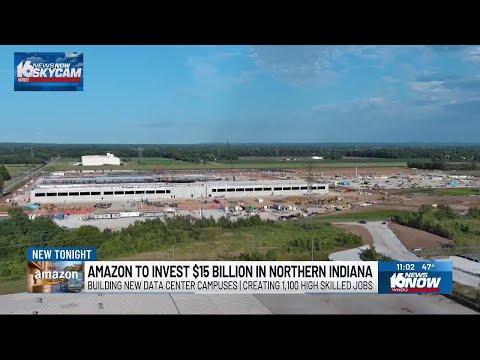
Amazon is transforming northern Indiana farmland into one of the world's largest artificial intelligence computing hubs. In November 2025, the company announced a $15 billion expansion on top of an $11 billion project already under construction near New Carlisle—bringing its total Indiana commitment to $26 billion and creating what officials call the state's largest construction project ever.

The investment reflects a fundamental shift in how AI companies are building infrastructure. Rather than compete for scarce power and land in Virginia's crowded data center corridor, Amazon is betting on the Midwest, where electricity is cheaper and available in quantity. The Indiana facilities will house nearly 500,000 of Amazon's custom Trainium chips, training AI models for Anthropic and powering the next generation of cloud services—while reshaping the energy economics of an entire region.

Key Indicators

$26B
Total Amazon Investment
Combined commitment across New Carlisle and Northwest Indiana campuses
4.6 GW
Total Power Capacity
Equivalent to powering roughly 3.5 million homes
2,100+
Direct Jobs Created
High-skilled technical positions across both campuses
500,000
Trainium2 AI Chips
World's largest deployment of non-Nvidia AI accelerators

Interactive

Exploring all sides of a story is often best achieved with Play.

Dorothy Parker

Dorothy Parker

(1893-1967) · Jazz Age · wit

Fictional AI pastiche — not real quote.

"So they've traded Virginia's drawing rooms for Indiana's cornfields, and call it progress when silicone replaces soil. One supposes the artificial intelligence will feel right at home—nothing grows quite so well on borrowed land as something that doesn't need to eat."

Andrew Carnegie

Andrew Carnegie

(1835-1919) · Gilded Age · industry

Fictional AI pastiche — not real quote.

"Aye, the man who builds toward the future builds toward fortune! Twenty-six billion for thinking machines in the heartland—here is proof that wealth flows not to those who hoard the old ways, but to those bold enough to lay new rails of progress where land is cheap and power plentiful. Though I confess, in my day we at least employed thousands of strong backs in our mills; let us hope these Trainium contraptions leave something for the common man beyond marveling at their masters' profits!"

Ever wondered what historical figures would say about today's headlines?

Sign up to generate historical perspectives on this story.

Sign Up

Debate Arena

Two rounds, two personas, one winner. You set the crossfire.

People Involved

Mike Braun
Mike Braun
Governor of Indiana (Active proponent of data center development)
Eric Holcomb
Eric Holcomb
Former Governor of Indiana (2017-2025) (Left office January 2025)
Brandon Oyer
Brandon Oyer
Head of Americas Water and Power, Amazon Web Services (Leading AWS infrastructure expansion)

Organizations Involved

Amazon Web Services (AWS)
Cloud Infrastructure Provider
Status: Primary investor and operator

Amazon's cloud computing division and the world's largest provider of cloud infrastructure services.

NIPSCO (Northern Indiana Public Service Company)
Electric Utility
Status: Primary power provider for Amazon data centers

Regional electric and gas utility serving northern Indiana, now building 3 gigawatts of new generation capacity for Amazon.

Anthropic
Anthropic
Artificial Intelligence Company
Status: Primary tenant and AI training partner

AI safety startup and creator of Claude, valued at $61.5 billion, with exclusive access to Amazon's Indiana computing infrastructure.

Timeline

  1. Hobart Confirmed as Primary Expansion Site

    Location

    City officials confirm the 500-acre site at 61st Street and Colorado Avenue will host Amazon's $15 billion expansion. The city negotiated a $47 million upfront payment—reportedly the largest such payment in U.S. history for private development on private land.

  2. Amazon Announces $15 Billion Expansion

    Investment

    Governor Mike Braun announces Amazon will invest an additional $15 billion to build data center campuses in Northwest Indiana, including a site in Hobart. The project will add 2.4 gigawatts of capacity and 1,100 jobs.

  3. NIPSCO Announces $7 Billion Power Infrastructure Deal

    Energy

    NIPSCO reveals plans to build two 1.3-gigawatt gas plants and 400 megawatts of battery storage to power Amazon's expansion. Amazon funds all new infrastructure; existing customers expected to save $1 billion over 15 years.

  4. Project Rainier Goes Live

    Operations

    Amazon activates seven data center buildings at New Carlisle containing nearly 500,000 Trainium2 chips—the world's largest deployment of non-Nvidia AI accelerators. Anthropic begins training frontier models on the infrastructure.

  5. Amazon Doubles Anthropic Investment to $8 Billion

    Partnership

    Amazon increases its stake in Anthropic with an additional $4 billion investment. AWS becomes Anthropic's primary training partner, with Anthropic committing to use Amazon's Trainium chips.

  6. Amazon Breaks Ground at New Carlisle Site

    Construction

    Officials hold ceremonial groundbreaking on the 1,200-acre site. The campus will eventually include 30 buildings drawing 2.2 gigawatts of electricity.

  7. Google Commits $2 Billion to Fort Wayne Campus

    Industry

    Google announces Project Zodiac, a $2 billion hyperscale data center campus in Fort Wayne, adding to Indiana's growing cluster of technology infrastructure investments.

  8. AWS Announces $11 Billion New Carlisle Investment

    Investment

    Governor Eric Holcomb announces Amazon Web Services will invest $11 billion to build a data center campus near New Carlisle in St. Joseph County, creating at least 1,000 jobs over a decade-long build.

  9. Meta Announces $800M Indiana Data Center

    Industry

    Meta commits to building a 700,000-square-foot hyperscale data center campus in Jeffersonville, signaling Indiana's emergence as a data center destination.

Scenarios

1

Indiana Becomes Midwest AI Infrastructure Capital

Discussed by: Data Center Frontier, McKinsey analysis of regional data center trends

Amazon completes its buildout on schedule, other hyperscalers follow with additional investments, and Indiana emerges as the primary Midwest alternative to Virginia's congested data center corridor. The state's combination of available power, lower land costs, and utility willingness to build dedicated infrastructure attracts $50+ billion in cumulative investment by 2030.

2

Power Grid Strain Forces Buildout Delays

Discussed by: Utility Dive, Citizens Action Coalition of Indiana, PJM Interconnection capacity analyses

NIPSCO's new power plants face permitting delays or construction problems, forcing Amazon to slow its expansion timeline. Grid reliability concerns mount as data center demand approaches residential consumption levels. The 2027 target for initial power delivery slips, and full 2.4-gigawatt capacity isn't reached until the mid-2030s.

3

Community Opposition Blocks Further Expansion

Discussed by: NBC Chicago, ABC7 Chicago coverage of Hobart city meetings, parallel cases in Michigan

Following the pattern of Howell Township, Michigan—where a $1 billion data center was withdrawn after community pushback—Indiana residents organize against additional sites. Concerns about minimal job creation per dollar invested, water usage, and industrial impact on residential areas lead local governments to reject future Amazon expansion requests.

4

AI Chip Competition Reshapes Amazon's Strategy

Discussed by: CNBC technology coverage, semiconductor industry analysts

Amazon's bet on proprietary Trainium chips faces setbacks as Nvidia maintains its AI training dominance or new competitors emerge. The exclusive Anthropic partnership underdelivers, and Amazon pivots to hybrid chip strategies. Indiana facilities remain valuable but lose their distinctive role as the proving ground for non-Nvidia AI infrastructure.

Historical Context

Northern Virginia's Data Center Corridor (1990s-Present)

1990s-2025

What Happened

Loudoun County, Virginia became home to the world's largest concentration of data centers after major internet companies like AOL established operations there in the 1990s. Proximity to Washington, D.C., abundant fiber connectivity, and low natural disaster risk attracted hyperscalers. By 2025, roughly 70% of global internet traffic flows through the county's 665 data centers.

Outcome

Short Term

Loudoun County became the wealthiest county in America by median household income, with data centers generating billions in tax revenue.

Long Term

Grid congestion, land scarcity, and power constraints now limit new development. Hyperscalers are redirecting investment to Texas, Arizona, and increasingly the Midwest.

Why It's Relevant Today

Indiana is positioning itself as the next major data center hub by offering what Virginia can no longer provide at scale: available power and land.

Tesla Gigafactory Nevada (2014-2020)

2014-2020

What Happened

Tesla announced it would build a $5 billion battery factory in the Nevada desert, the largest building in the world by footprint. Nevada offered $1.3 billion in tax incentives. The factory employed 7,000 workers directly and transformed the Reno-Sparks economy, with dozens of supplier companies following.

Outcome

Short Term

Construction created thousands of jobs; housing prices in the region doubled as workers relocated.

Long Term

The factory became a template for how large-scale manufacturing investments can reshape regional economies—and sparked debate about whether tax incentives deliver proportionate returns.

Why It's Relevant Today

Amazon's Indiana investment follows a similar pattern: massive capital commitment, significant tax arrangements, and promises to transform a region's economic identity from agriculture and manufacturing to technology.

Foxconn Wisconsin (2017-2020)

2017-2020

What Happened

Foxconn announced a $10 billion LCD manufacturing plant in Mount Pleasant, Wisconsin, promising 13,000 jobs. The state offered $4.5 billion in incentives—the largest subsidy package in U.S. history for a foreign company. Governor Scott Walker called it 'transformational.'

Outcome

Short Term

Construction began, but plans repeatedly shrank. The promised 13,000 jobs became fewer than 1,500.

Long Term

The project became a cautionary tale about mega-incentive deals. The state renegotiated in 2021, dramatically reducing both the project scope and public subsidies.

Why It's Relevant Today

The Foxconn failure explains why some Indiana communities are cautious about data center deals offering relatively few permanent jobs per dollar invested. Amazon's arrangements include upfront payments and binding commitments that address some of these concerns.

10 Sources: