
Pull to refresh
Logo
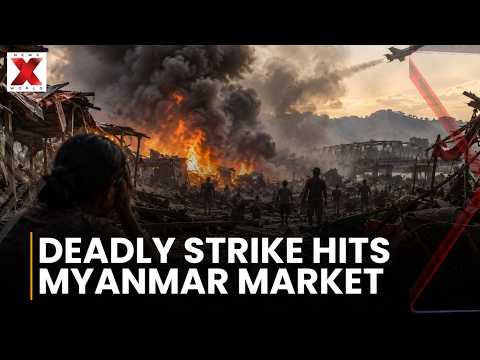
Myanmar military airstrike kills dozens at rebel-held Rakhine market

Myanmar military airstrike kills dozens at rebel-held Rakhine market

Force in Play

At least 49 civilians dead in Kyauktaw after a fighter jet drops two bombs on the region's main wholesale market

Yesterday: UN condemns the strike

Overview

Updated 2 hours ago

A Myanmar military fighter jet dropped two 500-pound bombs on a crowded wholesale market in Kyauktaw, a town in western Rakhine State that the Arakan Army rebel group controls. At least 49 people died and 58 were wounded, local rescue workers said.

The market was the region's main trading hub, drawing vendors and shoppers from across the state. The strike is the deadliest on civilians in Rakhine since a December 2025 attack on a hospital killed 33.

The junta has lost 14 of Rakhine's 17 townships to the Arakan Army since it launched its offensive in November 2023. With ground forces pushed back, airstrikes have become the military's main countermeasure, and civilian areas keep bearing the weight.

Why it matters

The junta's airstrikes are its main weapon against rebel-held territory. Each civilian-market strike raises the war's human cost and blocks refugee returns.

Questions about this story

Free account needed to ask — your question is kept and asked for you right after sign-up. Answers are public.

No questions yet — be the first to ask.

Key Indicators

49
Civilians killed in the Sept 28 Kyauktaw strike
Rescue workers recovered 49 bodies; 31 had not yet been identified in early reports.
58
Civilians injured in the strike
Twenty-two of the wounded were in critical condition, according to rescue officials.
14 of 17
Rakhine State townships under Arakan Army control
The rebel group has captured 14 of the state's 17 townships since November 2023.
602
Civilians killed by airstrikes in Rakhine, April 2024–September 2026
Recorded by the Development Media Group; 1,211 more were injured.

Voices

Curated perspectives — historical figures and your fellow readers.

Ever wondered what historical figures would say about today's headlines?

Sign up to generate historical perspectives on this story.

People Involved

Organizations Involved

Timeline

February 2021 September 2026

7 events Latest: Yesterday
Tap a bar to jump to that date
  1. UN condemns the strike

    Latest Statement

    The UN and Human Rights Chief Volker Turk deplore the attack, warning the toll may rise and that refugees cannot yet return.

  2. Fighter jet bombs Kyauktaw market

    Conflict

    A military jet drops two 500-pound bombs near India Market and the Kachapannadi Bridge, killing at least 49 and wounding 58.

  3. Airstrikes kill 22 across nine townships

    Conflict

    Attacks from Sept 17–27 kill or injure 22 civilians across Ann, Minbya, Gwa, Kyauktaw, and other townships.

  4. DMG records 602 airstrike deaths in Rakhine

    Report

    Development Media Group counts 602 civilians killed and 1,211 injured by military airstrikes since April 2024.

  5. Airstrike on Mrauk-U hospital kills 33

    Conflict

    A military airstrike on Mrauk-U People Hospital kills at least 33 civilians and injures nearly 80.

  6. Arakan Army launches Rakhine offensive

    Conflict

    The rebel group begins a campaign that captures a major regional military headquarters and 14 of Rakhine's 17 townships.

  7. Military seizes power in Myanmar

    Political

    The Tatmadaw overthrows the elected government of Aung San Suu Kyi, triggering armed resistance across the country.

Scenarios

1

Arakan Army retaliates, airstrikes intensify

Likely Resolves by End of 2026

Discussed by: Arakan Army statements, Reuters, UN reports

The Arakan Army has promised 'effective retaliatory measures' against those responsible for the strike. If it attacks military positions or supply lines, the junta would likely answer with more airstrikes on towns it holds. The pattern in Rakhine since 2023 points to escalation rather than restraint, with the civilian toll as the main variable.

2

International accountability moves forward

Possible Resolves by Q2 2027

Discussed by: UN Human Rights Office, Anadolu Agency coverage

Volker Turk has raised concerns about compliance with international humanitarian law and invoked non-refoulement obligations. The UN Human Rights Council, an OHCHR mandate, or the International Criminal Court could open a formal inquiry into the strike. These processes move slowly and historically have not changed the military's conduct on the ground.

3

Ceasefire talks gain ground

Unlikely Resolves by Q2 2027

Discussed by: Reuters, UN statements on refugee returns

The UN says conditions do not exist for the safe return of refugees and displaced people from Bangladesh and Malaysia. A ceasefire between the junta and the Arakan Army would be required before returns become realistic. China, which has mediated in Myanmar's conflicts, is the most likely broker; no talks are publicly underway.

Historical Context

2 moments from history that rhyme with this story — and how they unfolded.

2013–2016

Syrian barrel bomb campaigns on opposition markets (2013–2016)

The Assad government's air force dropped barrel bombs, improvised unguided explosives, on markets, hospitals, and residential blocks in rebel-held areas of Aleppo and other cities. The strikes killed thousands of civilians and drew repeated war-crime allegations.

Then

International condemnation produced no enforcement, and the regime continued flying sorties throughout the war.

Now

The campaign became the defining example of aerial counterinsurgency against territory-based rebels, with civilians as the primary casualties.

Why this matters now

Mirrors how Myanmar's military uses airstrikes against Arakan Army-controlled towns, with markets and hospitals hit and civilians bearing the cost.

August 2017

Rohingya clearance operations in Rakhine (August 2017)

Myanmar's military launched 'clearance operations' in northern Rakhine after an insurgent attack, burning villages and attacking civilians. An estimated 700,000 Rohingya fled to Bangladesh within months.

Then

The UN called the operations ethnic cleansing; Myanmar's military denied wrongdoing and blocked independent investigation.

Now

The episode established the military's record of disproportionate force in Rakhine and left a large refugee population in Bangladesh unable to return.

Why this matters now

Explains why UN officials stress that conditions in Rakhine remain unsafe for refugee returns, and why the region stays a flashpoint.

Sources

(9)