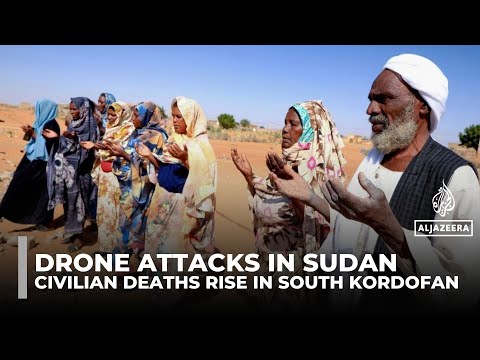
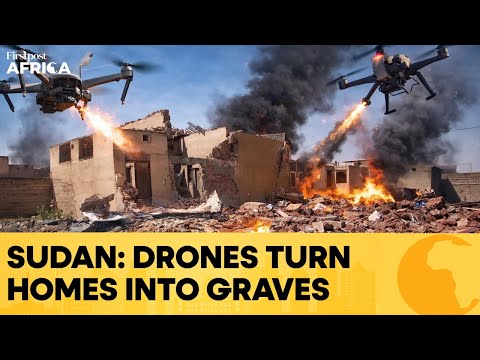
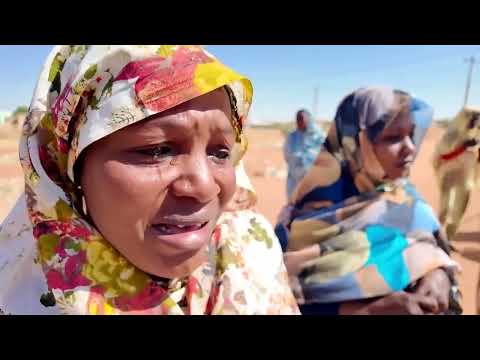
Sudan's civil war has entered a new phase defined by drone strikes that hit markets, hospitals, and roads nearly every day. On March 26, two strikes killed at least 28 civilians—22 at a market in Saraf Omra, North Darfur when one hit a parked oil truck, and six along a road in Kordofan. The market strike ignited part of the market, and an infant was among the 22 dead.
The first two months of 2026 brought 198 drone strikes by both sides. At least 52 caused civilian casualties, killing 478 people.
Both sides have reliable foreign suppliers: Iran, Turkey, and Russia arm the SAF; the UAE channels Chinese-made drones to the RSF through Chad and Libya. As both factions acquire more capable aircraft, civilian deaths have soared—more than 200 were killed in drone strikes during the first three weeks of March alone. The conflict has already displaced 13.6 million people; a UN fact-finding mission has concluded the RSF committed genocide during the fall of El Fasher in October 2025.
Why it matters
Foreign drone sales are turning an African civil war into a testing ground for remote killing, with civilians paying the price daily.
Questions about this story
Free account needed to ask — your question is kept and asked for you right after sign-up. Answers are public.
No questions yet — be the first to ask.
Key Indicators
198
Drone strikes in January–February 2026
Both SAF and RSF launched strikes at an average rate of more than three per day in the first two months of 2026.
500+
Civilians killed by drones, January–mid-March 2026
The United Nations Office of the High Commissioner for Human Rights documented over 500 civilian drone deaths in under three months.
1,003
Total drone strikes since war began
From April 15, 2023 through January 23, 2026, monitors tracked over a thousand drone attacks by both warring parties.
13.6M
People displaced
Sudan is the world's largest displacement crisis — 9.3 million internally displaced and 4.3 million refugees in neighboring countries.
5.5%
Humanitarian funding received
Of the $2.9 billion the UN requested for Sudan's 2026 humanitarian response, only 5.5 percent has been funded.
17 events
Latest: March 26th, 2026 · 6 months ago
Showing 8 of 17
JK to step
Tap a bar to jump to that date
Jump to
March 2026
Double drone strikes kill 28 in Darfur and Kordofan
LatestAttack
A drone hits a parked oil truck at a market in Saraf Omra, North Darfur, igniting part of the market and killing 22 people including an infant, with 17 more injured. A separate strike along a Kordofan road kills six more.
Eid al-Fitr hospital strike kills 64 in El Daein
Attack
On the first day of Eid al-Fitr, an airstrike hits El Daein Teaching Hospital in East Darfur, killing 64 people including children and a doctor. Satellite analysis by Yale's Humanitarian Research Lab confirms the SAF carried out the attack. The hospital's emergency, maternity, and pediatric units are destroyed, leaving over two million people without proper medical care.
RSF drone strike kills 17 in Chad; border sealed
Attack
A drone attack from Sudan kills 17 people in the Chadian border town of Tine, striking mourners at a funeral. Chad's president orders the military to retaliate and closes the entire 1,300-kilometer border.
UN rights chief says 200+ civilians killed by drones since March 4
Statement
Volker Türk declares he is 'appalled' by reports that more than 200 civilians have been killed by drone attacks in the Kordofan region and White Nile state in less than two weeks.
School and health clinic struck in Shukeiri village
Attack
A drone strike hits a secondary school and health clinic in Shukeiri village, killing at least 17 civilians including a health worker.
Drone hits civilian truck in Al-Sunut, killing ~50
Attack
An SAF drone strikes a truck carrying civilians on a road in Al-Sunut, reportedly killing approximately 50 people.
Drone strikes on Abu Zabad and Wad Banda markets kill ~40
Attack
Two separate markets in Abu Zabad and Wad Banda are struck by drones, killing approximately 40 civilians in a single day.
SAF drone strikes hit Al-Muglad market and hospital, killing ~50
Attack
A Sudanese Armed Forces drone strike hits a market and a hospital simultaneously in Al-Muglad, West Kordofan, killing approximately 50 civilians and marking the start of the deadliest month for drone warfare in the conflict.
January 2026
Drone strike count passes 1,000 since war began
Investigation
Conflict monitors record over 1,003 drone strikes since April 2023, with drone use accelerating as both sides acquire more capable aircraft from foreign suppliers.
Sudan's government returns to Khartoum
Political
The military-led government formally returns to Khartoum and begins restoring services in the war-ravaged capital.
December 2025
Sudan's PM presents peace plan to UN Security Council
Diplomatic
Prime Minister Kamil Idris presents a peace plan to the Security Council. The United States pushes for an immediate humanitarian truce as a precondition to broader negotiations.
RSF seizes Heglig oilfield
Military
The RSF captures Sudan's largest oilfield in West Kordofan, cutting a major government revenue source and shifting the war's economic balance.
October 2025
RSF captures El Fasher; massacres begin
Military
The RSF overruns El Fasher, the last SAF stronghold in Darfur. The UN documented more than 6,000 killings in the first three days. A fact-finding mission later classified the violence as genocide against non-Arab ethnic groups.
March 2025
SAF recaptures Khartoum
Military
The Sudanese Armed Forces retake Khartoum after months of fighting, ending two years of RSF control over parts of the capital.
July 2024
Iran and UAE drone supplies to Sudan documented
Investigation
Reports confirm Iran is supplying Mohajer-6 drones to the SAF while the UAE channels Chinese-made Wing Loong II drones to the RSF through Chad, turning the conflict into a proxy drone war.
June 2023
RSF overruns Darfur; ethnic massacres in El Geneina
Military
The RSF captures most of Darfur and carries out ethnic massacres against the Masalit people in West Darfur's capital, El Geneina.
April 2023
War erupts between SAF and RSF in Khartoum
Military
Fighting breaks out across Khartoum between the Sudanese Armed Forces and the Rapid Support Forces after months of tension over RSF integration into the regular army.
Scenarios
1
Drone arms race accelerates; civilian deaths double by year-end
Both sides continue acquiring more capable drones from their respective foreign backers, with no international mechanism in place to restrict supply. The SAF expands its Iranian and Turkish drone fleet; the RSF secures additional UAE-supplied Wing Loong IIs. Civilian deaths from drone strikes, already over 500 in the first eleven weeks of 2026, could exceed 2,000 for the year. This scenario is the default trajectory absent external intervention.
2
Cross-border strikes draw regional military response
Possible
Discussed by: Sudan Tribune, Al Jazeera, Middle East Monitor analysis of Chad border closure
The March 18 RSF strike on Chad that killed 17 and prompted President Deby to seal the border and threaten retaliation signals that the drone war is no longer confined to Sudan. If strikes hit Chad, South Sudan, or Egypt — all of which border active conflict zones — regional powers could intervene militarily or impose no-fly zones. Chad's willingness to conduct operations on Sudanese territory sets a precedent.
3
International pressure forces drone supply restrictions
Unlikely
Discussed by: UN Security Council reporting, Human Rights Watch, arms embargo analysts
The accumulating evidence of war crimes from drone strikes — particularly the satellite-confirmed SAF attack on El Daein hospital — creates enough diplomatic pressure for the UN Security Council to expand the existing Darfur arms embargo to cover all of Sudan, or for key supplier states to face targeted sanctions. However, Russia and China have historically blocked stronger Security Council action on Sudan, and Iran, the UAE, and Turkey face no current penalties for supplying drones to the warring parties.
4
Ceasefire achieved through U.S.-led Board of Peace initiative
Unlikely
Discussed by: Sudan Tribune, U.S. State Department, Security Council Report
The U.S.-led Board of Peace, established in January 2026, set a March deadline to end the fighting. With backing from Saudi Arabia, Egypt, and the UAE, this initiative aims to secure a permanent ceasefire with conditions including military reform and exclusion of extremist elements. If both sides face genuine economic and military pressure from their patrons, a truce is possible — but neither the SAF nor RSF has shown willingness to negotiate from anything less than a position of advantage.
Historical Context
3 moments from history that rhyme with this story — and how they unfolded.
1 of 3
November 2020 – November 2022
Ethiopia's Tigray War drone campaign (2020–2022)
During Ethiopia's civil war in Tigray, the federal government deployed Turkish Bayraktar TB2 and Iranian Mohajer-6 drones against Tigrayan forces. Strikes hit civilian targets repeatedly — at least 50 people were killed at a camp for displaced people in January 2022 alone. The government's drone arsenal, sourced from many of the same suppliers now arming the SAF, killed over 449 civilians in Amhara from 2023 onward as the drone program expanded to fight other insurgencies.
Then
Drone strikes helped the Ethiopian military regain control of Tigray but at devastating civilian cost. The Pretoria Agreement ended the Tigray war in November 2022.
Now
Ethiopia's use of foreign-supplied drones against its own population established a template now being replicated in Sudan: governments buying off-the-shelf drone capability from Iran, Turkey, and the UAE to wage wars against domestic opponents, with minimal international consequence.
Why this matters now
Sudan's drone war follows the Ethiopian playbook almost exactly — the same suppliers, the same pattern of market and hospital strikes, the same failure of international mechanisms to restrict drone transfers to governments demonstrably hitting civilian targets.
2 of 3
March 2015 – present
Yemen's Saudi-led coalition air war (2015–present)
The Saudi-led coalition fighting Houthi rebels in Yemen carried out thousands of airstrikes that repeatedly hit weddings, funerals, school buses, and hospitals. A 2018 strike on a school bus in Dahyan killed 40 children. Despite extensive documentation by the UN and human rights organizations, arms sales to the coalition continued for years. The coalition's own investigation mechanism was widely dismissed as inadequate.
Then
International condemnation led some Western nations to pause arms sales, but the coalition's main suppliers continued deliveries. The strikes persisted for years.
Now
Yemen demonstrated that documented civilian casualties and war crimes findings alone are insufficient to halt arms transfers when supplier states have strategic relationships with the buyers.
Why this matters now
Sudan faces the same accountability gap. Iran, the UAE, Turkey, and Russia all have strategic reasons to arm their preferred faction, and the UN Security Council has proven unable to act — exactly as it was unable to halt arms flows to the Yemen coalition for years despite mounting evidence of civilian harm.
3 of 3
2003 – 2005
Darfur genocide and arms embargo (2003–2005)
The Sudanese government under Omar al-Bashir armed Janjaweed militias — the direct predecessors of today's RSF — to carry out ethnic cleansing in Darfur. An estimated 300,000 people died. The UN Security Council imposed an arms embargo on Darfur in 2004 and referred the situation to the International Criminal Court in 2005, which eventually issued warrants for Bashir.
Then
The arms embargo was routinely violated. A UN peacekeeping mission (UNAMID) was deployed but was too small and poorly equipped to protect civilians.
Now
The ICC warrants were never enforced during Bashir's rule. The Janjaweed militias were formalized into the RSF in 2013, and the same commanders now lead one side of today's civil war.
Why this matters now
The original Darfur arms embargo — still technically in effect — has failed to prevent both sides from acquiring advanced drone technology from foreign suppliers. The same ethnic dynamics and the same armed groups are at the center of today's conflict, now equipped with far more lethal technology.