



Pull to refresh
Logo
Australia's unemployment jumps to 4.9% and traders flip to pricing rate cuts

Australia's unemployment jumps to 4.9% and traders flip to pricing rate cuts

Money Moves

Five rate rises in 2026 were meant to cool the labour market gradually. October's jobs report says the cooling is arriving years ahead of schedule.

Overview

Updated 59 minutes ago

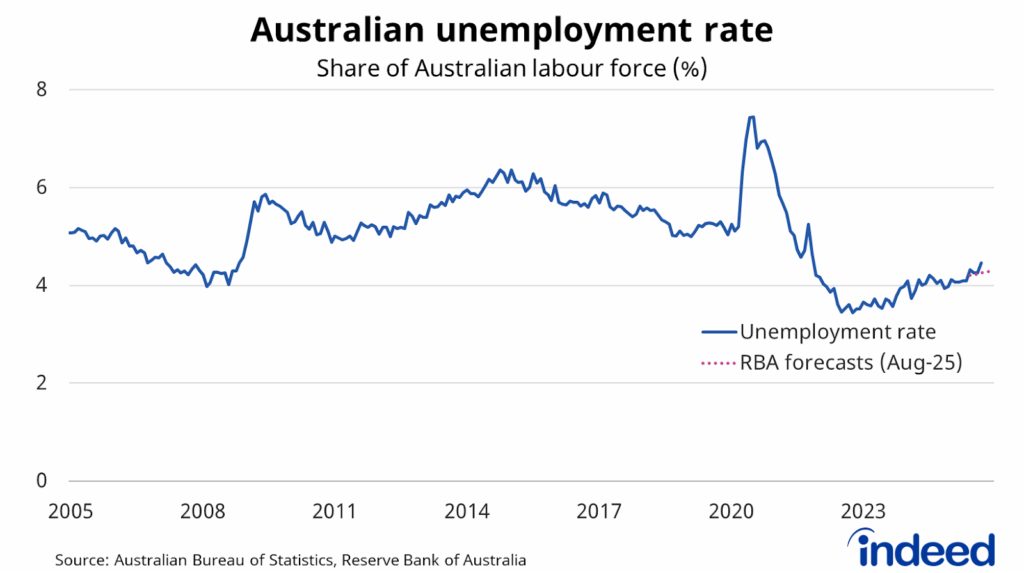
Australia's unemployment rate rose to 4.9% in October, the highest since 2021, after employers cut 43,500 jobs. It was the second straight monthly decline, and the combined two-month loss was the largest in five years. More than 750,000 people were out of work and actively looking, the first time that has happened since the COVID-19 period.

Those numbers landed days after the Reserve Bank of Australia lifted its cash rate to 4.85%, an 18-year high and its fifth increase of 2026, on the argument that a cooler labour market was needed to bring inflation down. Within hours, traders stopped pricing further rises and started pricing cuts: 68% odds of a reduction at the June 2027 board meeting, and around 90% by August.

Why it matters

Five rate rises were supposed to cool hiring without breaking it. October's report suggests the break may have started, which puts mortgage relief and job security on the same trade-off.

Questions about this story

Free account needed to ask — your question is kept and asked for you right after sign-up. Answers are public.

No questions yet — be the first to ask.

Key Indicators

4.9%
Unemployment rate, October 2026
Up from 4.7% in September; the highest reading since October 2021.
43,500
Jobs lost in October
Followed a revised 36,400 fall in September, the biggest two-month drop in five years.
4.85%
RBA cash rate target
Raised in November 2026, an 18-year high and the fifth increase of the year.
68%
Market odds of a June 2027 rate cut
Rose to about 90% for the August 2027 meeting after the October jobs data.
11.3%
Youth unemployment (ages 15–24)
Up from 11.1%; the highest in five years.
750,000
Unemployed and actively looking
First time above 750,000 since the COVID-19 period, per ABS labour force data.

Voices

Curated perspectives — historical figures and your fellow readers.

Sign up to generate historical perspectives on this story.

People Involved

Organizations Involved

Timeline

5 events Latest: Today
Tap a bar to jump to that date
  1. Unemployment jumps to 4.9% as employers cut 43,500 jobs

    Today Economic data

    The jobless rate rose from 4.7%, against forecasts it would hold steady, and employment fell well short of the expected 25,000 gain.

  2. Traders price a 68% chance of a June 2027 rate cut

    Today Markets

    Odds of a cut at the August 2027 meeting reached about 90%. The Australian dollar fell to a 10-month low and three-year bond futures hit their highest since late August.

  3. UBS, Nomura, CommBank and NAB move first-cut calls to August 2027

    Today Forecasts

    UBS shifted its first cut from November 2027 and widened its expected easing cycle to 75 basis points.

  4. David Jones to cut about 1,500 jobs after entering administration

    Corporate

    A union said the department store chain's administrators would cut the roles, adding to a year of corporate layoffs in Australia.

  5. RBA lifts cash rate to 4.85%, its fifth rise of 2026

    Monetary policy

    The board voted 6-3 to raise rates to an 18-year high. The three dissenters worried the economy could face a materially sharper downturn.

Scenarios

1

RBA cuts rates at its August 2027 meeting

Likely Resolves by Q3 2027

Discussed by: UBS, Nomura, Commonwealth Bank and National Australia Bank

The consensus among the four forecasters that have published calls is that the RBA holds through the summer as inflation stays high, then cuts 25 basis points in August 2027. UBS expects three cuts in total, taking the cash rate down 75 basis points by February 2028. The trigger is continued labour market weakness combined with inflation drifting toward the target range, which the bank's own forecasts put in late 2027.

2

Inflation keeps the RBA on hold through the end of 2027

Possible Resolves by End of 2027

Discussed by: Moody's analysts, who said the data shift the debate to how long rates stay at their peak

Underlying inflation and wage growth stay high enough that the board refuses to ease even as unemployment climbs. Moody's argued elevated inflation 'rules out a pivot to easing', and the RBA's November forecasts have inflation back in the target range only in late 2027. In this path, the bank accepts a higher jobless rate rather than risk cutting too soon.

3

Australia enters a recession before the first rate cut arrives

Unlikely Resolves by End of 2027

Discussed by: BetaShares chief economist David Bassanese and HSBC chief economist Paul Bloxham

Bassanese argues that back-to-back employment declines of this size, combined with weak productivity, imply GDP has already shrunk. Bloxham said 'recession is clearly a concern'. This path would force the RBA to cut earlier than its 2027 timetable, inverting the current plan of holding through mid-year.

4

The RBA cuts as early as February 2027

Unlikely Resolves by Q1 2027

Discussed by: Traders cited by the Australian Financial Review

Some market participants moved faster than the bank economists, pricing a cut as early as February 2027 on the view that the labour market is deteriorating faster than the board can tolerate. This requires the next two labour force reports to confirm October was not a statistical artifact, and inflation to cooperate. Bassanese flagged that changes to how the labour force survey is conducted could mean the weakness is statistical noise.

Historical Context

3 moments from history that rhyme with this story — and how they unfolded.

1989–1992

The recession Australia 'had to have' (1989–1992)

The Reserve Bank pushed the cash rate to 17.5% to kill double-digit inflation. Unemployment climbed from around 6% to more than 10% by 1992, and the economy contracted through 1990 and 1991.

Then

Treasurer Paul Keating called it 'the recession Australia had to have'. Hundreds of thousands lost jobs.

Now

Inflation was brought under control and the RBA's inflation-targeting framework followed in the 1990s, but the episode became the standard warning about tightening too far.

Why this matters now

It is the reference point for every argument that the RBA has 'overcooked' the economy, the charge Nomura's Andrew Ticehurst says the bank now faces.

2023–2024

The US Sahm rule false alarm (2024)

US unemployment rose from 3.4% in April 2023 to 4.3% in July 2024, triggering the Sahm rule, a recession indicator built on the three-month average jobless rate. Markets briefly panicked.

Then

The Federal Reserve began cutting rates in September 2024. The feared recession did not arrive.

Now

The episode became a case study in how a fast-rising unemployment rate can reflect labour supply returning rather than demand collapsing.

Why this matters now

It is the counter-argument to the recession scenarios: a rising jobless rate can signal normalisation, not contraction. Australia's participation rate fell in October, which points the other way.

2024

New Zealand's rapid pivot (2024)

The Reserve Bank of New Zealand held its cash rate at 5.5% for about a year, then began cutting as the economy stalled and unemployment climbed from historic lows.

Then

The first cut came in August 2024, earlier than the bank had signalled, as activity data weakened.

Now

New Zealand showed how fast a small, mortgage-heavy economy can turn once the labour market cracks, and how quickly a central bank can reverse.

Why this matters now

Australia has a similar household debt profile and a comparable recent hiking cycle, which is why traders there moved so fast to price 2027 cuts.

Sources

(10)