
Pull to refresh
Logo
AWS adds GPU inference to Lambda managed instances

AWS adds GPU inference to Lambda managed instances

New Capabilities

Up to 48 concurrent invocations can share one model per GPU, billed at EC2 on-demand rates plus a 9.75% fee

Overview

Updated 33 minutes ago

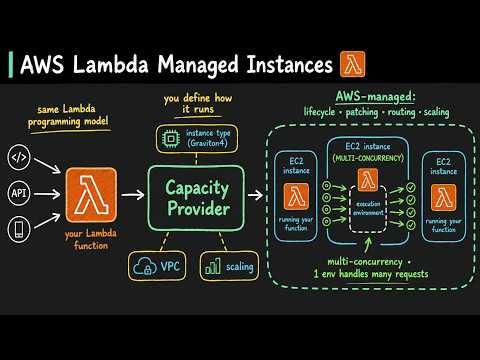
AWS has sold Lambda since 2014 on one promise: no servers to manage. GPUs were the exception, so anyone who needed one left for EC2 or SageMaker and took on drivers, CUDA libraries and autoscaling themselves. On November 18, AWS dropped that exception for Event Functions running on Lambda Managed Instances.

You ship a container image; Lambda provisions G-series hardware, assigns one GPU per execution environment, and runs up to 48 invocations against it. AWS's vLLM and SGLang base images hold one copy of the model in memory and batch requests from every worker, so memory use stays flat as concurrency climbs. Billing is the EC2 on-demand rate plus a 9.75% management fee, which makes this rented hardware behind a managed control plane rather than per-millisecond serverless.

Why it matters

A team can now trigger a small AI model from S3 or SQS without operating a cluster, but only by renting whole GPUs.

Questions about this story

Free account needed to ask — your question is kept and asked for you right after sign-up. Answers are public.

No questions yet — be the first to ask.

Key Indicators

48
Concurrent invocations per GPU environment
The maximum number of invocations Lambda will run against a single physical GPU.
9.75%
Lambda management fee
Charged on top of the EC2 on-demand instance price, plus $0.20 per million requests.
7
GPU instance families at launch
G4dn, G5, G6, G6f, Gr6, Gr6f and G6e. The g4dn.metal size is excluded.
48 GB
Largest single-GPU memory available
The NVIDIA L40S on G6e. Fractional G6f sizes offer 3, 6 or 12 GB.
40%
Default GPU utilization target
Lambda adds execution environments when utilization passes this level, leaving room for traffic to double in five minutes.

Voices

Curated perspectives — historical figures and your fellow readers.

Sign up to generate historical perspectives on this story.

People Involved

Organizations Involved

Timeline

November 2014 November 2026

3 events Latest: 4 days ago
  1. GPU-accelerated Event Functions go live

    Latest Launch

    G-series instances join Managed Instances. Lambda assigns one GPU per execution environment and runs up to 48 invocations against it, with vLLM and SGLang base images that batch requests through a single model copy.

  2. Lambda Managed Instances ships without GPUs

    Launch

    Functions run on EC2 capacity the customer selects, with Lambda handling provisioning and scaling. GPU instances are not an option.

  3. AWS previews Lambda

    Launch

    Functions run on event triggers with no server to manage. The service is CPU-only.

Scenarios

1

AWS extends GPU support beyond Event Functions

Possible Resolves by Q2 2027

Discussed by: InfoQ, which noted that Managed Instances still support only Event Functions and that AWS has not said whether Web Functions will follow.

Two Lambda shapes stay on CPU: Web Functions, the HTTP-server form added in 2026, and standard functions on AWS's shared fleet. Web Functions are the easier next step, since request routing around a shared model server is close to what Lambda already does for events. Standard Lambda is harder, because it bills per millisecond on shared hardware and GPUs do not partition that way.

2

Pricing moves off EC2 instance-hours

Unlikely Resolves by End of 2027

Discussed by: No public advocate. AWS's pricing page is the only stated position, and neither AWS nor outside analysts have floated a change.

A GPU function costs whatever its instances cost, whether requests arrive or not. Scaling to zero is available but takes several minutes and can fail when GPU capacity is tight. Billing by the second of GPU time would suit bursty work, and it would move idle-capacity risk from the customer to AWS. That is the trade AWS has declined to make so far.

3

A named customer runs production inference on GPU Lambda

Likely Resolves by Q2 2027

Discussed by: AWS's launch post, which lists AI inference first among target workloads but names no customers.

Launch posts list workloads; case studies show adoption. AWS usually publishes reference customers within a couple of quarters of a launch like this. A named deployment with throughput and cost figures would be the first outside evidence that one model serving 48 workers holds up beyond a demo.

Historical Context

3 moments from history that rhyme with this story — and how they unfolded.

November 2014

AWS Lambda launch (2014)

At its re:Invent conference, AWS showed a service that ran a function in response to an event and billed by execution time. Developers stopped provisioning servers for glue code, thumbnail generation and scheduled jobs.

Then

Adoption started with small teams using the free tier and S3 triggers.

Now

Lambda became the reference model for serverless computing, and rival clouds shipped equivalents within two years.

Why this matters now

The boundaries on the 2026 GPU release, event triggers only and no standard functions, are inherited from that original event-driven design.

November 2017

Amazon SageMaker (2017)

AWS announced a managed service for training and hosting machine learning models, with real-time endpoints priced by instance-hour. It shipped as a separate product with its own console, software kit and scaling rules.

Then

SageMaker became AWS's default answer for model serving.

Now

Model hosting settled into its own product line, apart from the function platform.

Why this matters now

GPU Lambda puts model serving back inside the function platform, where it competes for the same budget as a SageMaker endpoint.

November 2017

AWS Fargate (2017)

Fargate let customers run containers without managing the underlying EC2 hosts. It runs on CPU instances only; a container that needs a GPU still runs on EC2 or on GPU-backed container instances.

Then

Containers got a serverless option and adoption grew among teams avoiding cluster management.

Now

Accelerators stayed outside the abstraction, so machine learning work kept landing on raw instances.

Why this matters now

AWS has abstracted the host before without abstracting the GPU. This is the first time it does both in the same product.

Sources

(6)