Anchor

Biohaven epilepsy drug hits FDA hold nine days after SK Biopharma licensing deal
New CapabilitiesA rodent-metabolite finding freezes new enrollment in the drug's pivotal trials, splitting the programs's timeline
Today: Biohaven discloses hold;shares sink, timelines splitNew here? Follow stories to track developments over time. Create a free account to get updates when stories you care about change.
Overview
Updated 1 hour agoNine days after Biohaven signed a licensing deal worth up to $795 million with SK Biopharmaceuticals for its epilepsy drug platform, the FDA halted new enrollment in the drug's two late-stage trials. The hold came not because BHV-7000 (opakalim) showed safety problems in humans—over 1,200 people have taken it and tolerability has been generally clean—but because a metabolite found in rat studies raised questions the agency couldn't fully assess. Biohaven says the finding's significance to people is uncertain and may be rodent-specific.
The split isfateful: BHV7000-303 (RISE 3), one of two pivotal trials in refractory focal epilepsy, finished enrolling in June and remains on track for top-line data in H2 2026. But BHV7000-302 (RISE 2), which had not yet completed recruitment, now sits frozen at new-patient entry, likely delaying its readout. Two weeks earlier, that same drug had been the centerpiece of a deal designed to share development costs with a deep-pocketed Korean licensee. Now the FDA's request for more nonclinical data—expected in the coming weeks—determines whether that deal's central asset limps or flies.
Why it matters
If the partial hold pushes BHV-7000 off schedule, Biohaven loses its main value driver and SK Biopharmaceuticals' $795M bet stalls—leaving both with few options.
Questions about this story
Free account needed to ask — your question is kept and asked for you right after sign-up. Answers are public.
No questions yet — be the first to ask.
Key Indicators
$795M
SK Biopharma licensing deal value
Upfront and milestone payments for worldwide rights to the Kv7 platform,BHV-7000 included.
600+
Patients already randomized can continue dosing
Existing participants across BHV-7000 trials keep treatment;only new enrollment is paused.
1,200+
Participants dosed across BHV-7000 program
Clinical safety has been generally good, with no signal in humans tied to the rodent metabolite.
13%+
Biohaven premarket share drop after disclosure
Reuters reported shares down more than 13% in premarket trading the morning of Sept 10.
Related Media
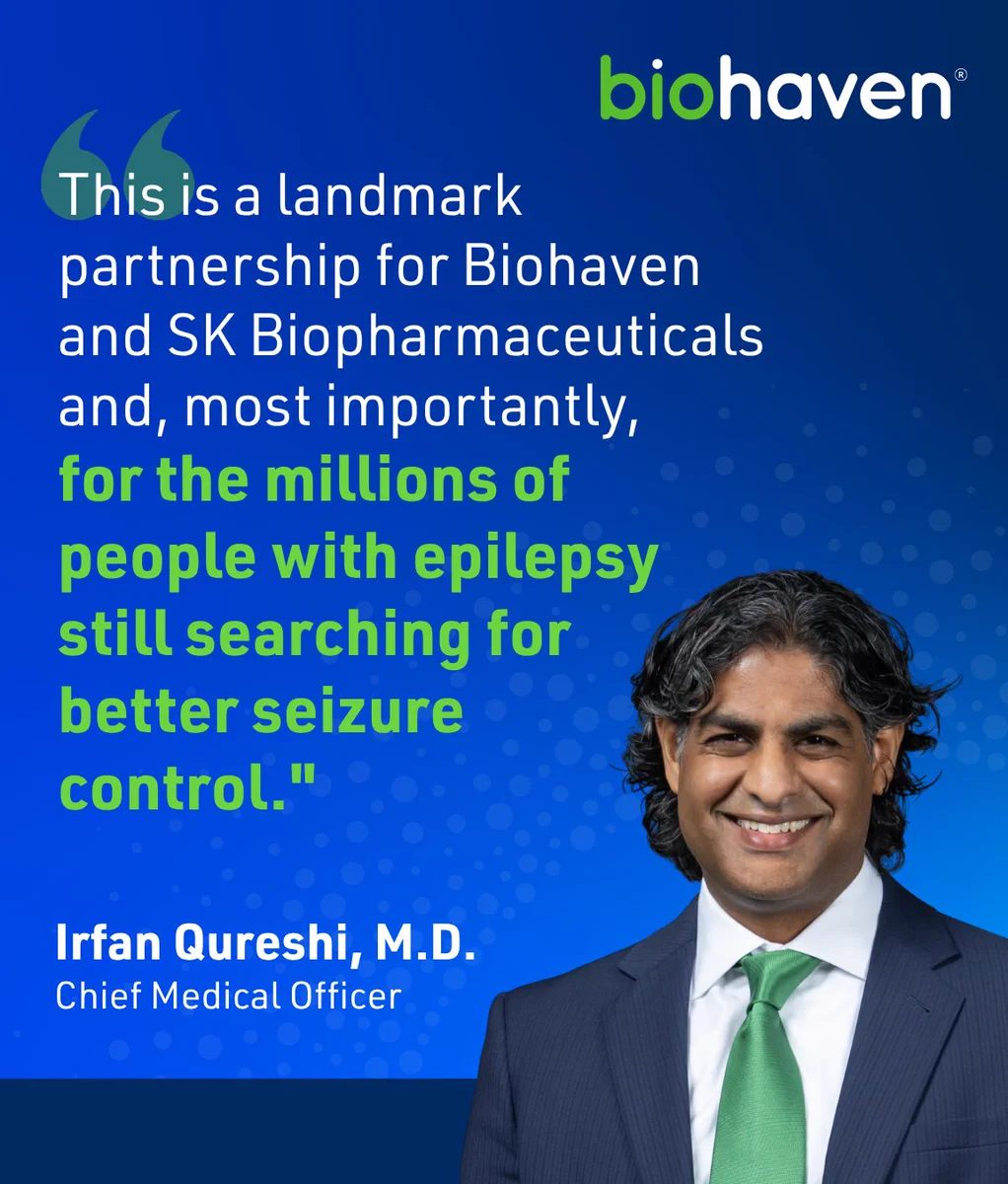
Biohaven on X: "Today, we announced a strategic global licensing and collaboration agreement with SK Biopharmaceuticals, the parent company of @SKLifeScience, focused on advancing our Kv7 platform and opakalim, our lead candidate
Biohaven Pharmaceutical Holding Company Ltd | Reuters
2.6K views
1:41
SK Biopharmaceuticals Bets 1.1 Trillion Won to Secure Next- ...
서울경제TV
3.8K views
7:08
Biohaven Pharma CEO: We're looking to end 30-year drought ...
CNBC Television
6.4K views
41:43
12 Massive Pharma Updates // BIOptimizers
Countess of Shopping
Images from Openverse under Creative Commons licenses. Videos from YouTube.
Voices
Curated perspectives — historical figures and your fellow readers.
Play
Exploring all sides of a story is often best achieved with Play.
Most of these play right now — no account needed. Sign up to save scores, keep a streak, and unlock Debate and Predict.
Log in
Sign Up
Higher or Lower
A number from this story, against one from elsewhere in the news — guess which is bigger, then keep the chain going. 5 rounds, 3 strikes; a miss costs a strike and resets your streak.
Example
Anchor
EU tariff revenue
$52B
Big for this kind of number
Mystery
Pentagon AI contract
?
Round 1
Streak: 0
Mystery
?
Keyboard: ↓/L lower · ↑/H higher
0 pts
Best streak: 0 · Rounds: 0
0 points — sign up to put that on the leaderboard.
Now try on this story
Connections
Sixteen names from the news. Find the four hidden groups of four. Four mistakes max.
Loading today's puzzle…
0/4 groups
Mistakes
Sign up to keep a daily streak — a new puzzle lands every day.
Now try on this story
Exit debate?
Your progress in this debate will be lost.
How it works
- 1 Two AI personas square off on this story.
- 2 You predict who'll win each round — correct picks earn XP.
- 3 One crossfire question is yours to fire. Pick it carefully.
Couldn't generate a topic
Select Your Champions
Choose one persona for each side of the debate
DEBATE TOPIC
Choose personas with different perspectives for a more dynamic debate.
SIDE A (PRO)
Select debater for this side:
No debate personas available right now.
SIDE B (CON)
Select debater for this side:
No debate personas available right now.
VS
Get ready to make your prediction...
Round of
Claim
Evidence
Stakes
Crossfire Answer
Closing Statement
Claim
Evidence
Stakes
Crossfire Answer
Closing Statement
Your Crossfire Question
Generating arguments...
Who's Got This Round?
Make your prediction before the referee scores
The referee scores both sides on
Correct predictions earn +20 XP
· Press 1 or 2 to pick
Evidence
40%
Logic
30%
Detail
20%
Style
10%
Round Results
Your Pick
Not this time
(%)
Overall Score
/10
Your Pick
Not this time
(%)
Overall Score
/10
Set the Crossfire
Pick the question both personas must answer in the final round
Crafting crossfire questions...
Choosing a question earns +10 XP crossfire bonus
🏆
Total XP Earned
Cred Change
Predictions
Debate Oracle! You called every round!
Sharp Instincts! You know your debaters!
The Coin Flip Strategist! Perfectly balanced!
The Contrarian! Bold predictions!
Inverse Genius! Try betting the opposite next time!
XP Breakdown
Base completion
+20 XP
Rounds played ( rounds x 5 XP)
+ XP
Correct predictions ( correct x 20 XP)
+ XP
Crossfire bonus
+10 XP
Accuracy
%
Prediction History
Round
You picked:
✓
✗
Now try on this story
Keep debating to level up your credibility and unlock achievements
Organizations Involved
Biohaven
Public biotech (NYSE: BHVN)
Sponsor of BHV-7000 trials;under partial FDA hold
Neuroscience biotech developing opakalim (BHV-7000) for refractory focal epilepsy and other Kv7-targeting compoundshan.
SK Biopharmaceuticals
South Korean pharma (KRX: 326030)
Worldwide licensee of Biohaven's Kv7 platform;deal not yet closed as of hold date
Acquired exclusive worldwide rights to the Kv7 ion channel platform, including BHV-7000, nine days before FDA room.
U.S. Food and Drug Administration
Federal regulatory agency
Partial clinical hold in effect since Sept 4, 2026
Paused new enrollment in BHV-7000 trials requesting more nonclinical data ona rodent metabolite before proceeding.
Timeline
January 2024 September 2026
6 events
Latest: Today
Tap a bar to jump to that date
-
Biohaven discloses hold;shares sink, timelines split
Today MarketSEC filing and Reuters report;stock drops 13%+ premarket. RISE 3 unaffected, but RISE 2 enrollment stays paused, delaying its readout.
-
FDA issues partial clinical hold
RegulatoryAgency pauses new enrollment citing insufficient info on a rodent metabolite's potential human risk.Biohaven extends pause globally.
-
Biohaven licenses Kv7 platform to SK Biopharmaceuticals
CommercialSK gets worldwide rights including BHV-7000, valued at up to $795 million in upfront and milestones.
-
RISE 3 fully enrolled
ClinicalEnrollment completes in BHV7000-303,one of two pivotal trials,robo-pulsing dosing continues.
-
Troriluzole rejection forces R&D cuts
RegulatoryFDA turns away Biohaven's ataxia drug, prompting a 60% budget slash and a near-half stock collapse.
-
Biohaven clears FDA phase-2 gate
RegulatoryCompletes end-of-phase-2 meeting;advances BHV-7000 into two pivotal phase-3 focal epilepsy trials.
Historical Context
2 moments from history that rhyme with this story — and how they unfolded.
February 2017 – March 2019
Sage Therapeutics' brexanolone (2017–2019)
Sage's postpartum-depression drug brexanolone hit an FDA clinical hold over a metabolite question yet despite initial data, the agency eventually approved it—two years later—after resubmission with additional safety analyses.
Then
A two-year delay and added trial costs pushed Sage deep intoins the red, forcing equity raises.
Now
The drug reached market on the strength of the original efficacy data, but its launch stalled on reimbursement and route-of-administration issues;Sage later restructured around newer CNS assets.
Why this matters now
Shows unmetabolite-relatedholds can resolve without killing a drug—but they still cost years and large sums, which is exactly what BHV-7000's partners hope to avoid.
June 2019 – May 2020
Intercept Pharmaceuticals' Ocaliva (2019–2020)
FDA issued a complete-response letter then a clinical hold on Intercept's NASH drug obeticholic acid over a drug-induced liver-injury signal,and subsequent data failed to win approval, eventuallydooming the program.
Then
Intercept's shares lost roughly 80% of value within a year,and the company abandonedthe NASH indication.
Now
The case became a cautionary tale about how regulator-requested safety analyses, whenunfavorable, can torpedo even late-stage programs.
Why this matters now
Contrast scenario:if Biohaven's rodent-metabolite data come back inconclusive or worse, a similar fate awaits—making the upcoming nonclinical results existential,not a formality.
Sources
(11)Related Stories
uniQure files Huntington's gene therapy for FDA and UK approval
New Capabilities
Updated 6 days ago
First drug engineered to cross the blood-brain barrier wins FDA approval
New Capabilities
Updated May 30
The BTK inhibitor race for multiple sclerosis
New Capabilities
Updated May 16
First Lyme disease vaccine in two decades edges toward approval after Phase 3 trial
New Capabilities
Updated Aug 15
FDA approves Gilead's Bixlenvo, a single-tablet option for HIV patients on complex regimens
New Capabilities
Updated Aug 27
Novartis\' $12B del-desiran flops in crucial phase 3 trial
Money Moves
Updated 2 days ago