





uniQure files Huntington's gene therapy for FDA and UK approval
New CapabilitiesAMT-130 seeks accelerated US approval after the FDA reversed its position on the trial data
2 days ago: uniQure files for FDA and UK approvalNew here? Follow stories to track developments over time. Create a free account to get updates when stories you care about change.
Overview
Updated 1 hour agouniQure filed its Huntington's disease gene therapy, called AMT-130, for approval in the United States and the United Kingdom on September 2, 2026. If approved, it would be the first disease-modifying treatment for a disease that today has none.
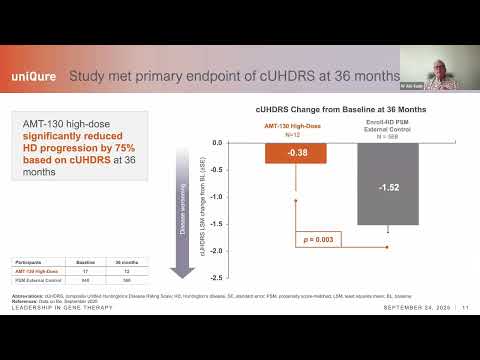
The filing follows a sharp FDA reversal. Early in 2026 the agency said the trial data were insufficient; in June it accepted the same data as the primary evidence for accelerated approval. A decision could come within eight months if priority review is granted.
Why it matters
Approval would give Huntington's patients the first therapy that slows the disease, which today has no disease-modifying treatment.
Questions about this story
Free account needed to ask — your question is kept and asked for you right after sign-up. Answers are public.
No questions yet — be the first to ask.
Key Indicators
Voices
Curated perspectives — historical figures and your fellow readers.
Play
Exploring all sides of a story is often best achieved with Play.
Higher or Lower
A number from this story, against one from elsewhere in the news — guess which is bigger, then keep the chain going. 5 rounds, 3 strikes; a miss costs a strike and resets your streak.
Keyboard: ↓/L lower · ↑/H higher
0 points — sign up to put that on the leaderboard.
Connections
Sixteen names from the news. Find the four hidden groups of four. Four mistakes max.
Sign up to keep a daily streak — a new puzzle lands every day.
Exit debate?
Your progress in this debate will be lost.
- 1 Two AI personas square off on this story.
- 2 You predict who'll win each round — correct picks earn XP.
- 3 One crossfire question is yours to fire. Pick it carefully.
Couldn't generate a topic
Select Your Champions
Choose one persona for each side of the debate
DEBATE TOPIC
Choose personas with different perspectives for a more dynamic debate.
Select debater for this side:
No debate personas available right now.
Select debater for this side:
No debate personas available right now.
Who's Got This Round?
Make your prediction before the referee scores
The referee scores both sides on
Round Results
Set the Crossfire
Pick the question both personas must answer in the final round
Debate Oracle! You called every round!
Sharp Instincts! You know your debaters!
The Coin Flip Strategist! Perfectly balanced!
The Contrarian! Bold predictions!
Inverse Genius! Try betting the opposite next time!
XP Breakdown
Prediction History
People Involved
Organizations Involved
Amsterdam-based gene therapy company with US operations in Lexington, Massachusetts.
The US agency that decides whether new drugs and biologics can be marketed.
The UK regulator for medicines, medical devices, and blood products.
Timeline
June 2026 November 2026
-
FDA filing decision expected
Upcoming RegulatoryFDA has 60 days from submission to decide whether to accept the filing for review.
-
Four-year data presentation expected
Upcoming Data releaseuniQure to present four-year results from Phase I/II studies before quarter's end.
-
uniQure files for FDA and UK approval
Latest RegulatoryCompany filed for accelerated US approval and UK approval, requesting priority review.
-
FDA reverses course on AMT-130 data
RegulatoryFDA accepts three-year Phase I/II data as basis for accelerated-approval filing.
Historical Context
3 moments from history that rhyme with this story — and how they unfolded.
Glybera, Europe's first gene therapy (2012)
uniQure, then Amsterdam Molecular Therapeutics, won European approval for Glybera, a gene therapy for the rare fat-metabolism disorder lipoprotein lipase deficiency. The one-time treatment carried a list price over $1 million.
Only a small number of patients were ever treated, and the drug was withdrawn from the market in 2017.
Showed that a gene therapy could be approved yet fail commercially if the patient pool is tiny and reimbursement is never secured.
AMT-130 is another one-time, high-cost gene therapy for a small patient population. Approval would not resolve the access and coverage hurdles that sank Glybera.
Zolgensma approval (2019)
The FDA approved Novartis's Zolgensma, a one-time gene therapy for spinal muscular atrophy, with a list price near $2.1 million. It became the first gene therapy for a neurological disease to reach the US market.
Zolgensma saw rapid adoption but also years of reimbursement disputes and installment payment plans.
Set the precedent that regulators would approve ultra-expensive, one-time gene therapies for rare neurological conditions.
AMT-130 follows the Zolgensma template: a single administration, a high price, and reliance on specialized treatment centers and a long reimbursement tail.
Roche's tominersen trial halted (2021)
Roche's tominersen, an antisense drug designed to lower huntingtin protein, was the leading disease-modifying candidate for Huntington's. The Phase 3 trial was halted in March 2021 after the higher-dose arm showed worsening outcomes.
Roche scaled back the program; the setback shifted attention to other modalities, including gene therapy.
Demonstrated how difficult it is to prove a therapy modifies Huntington's in a standard randomized trial.
AMT-130 aims at the same target, huntingtin, but delivers gene silencing once through neurosurgery instead of repeated spinal injections.
