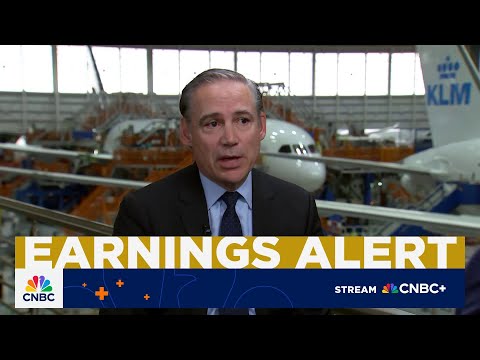
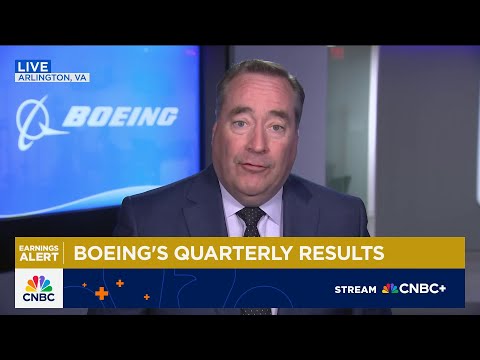
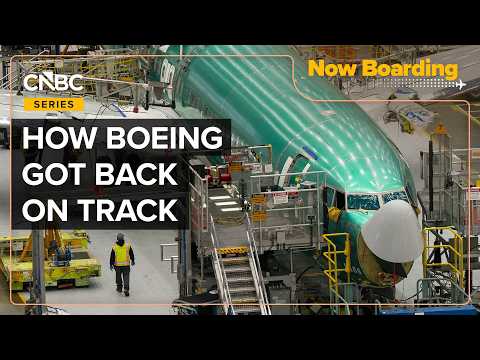
Boeing has burned cash every year since 2018. On Wednesday it reported a first-quarter adjusted loss of 20 cents per share — four times smaller than Wall Street's expected 83-cent loss — with $22.22 billion in revenue. CEO Kelly Ortberg told investors the company sees a path to roughly $3 billion in free cash flow for the full year.
If Boeing hits that target, it would be the first meaningful positive cash generation since the 737 MAX was grounded after two fatal crashes in 2018 and 2019. The intervening years piled on a pandemic, a door plug that tore off an Alaska Airlines 737 at 14,830 feet in January 2024, and a 54-day machinists strike. Then came an FAA production cap and a $20 billion emergency share sale. Shares rose more than 4 percent on the results.
Why it matters
Boeing is one of only two large-jet makers on Earth. If its recovery holds, airline capacity, U.S. manufacturing jobs, and roughly $700 billion in order backlog move with it.
Questions about this story
Free account needed to ask — your question is kept and asked for you right after sign-up. Answers are public.
No questions yet — be the first to ask.
Key Indicators
-$0.20
Q1 2026 adjusted EPS
Loss per share, versus the 83-cent loss Wall Street analysts had modeled.
$22.2B
Q1 2026 revenue
Up roughly 14% year-on-year and ahead of the $21.78 billion consensus estimate.
$1–3B
2026 free cash flow guidance
First full-year positive FCF guidance since the 737 MAX crisis began.
143
Q1 commercial deliveries
Beat Airbus's 114 — Boeing's first quarterly delivery win since around 2019.
42/mo
737 MAX production rate
Current build rate, with a stated ramp to 47 per month by mid-2026.
~7 yrs
Consecutive cash-burn years
Boeing last generated meaningful positive free cash flow in 2018.
14 events
Latest: April 22nd, 2026 · 6 months ago
Showing 8 of 14
JK to step
Tap a bar to jump to that date
Jump to
April 2026
Q1 2026 earnings beat; $3B FCF path laid out
LatestEarnings
Boeing reports a 20-cent adjusted loss (vs. 83-cent loss expected) on $22.22 billion in revenue. Ortberg tells investors the company sees a path to roughly $3 billion in free cash flow in 2026. Shares rise more than 4 percent.
March 2026
FAA replaces production cap with performance-based oversight
Regulatory
The agency retires the numerical monthly cap in favor of rolling quality metrics, giving Boeing room to push past 42 per month on the 737 MAX.
January 2026
First positive annual operating cash flow since 2018
Financial
In Q4 2025 results, Boeing reports its first full year of positive operating cash flow since the MAX crisis began — a turning point even as core manufacturing losses persist.
December 2025
Spirit AeroSystems acquisition closes
M&A
Boeing completes its $8.3 billion reacquisition of Spirit, bringing fuselage manufacturing and roughly 15,000 workers back in-house.
October 2025
FAA raises 737 MAX cap to 42 per month
Regulatory
After Boeing demonstrates improved quality metrics, the FAA lifts the 38/month ceiling for the first time since the Alaska Airlines incident.
November 2024
Strike ends with 38% raise deal
Labor
Machinists ratify a four-year contract with 38% raises, a signing bonus, and higher 401(k) contributions. Production restarts in stages.
October 2024
Boeing raises $20+ billion in share sale
Financial
Facing an estimated $1 billion monthly strike burn, Boeing sells more than $20 billion in equity to shore up its balance sheet.
September 2024
Machinists strike begins
Labor
Roughly 33,000 IAM machinists walk off the job in the Puget Sound region, halting 737, 777, and 767 production.
July 2024
Kelly Ortberg named CEO
Leadership
Boeing's board taps the former Rockwell Collins chief to replace Dave Calhoun, effective August 8. The board signals it wants an engineering-focused outsider.
January 2024
FAA caps 737 MAX production at 38 per month
Regulatory
The agency freezes Boeing's 737 MAX output at the rate it was running during the blowout and orders a quality overhaul.
Alaska Airlines door plug blows out at 14,830 feet
Safety Incident
A left mid-exit door plug separates from Alaska Airlines Flight 1282, a 737 MAX 9, shortly after takeoff from Portland. All 177 on board survive; investigators find four bolts were never reinstalled at the factory.
November 2020
FAA clears 737 MAX to return to service
Regulatory
After software fixes and pilot training changes, the FAA lifts the grounding order. Airlines begin reintroducing the jet in late 2020.
March 2019
Ethiopian Airlines 302 crash; global grounding follows
Safety Incident
A second 737 MAX 8 crash kills 157 people. Regulators worldwide ground the MAX within days — Boeing's best-selling jet stays grounded for 20 months.
October 2018
Lion Air Flight 610 crashes
Safety Incident
A Boeing 737 MAX 8 operated by Lion Air crashes into the Java Sea shortly after takeoff, killing all 189 people on board. Investigators later link the crash to the MCAS flight-control software.
Scenarios
1
Boeing lands $2–3B in free cash flow, recovery narrative sticks
Boeing hits the middle-to-upper end of its $1–3B guidance as 737 MAX output climbs to 47 a month, 787 deliveries accelerate, and Spirit integration stays on budget. Positive full-year FCF reopens Boeing's access to investment-grade debt markets on better terms and validates Ortberg's stabilization strategy heading into the 737 MAX 10 certification push.
2
Boeing delivers only the low end — $1B or less — as Spirit integration drags
Possible
Discussed by: Manufacturing Dive, skeptical aerospace analysts noting the $1B negative 2026 cash impact from Spirit
Production hiccups, supplier bottlenecks, or slower-than-planned 787 rate increases keep Boeing at the bottom of its guide. The Spirit deal's $1B drag on 2026 cash flow swallows most of the operating gains. The turnaround narrative survives but analysts push their FCF ramp forecasts out by 6–12 months.
3
A new safety incident resets the recovery clock
Uncertain
Discussed by: NTSB officials, aviation safety researchers who view manufacturing fixes as incomplete
A quality escape — on the MAX, the 787, or a newly integrated Spirit line — triggers fresh FAA intervention, a delivery pause, or worse. Any such event would likely restore production caps, delay FCF targets, and reopen questions about whether the cultural fix is real. The NTSB's own 2025 final report flagged systemic, not one-off, failures.
4
737 MAX 10 certification delay caps the upside
Possible
Discussed by: The Motley Fool, AirInsight, analysts tracking the MAX 10 backlog
The longest MAX variant, still awaiting certification, anchors roughly a quarter of Boeing's single-aisle backlog. A 2026 certification slip would push deliveries and cash-on-handover payments into 2027, hold production ramps below target, and keep Boeing near the bottom of its FCF range even as quality metrics improve.
Historical Context
3 moments from history that rhyme with this story — and how they unfolded.
1 of 3
January–April 2013
Boeing 787 Dreamliner battery grounding (2013)
After lithium-ion battery fires on two 787s, the FAA grounded the entire Dreamliner fleet for three months — the first U.S. grounding of a type since 1979. Boeing redesigned the battery enclosure, and the jet returned to service in April 2013.
Then
Deliveries resumed within months; Boeing took charges but avoided major financial damage.
Now
The 787 became a profitable program, but the episode previewed the regulator-manufacturer dynamics that would define the 737 MAX crisis a few years later.
Why this matters now
Shows that Boeing has recovered from a grounded-flagship crisis before. The difference: the 787 fix was an engineering change; the MAX and door-plug crises exposed manufacturing-culture problems that take years of factory-floor work to resolve.
2 of 3
November 2009–early 2011
Toyota unintended acceleration crisis (2009–2010)
Toyota recalled more than 9 million vehicles over unintended acceleration complaints, paid a $1.2 billion U.S. criminal settlement in 2014, and watched its reputation for quality — its central brand promise — take the worst hit in its history.
Then
Sales dropped, executives made public apologies, and U.S. regulators imposed new oversight.
Now
Toyota regained market share within three years, reclaimed its global volume lead, and used the crisis to overhaul quality control — but the episode permanently changed how auto regulators treat electronic systems.
Why this matters now
A manufacturing giant can recover trust and margins after a quality-culture crisis, but only after years of visible, expensive fixes. Boeing's $3B FCF target is the financial mile-marker for a similar arc.
3 of 3
1972–1979
McDonnell Douglas DC-10 cargo-door crisis (1972–1979)
A design flaw in the DC-10's cargo door caused a near-catastrophe over Windsor, Ontario in 1972 and then the Turkish Airlines Flight 981 crash near Paris in 1974, killing 346. Later, the 1979 American Airlines Flight 191 crash in Chicago — unrelated but on the same type — grounded the DC-10 and badly damaged McDonnell Douglas's commercial franchise.
Then
DC-10 sales collapsed; McDonnell Douglas absorbed major losses.
Now
The company never recovered its commercial momentum; it merged with Boeing in 1997 and effectively disappeared as an independent jetmaker.
Why this matters now
The cautionary parallel — a planemaker whose manufacturing reputation failed to recover in time. Boeing's bet under Ortberg is that decisive operational reset, rather than slow erosion, puts it closer to the Toyota arc than the McDonnell Douglas one.