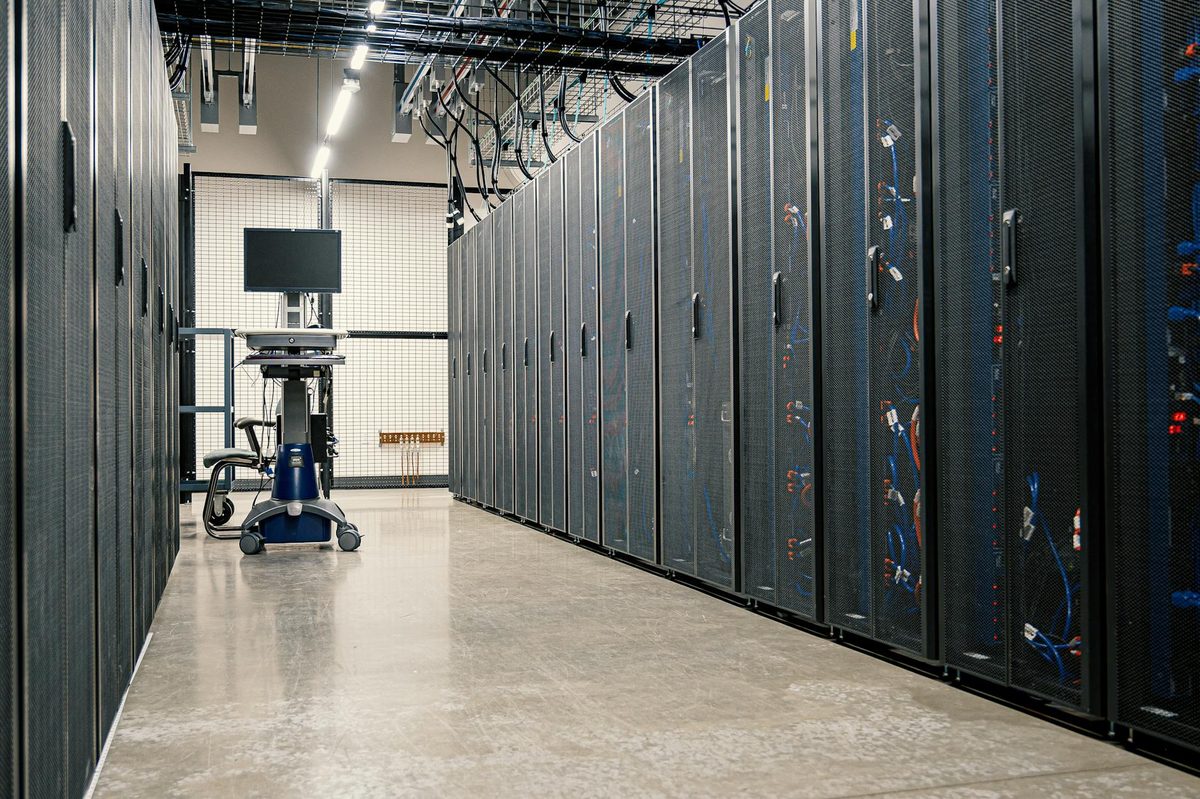
Four months ago, Sam Altman told the world OpenAI had $1.4 trillion in data center commitments. Now the company is telling investors the real number is $600 billion — and that it would rather rent computing power than build its own facilities. The retreat, disclosed to investors in February 2026 and detailed publicly on March 22, marks the sharpest pivot in the short history of the artificial intelligence spending boom.
The shift matters. OpenAI is preparing to go public as early as late 2026 at a valuation near $1 trillion while projecting $14 billion in losses this year and no profit until 2029 at the earliest. Wall Street is forcing the company to answer a question it has avoided for years: can it turn the most expensive technology bet in history into a business that actually makes money?
Why it matters
The largest AI company just admitted its original infrastructure plan was unsustainable.
Questions about this story
Free account needed to ask — your question is kept and asked for you right after sign-up. Answers are public.
No questions yet — be the first to ask.
Key Indicators
$600B
Revised compute spending target by 2030
Down from the $1.4 trillion Sam Altman disclosed in November 2025 — a 57% reduction.
$14B
Projected 2026 losses
Nearly triple the roughly $5 billion OpenAI lost in 2025. Profitability not expected until 2029 or 2030.
$730B
Pre-money valuation
Set in the $110 billion February 2026 funding round led by Amazon, NVIDIA, and SoftBank.
236%
2025 revenue growth
Revenue grew from $3.7 billion in 2024 to roughly $13 billion in 2025, reaching $20 billion in annualized run rate.
$168B
Total funding raised
Across 11 rounds from 68 investors, making OpenAI the most heavily funded private company in history.
Images from Openverse under Creative Commons licenses.
Videos from YouTube.
Voices
Curated perspectives — historical figures and your fellow readers.
Oscar Wilde
(1854-1900) ·Victorian · wit
Fictional AI pastiche — not real quote.
"How delightfully American — to promise the world a cathedral and deliver merely a very expensive tent, then call it prudence. One trillion in valuation, not a penny in profit: Wall Street has at last discovered what every artist has always known, that the most magnificent ambitions are best appreciated before they must be paid for."
0% found this insightful
Dorothy Parker
(1893-1967) ·Jazz Age · wit
Fictional AI pastiche — not real quote.
"They've discovered that the distance between a trillion-dollar vision and a billion-dollar reality is measured entirely in the time it takes Wall Street to ask a single, unforgivable question: *how?*"
0% found this insightful
Ever wondered what historical figures would say about today's headlines?
Sign up to generate historical perspectives on this story.
12 events
Latest: March 22nd, 2026 · 7 months ago
Showing 8 of 12
JK to step
Tap a bar to jump to that date
Jump to
March 2026
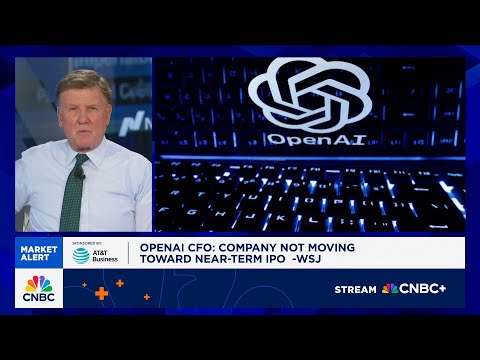
CNBC details the full scope of OpenAI's infrastructure retreat
LatestAnalysis
CNBC reported that OpenAI had shifted from building its own data centers to purchasing cloud capacity, reorganizing its infrastructure teams and embracing an asset-light model ahead of a potential late-2026 initial public offering.
Microsoft considers legal action over Amazon deal
Legal
Reports surfaced that Microsoft was exploring legal action over the $50 billion Amazon-OpenAI deal, which potentially conflicts with Microsoft's existing partnership agreements.
Stargate Abilene expansion canceled
Infrastructure
Bloomberg reported that Oracle and OpenAI dropped plans to expand the flagship Abilene campus from 1.2 to 2.0 gigawatts after negotiations broke down. Reliability issues at operator Crusoe Energy contributed to the decision.
February 2026
$110 billion funding round closes
Funding
OpenAI raised $110 billion at a $730 billion pre-money valuation. Amazon invested $50 billion (with $35 billion contingent on IPO or artificial general intelligence milestone), NVIDIA $30 billion as equity, and SoftBank $30 billion.
OpenAI resets spending target to $600 billion
Financial
OpenAI told investors it was now targeting roughly $600 billion in total compute spending by 2030 — less than half the $1.4 trillion figure Altman had promoted three months earlier.
January 2026
NVIDIA $100 billion deal stalls
Deal Collapse
The Wall Street Journal reported that NVIDIA had put its $100 billion deployment deal with OpenAI on ice. NVIDIA privately expressed doubts about OpenAI's business model and spending discipline.
November 2025
Financial documents reveal losses through 2028
Financial
Fortune reported that internal financial documents showed OpenAI expecting annual losses through at least 2028, with profitability not arriving until 2029 or 2030.
Altman discloses $1.4 trillion in commitments
Statement
Altman posted publicly that OpenAI had roughly $1.4 trillion in data center commitments over the next eight years, equaling about 30 gigawatts of capacity, alongside $20 billion in annualized revenue.
October 2025
Altman targets $1 trillion per year in infrastructure
Statement
In an Axios interview, Altman said OpenAI wanted to reach $1 trillion in annual infrastructure spending, a figure that would exceed the gross domestic product of most countries.
September 2025
First Stargate campus goes live; NVIDIA $100B deal announced
Infrastructure
The flagship Abilene, Texas campus reached 1.2 gigawatts of capacity. Simultaneously, OpenAI and NVIDIA announced a $100 billion deal to deploy 10 gigawatts of NVIDIA systems.
March 2025
SoftBank leads $40 billion funding round
Funding
OpenAI closed the largest private fundraise in history at a $300 billion valuation. SoftBank committed $30 billion, with the remainder from Microsoft, Coatue, and others.
January 2025
Stargate announced at the White House
Announcement
President Trump unveiled the Stargate joint venture alongside Altman, Larry Ellison of Oracle, and Masayoshi Son of SoftBank, promising up to $500 billion in American AI infrastructure by 2029.
Scenarios
1
OpenAI goes public in late 2026, valuation holds near $1 trillion
Possible
Discussed by: Fortune, Sacra, multiple Wall Street analysts covering the AI sector
If revenue continues growing at triple-digit rates and the broader market remains receptive to AI companies, OpenAI could price an initial public offering in the fourth quarter of 2026. The spending reset to $600 billion and asset-light cloud strategy would be framed as fiscal maturity. The IPO would provide liquidity for employees and early investors while funding the gap years before profitability. This path requires continued revenue acceleration from the Frontier enterprise platform and ChatGPT's consumer business.
2
IPO delayed to 2027 or later as losses mount and competition intensifies
Possible
Discussed by: Tomasz Tunguz of Theory Ventures, Fortune's economics team, The Information
Anthropic's Claude has already overtaken ChatGPT as the most-downloaded AI app in the United States and captures 73% of first-time enterprise AI spending. If OpenAI's revenue growth decelerates or losses widen beyond the projected $14 billion, the company may be forced to delay going public. Chief Financial Officer Sarah Friar has already hedged the timeline to include 2027. A delay would increase pressure on the $730 billion valuation and could trigger repricing in the next private round.
3
Spending cuts trigger a broader pullback in AI infrastructure investment
If the company that defined the AI infrastructure boom is cutting its plans by 57%, others may follow. Big Tech firms are collectively spending $635-665 billion on capital expenditure in 2026, with roughly 75% directed at AI. DeepSeek's demonstration that comparable AI capabilities can be achieved at 90-95% lower cost has already shaken confidence in the scaling thesis. A cascade of spending reductions could deflate AI-related asset prices — though it could also make the underlying technology more economically sustainable.
4
Microsoft-OpenAI partnership fractures over Amazon deal
Microsoft did not participate in the February 2026 funding round and is reportedly considering legal action over the $50 billion Amazon deal. Microsoft retains a 27% ownership stake worth roughly $135 billion, but OpenAI's shift to multi-cloud computing — including a $100 billion, eight-year Amazon Web Services contract — directly competes with Microsoft's Azure business. If the partnership formally ruptures, it could destabilize both companies' AI strategies and force OpenAI to renegotiate billions in existing Azure commitments.
Historical Context
3 moments from history that rhyme with this story — and how they unfolded.
1 of 3
1996-2002
Telecom infrastructure bubble (1996-2002)
Telecommunications companies spent more than $500 billion laying fiber optic cable across the United States and under the oceans, betting that internet traffic would grow exponentially. WorldCom accumulated $100 billion in debt and Global Crossing $25 billion. When the bubble burst, network utilization stood at roughly 20% of installed capacity.
Then
WorldCom and Global Crossing filed for bankruptcy. The telecom sector lost more than $2 trillion in market value between 2000 and 2002, and hundreds of thousands of workers lost their jobs.
Now
The infrastructure eventually proved useful — utilization reached 30% by 2010 and continues growing today — but the original investors were largely wiped out. The companies that profited were those that bought distressed fiber assets cheaply after the crash.
Why this matters now
Big Tech's AI capital expenditure as a share of earnings before interest, taxes, depreciation, and amortization now runs at 50-70%, comparable to AT&T's 72% at the peak of the telecom bubble. OpenAI's decision to cut spending rather than build could be read either as prudent correction or as an early signal that the AI infrastructure boom is overextended.
2 of 3
August-September 2019
WeWork's pre-IPO valuation collapse (2019)
WeWork, a coworking-space company, filed for an initial public offering at a $47 billion valuation after raising $12.8 billion in private funding from SoftBank and others. The prospectus revealed $1.9 billion in losses on $1.8 billion in revenue, a business model that amounted to signing long-term leases and renting desks short-term, and extensive self-dealing by founder Adam Neumann.
Then
The IPO was pulled within six weeks. Neumann was removed as chief executive. The valuation collapsed to $8 billion by the time WeWork eventually went public via a special purpose acquisition company in 2021.
Now
The episode made investors far more skeptical of private valuations disconnected from financial fundamentals. SoftBank's Masayoshi Son — now OpenAI's largest investor — personally absorbed billions in losses and publicly called it his worst investment decision.
Why this matters now
OpenAI's spending reset echoes the pre-IPO discipline companies adopt when they realize public-market investors will not accept the same narratives as private-market backers. The involvement of Son, who learned this lesson with WeWork, adds a direct through-line. The question is whether $600 billion in planned spending and $14 billion in annual losses will pass the same scrutiny that destroyed WeWork's $47 billion valuation.
3 of 3
May 1997 - January 2003
Amazon's long march to profitability (1997-2003)
Amazon went public in May 1997 and did not report its first profitable quarter until January 2002. The company lost $1.4 billion in 2000 alone and saw its stock drop 95% from its dot-com peak. Founder Jeff Bezos consistently argued that investing in infrastructure and market share would eventually generate returns that justified years of losses.
Then
Amazon nearly went bankrupt. Lehman Brothers analyst Ravi Suria published a widely cited report in 2000 arguing the company would run out of cash. Bond prices reflected serious default risk.
Now
Bezos was right. Amazon's infrastructure investments, particularly Amazon Web Services, created a dominant competitive position. The company is now worth over $2 trillion and AWS alone generates more than $100 billion in annual revenue.
Why this matters now
OpenAI's bull case rests on the same logic: invest heavily now, dominate later. But Amazon's total losses before profitability were roughly $3 billion — OpenAI projects $14 billion in losses in 2026 alone, with cumulative losses potentially reaching $115 billion by 2029. The scale of the bet is categorically different, even if the strategic logic is similar.