


Pull to refresh
Logo
Daily Brief
Following
Why
Race to replace injections for childhood dwarfism

Race to replace injections for childhood dwarfism

New Capabilities
By Newzino Staff |

BridgeBio's Oral Therapy Challenges the Only Approved Treatment for Achondroplasia

February 12th, 2026: BridgeBio Reports Positive Phase 3 Results

Overview

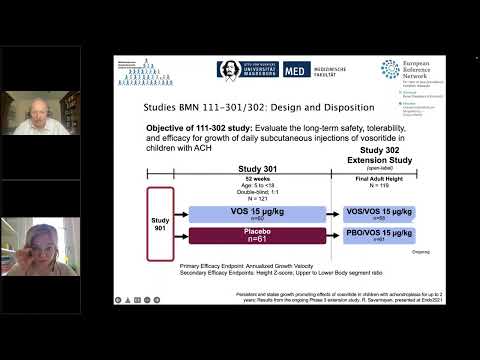
For the estimated 250,000 people worldwide living with achondroplasia—the most common genetic cause of dwarfism—the only approved treatment has required daily injections. On February 12, 2026, BridgeBio reported that its oral pill achieved a 2.10 cm/year increase in height growth over placebo in a Phase 3 trial, exceeding the 1.57 cm/year gain shown by BioMarin's injectable Voxzogo and marking the first statistically significant improvement in body proportionality ever demonstrated for this condition.

The stakes extend beyond convenience. Voxzogo generated $735 million in sales in 2024, with projected 2025 revenue approaching $900 million—a market now facing disruption from an oral alternative that children may actually take consistently. BridgeBio plans to file for approval in the second half of 2026, potentially offering families a daily pill instead of a daily needle.

Key Indicators

2.10 cm/yr
Height gain vs placebo
BridgeBio's infigratinib outperformed the 1.57 cm/year shown by Voxzogo in its pivotal trial
1 in 21,000
Birth prevalence
Approximately 250,000 people worldwide live with achondroplasia
$735M
Voxzogo 2024 sales
BioMarin's injectable has rapidly grown since 2021 approval, with ~$900M projected for 2025
0%
Serious adverse events
No discontinuations or serious drug-related adverse events in BridgeBio's Phase 3 trial

Interactive

Exploring all sides of a story is often best achieved with Play.

Ever wondered what historical figures would say about today's headlines?

Sign up to generate historical perspectives on this story.

Sign Up

Debate Arena

Two rounds, two personas, one winner. You set the crossfire.

People Involved

Neil Kumar, Ph.D.
Neil Kumar, Ph.D.
Co-Founder and CEO, BridgeBio Pharma (Leading company through pivotal achondroplasia data readout)

Organizations Involved

BridgeBio Pharma
BridgeBio Pharma
Biopharmaceutical Company
Status: Lead developer of oral achondroplasia treatment

BridgeBio develops therapies for genetic diseases through a network of subsidiary companies, with QED Therapeutics handling its FGFR inhibitor programs.

BioMarin Pharmaceutical
Biopharmaceutical Company
Status: Market leader with only approved achondroplasia treatment

BioMarin developed Voxzogo (vosoritide), the first FDA-approved treatment for achondroplasia, now generating over $700 million in annual revenue.

Ascendis Pharma
Ascendis Pharma
Biopharmaceutical Company
Status: Awaiting FDA decision on once-weekly injection

Ascendis developed TransCon CNP (navepegritide), a once-weekly injection for achondroplasia awaiting FDA decision by February 28, 2026.

U.S. Food and Drug Administration
Federal Regulatory Agency
Status: Reviewing multiple achondroplasia treatments

The FDA approved the first achondroplasia treatment in 2021 and is now reviewing competitors while evaluating BridgeBio's planned submission.

Timeline

  1. BridgeBio Reports Positive Phase 3 Results

    Clinical

    BridgeBio announces PROPEL 3 Phase 3 trial met primary endpoint with 2.10 cm/year height gain versus placebo and achieved first statistically significant improvement in body proportionality for achondroplasia.

  2. FDA Delays Ascendis Decision

    Regulatory

    FDA extends review period for Ascendis's TransCon CNP by three months to February 28, 2026, citing a major amendment to the application.

  3. Phase 2 Results Published in NEJM

    Publication

    New England Journal of Medicine publishes BridgeBio's Phase 2 PROPEL 2 study results for infigratinib in achondroplasia.

  4. FDA Grants Breakthrough Therapy Designation

    Regulatory

    FDA designates BridgeBio's oral infigratinib as a Breakthrough Therapy for achondroplasia, potentially expediting review.

  5. BridgeBio Reports Durable Phase 2 Results

    Clinical

    BridgeBio announces 12- and 18-month data from PROPEL 2 Phase 2 trial showing sustained 2.5 cm/year height gains with infigratinib.

  6. BridgeBio Signs $100M Japan Deal

    Business

    BridgeBio's QED Therapeutics licenses infigratinib rights in Japan to Kyowa Kirin for $100 million upfront plus potential milestones.

  7. Voxzogo Expanded to All Ages

    Regulatory

    FDA approves supplemental application expanding Voxzogo to children of all ages with achondroplasia and open growth plates.

  8. FDA Approves First Achondroplasia Treatment

    Regulatory

    BioMarin's Voxzogo (vosoritide) receives accelerated FDA approval for children aged 5 and older with open growth plates, becoming the first drug approved to treat the genetic condition.

Scenarios

1

Infigratinib Approved, Reshapes Market

Discussed by: Raymond James analysts, Fierce Biotech, BioPharma Dive

BridgeBio files for FDA approval in late 2026 and receives clearance in 2027. The oral formulation captures significant market share, particularly among families who struggled with daily injections. Voxzogo sales plateau while the achondroplasia market expands as more families choose treatment. BioMarin accelerates development of its long-acting weekly injection to compete on convenience.

2

Three-Way Competition Emerges

Discussed by: BioSpace, industry analysts

Ascendis receives FDA approval for TransCon CNP in February 2026, creating a three-way market alongside Voxzogo and an eventually approved infigratinib. Physicians segment patients by preference: daily injection for those comfortable with current regimen, weekly injection for those wanting fewer shots, and oral for those seeking maximum convenience. Market expands significantly as treatment uptake increases.

3

Regulatory Delays Extend Voxzogo Dominance

Discussed by: Bernstein analysts, competitive dynamics observers

FDA requests additional data from BridgeBio, delaying approval into 2028. Ascendis faces similar regulatory challenges. BioMarin maintains market leadership and advances BMN 333 into Phase 3, potentially offering a weekly alternative before oral competition arrives. The daily injection remains standard of care longer than expected.

4

Long-Term Safety Concerns Emerge

Discussed by: Medical literature, FDA safety reviews

Post-marketing surveillance or longer-term trial data reveals unexpected safety signals with one or more therapies targeting FGFR3 or CNP pathways. This could affect any competitor, potentially reshaping the market based on which approaches demonstrate the cleanest long-term profile. Physicians become more selective about which patients receive pharmacological treatment.

Historical Context

Growth Hormone for Turner Syndrome (1997)

1997

What Happened

The FDA approved growth hormone treatment for Turner syndrome, a chromosomal condition causing short stature in girls. The approval established a precedent for pharmacological intervention in genetic growth disorders, though treatment required daily injections for years.

Outcome

Short Term

Treatment became standard of care for Turner syndrome, with most affected children receiving growth hormone therapy.

Long Term

Demonstrated that chronic injection therapy could be successfully adopted in pediatric populations, paving the way for Voxzogo's approach two decades later.

Why It's Relevant Today

Voxzogo's approval followed a similar regulatory path, and the Turner syndrome experience showed that families will accept daily injections for growth benefits—but also highlighted the opportunity for less burdensome alternatives.

Hepatitis C Oral Therapy Revolution (2013-2014)

December 2013 - October 2014

What Happened

Gilead's Sovaldi and Harvoni replaced interferon injections with oral pills for hepatitis C treatment. The shift from injectable regimens with severe side effects to well-tolerated oral pills transformed treatment uptake and cure rates.

Outcome

Short Term

Cure rates exceeded 95% as patients completed oral regimens they had previously abandoned due to injection burden.

Long Term

Hepatitis C became a curable disease for most patients. The example demonstrated how oral alternatives can dramatically expand treatment adoption.

Why It's Relevant Today

BridgeBio's oral infigratinib represents a similar shift from injection to pill. If approved, the convenience advantage could similarly expand treatment uptake among achondroplasia families who have declined or discontinued Voxzogo.

Limb Lengthening Surgery Era (1980s-Present)

1980s-present

What Happened

Before Voxzogo, the only intervention for achondroplasia height was limb lengthening surgery using distraction osteogenesis—a painful process involving cutting bones and gradually separating them over months. Patients underwent an average of 3-4 procedures to gain 10-15 cm of height.

Outcome

Short Term

Surgery provided meaningful height gains but with significant pain, complications, and years of recovery.

Long Term

Only about 19% of achondroplasia patients chose surgery, with nearly half uncertain whether to recommend it. The invasiveness created demand for pharmacological alternatives.

Why It's Relevant Today

Voxzogo's approval in 2021 marked the first non-surgical option. BridgeBio's oral therapy represents the next evolution—from surgery to injection to pill—potentially making treatment accessible to families who rejected both prior options.

8 Sources: