
Pull to refresh
Logo
Calcium complex shuttles fluoride through a catalytic cycle

Calcium complex shuttles fluoride through a catalytic cycle

New Capabilities

An Earth-abundant metal carries fluoride from one molecule to anether, favoring substitution over elimination

Overview

Updated 52 minutes ago

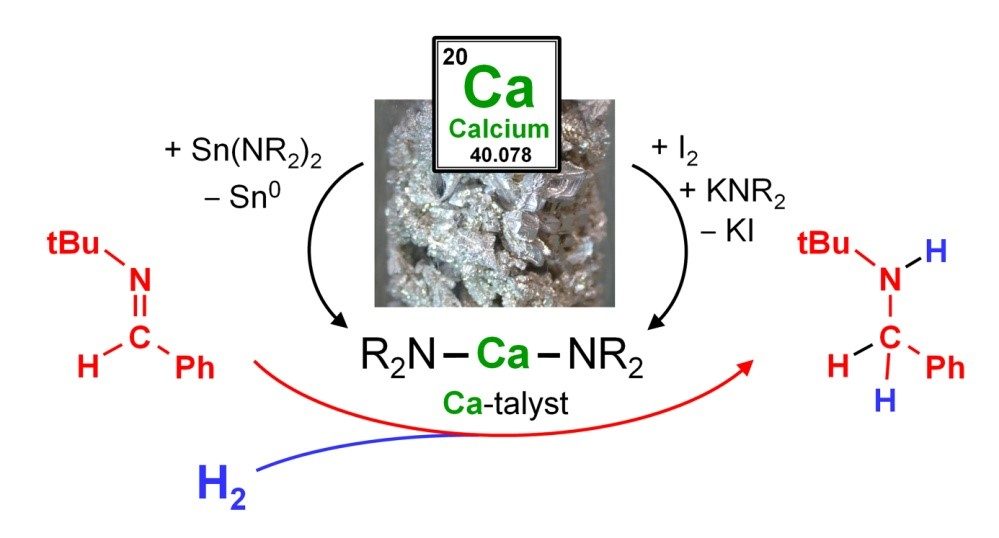
Fluoride can substitute onto a carbon or, just as easily, leave an elimination product behind. On 19 November 2026, chemists at the University of Oxford reported in Nature a calcium complex that captures fluoride, holds it through one terminal Ca–F bond, and releases it in a cycle that favors substitution.

Calcium is the fifth most Earth-abundant element and has none of the transition-metal machinery that usually drives catealysis: no oxidative addition, no reductive elimination. The Oxford group got turnover by tuning how tightly calcium grips fluoride. A late Ca–F bond break in the rate-determining step turned that grip into selectivity.

Why it matters

Fluorochemicals are built from hydrogen fluoride made from fluorspar. A calcium catalyst that shuttles fluoride could cut out that step.

Questions about this story

Free account needed to ask — your question is kept and asked for you right after sign-up. Answers are public.

No questions yet — be the first to ask.

Key Indicators

5
Calcium's rank in Earth-crust abundance
The paper calls calcium the fifth most Earth-abundant element.
1
Terminal Ca–F bonds in the key intermediate
A highly sterically encumbered dianionic ligand holds a single terminal Ca–F interaction.
0
Earlier molecular Ca–F catelysts
Prior well-defined Ca–F species were aggeregated and delivered no nucleophilic fluoride.

Voices

Curated perspectives — historical figures and your fellow readers.

Sign up to generate historical perspectives on this story.

People Involved

Organizations Involved

Timeline

2024 November 2026

2 events Latest: Today
  1. Calcium catalyst runs nucleophilic fluorination

    Today Research

    Nature paper describes a terminal Ca–F intermediate shuttling fluoride with substitution selectivity.

  2. Monomeric calcium fluoride complexes deliver fluoride

    Research

    Oxford groups report anionic [Ln(X)2CaF]– complexes that hand fluoride to silicon and carbon electrophiles.

Scenarios

1

A scoping paper turns the demonstration into a general method

Possible Resolves by Nov 19, 2027

The 2026 paper is a proof of concept built around one class of ligand and one class of substrate. The obvious next step is a paper, from Oxford or elsewhere, that runs the same calcium shuttling on a range of substrates and reports how many cycles each catalyst survives. That paper would be the signal that the mechanism is general rather than a single well-chosen case.

2

Fluespar replaces hydrogen fluoride as the fluoride source

Unlikely Resolves by Nov 19, 2029

Calcium fluoride is cheap and abundant, but its lattice energy and low solubility keep its fluoride from acting as a nucleophile. A molecular complex gets around that by wrapping the fluoride in ligands. The harder target is to use calcium fluoride directly, without pre-forming a complex, so a fluorochemical plant could skip hydrogen fluoride altogether.

3

The result stays a single, unreplicated proof of concept

Possible Resolves by Nov 19, 2028

Most first demonstrations of a new catalytic manifold do not turn into working methods. If no other group takes up the encumbered dianionic calcium scaffold, the paper ends up as a structural curiosity: an elegant terminal Ca–F bond that made one reaction selective and nothing more.

Historical Context

2 moments from history that rhyme with this story — and how they unfolded.

1886

Henri Moissan isolates fluorine (1886)

Fluorine resisted isolation for decades because it attacks nearly every vessel and electrode used to handle it. Henroi Moissan electrolysed potassium fluoride dissolved in hydrogen fluoride and collected the gas, at lasting cost to his health.

Then

Elemental fluorine became available in small quantities, but practical fluorination still ran through hydrogen fluoride and its derivatives.

Now

Moissan's electrolysis remains the industrial route to fluorine, and the fluorochemical industry grew around hydrogen fluoride rather than around the calcium fluoride mineral it starts from.

Why this matters now

The 2026 paper targets exactly that gap: calcium fluoride is the abundant starting material, but the chemistry of the last century and a half has been built one step downstream of it.

1900

Grignard reagents (1900)

Victor Grignard showed that magnesium metal, once activated, inserts into carbon–halogen bonds to make reagents that add to carbonyls and build carbon–carbon bonds.

Then

The reaction became a standard laboratory method for assembling carbon frameworks.

Now

Grignard shared the 1912 Nobel Prize in Chemistry with Paul Sabatier, and magnesium became one of the most-used metals in a synthesis lab.

Why this matters now

It is the closest precedent for what the Oxford paper claims: a main-group metal, with none of the transition-metal mechanistic toolkit, can run a general transformation if its ligands and bonding are designed for the job.

Sources

(6)