
Pull to refresh
Logo
Researchers show how to rationally design lanthanide triboluminescence

Researchers show how to rationally design lanthanide triboluminescence

New Capabilities

Ligand triplet-state tuning and lamellar crystal fracture select which lanthanide emits under mechanical stress

September 12th, 2026: Study published in Inorganic Chemistry Frontiers

Overview

Updated Yesterday

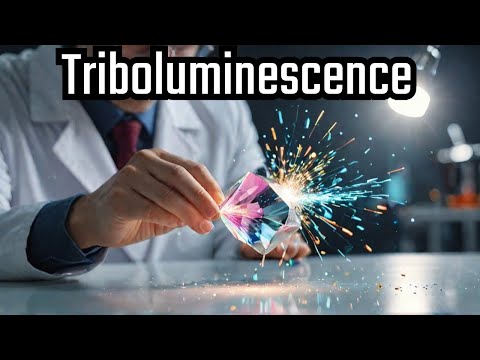
Crush a sugar crystal and it flashes. That's triboluminescence—light from mechanical fracture—known since Francis Bacon scraped sugar in 1605. For four centuries it resisted design: you could observe it, but not predict which materials would emit or what color.

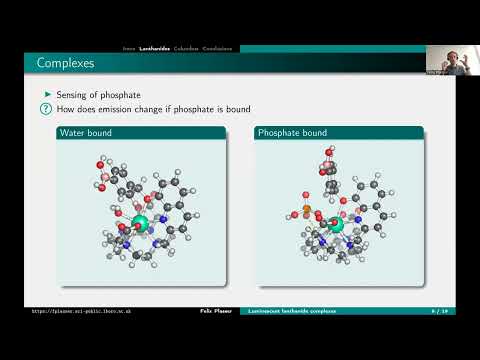
A Japanese team has now shown how to control it. In a paper published September 12 in Inorganic Chemistry Frontiers, they demonstrate that mechanical cleavage excites the coordinated ligand, which then transfers energy to a lanthanide ion—the same "antenna" mechanism that drives lanthanide photoluminescence. Swapping the ligand's bipyridine scaffold for phenanthroline lowered its triplet state from about 22,200 to 19,200 cm⁻¹, selectively sensitizing europium while excluding terbium.

The result turns triboluminescence from an unpredictable curiosity into an engineerable material property. Emission color is now chosen by ligand design, and the crystal structure—chiral, lamellar, fracturing in sheets—provides the mechanical trigger. That opens the door to impact sensors, stress monitors, and anti-counterfeiting marks that light up on demand.

Why it matters

Triboluminescent materials that flash on impact could become stress sensors and anti-counterfeiting marks—and now their color is predictable by design.

Questions about this story

Free account needed to ask — your question is kept and asked for you right after sign-up. Answers are public.

No questions yet — be the first to ask.

Key Indicators

19,200 cm⁻¹
Engineered ligand triplet state
Phenanthroline-based ligand triplet, down from about 22,200 cm⁻¹ in the bipyridine parent.
3
Lanthanide complexes tested
Europium, terbium, and gadolinium versions synthesized to map energy-transfer selectivity.
Eu³⁺
Selectively sensitized ion
Only europium emits triboluminescence; terbium is excluded by the lowered triplet state.

Voices

Curated perspectives — historical figures and your fellow readers.

Ever wondered what historical figures would say about today's headlines?

Sign up to generate historical perspectives on this story.

People Involved

Organizations Involved

Timeline

1 event Latest: September 12th, 2026 · 3 weeks ago
  1. Study published in Inorganic Chemistry Frontiers

    Latest Publication

    Paper reports rational control of lanthanide triboluminescence via ligand triplet-state tuning and lamellar crystal fracture.

Scenarios

1

Triplet-state tuning becomes the standard TL design rule

Likely Resolves by End of 2028

Discussed by: The paper's authors and the broader mechanoluminescence community

The approach—lowering the ligand triplet state to select which lanthanide emits—gives other labs a recipe. Follow-up work is expected to extend it to samarium, dysprosium, and other emitters, and to new ligand scaffolds. The paper's claim that triboluminescence follows the same antenna mechanism as photoluminescence makes the design rule transferable.

2

Triboluminescent lanthanide complexes reach prototype sensors

Possible Resolves by End of 2028

Discussed by: Materials scientists working on mechano-responsive and stress-sensing materials

Predictable color plus a mechanical trigger suits impact detection, structural health monitoring, and anti-counterfeiting. A prototype would require scaling crystal growth and integrating the complexes into films or composites—a step beyond the current single-crystal demonstrations.

3

Ligand-mediated excitation becomes the consensus TL mechanism

Likely Resolves by End of 2027

Discussed by: The mechanoluminescence research community

The paper's vacuum experiments and lanthanide-series measurements rule out nitrogen discharge and direct Ln³⁺ excitation, pointing to ligand excitation followed by antenna transfer. If independent groups replicate the selectivity pattern, the field is likely to converge on this mechanism, closing a debate that has run for decades.

Historical Context

3 moments from history that rhyme with this story — and how they unfolded.

1605

Francis Bacon observes sugar triboluminescence (1605)

Francis Bacon noted that scraping sugar with a knife produced a glow. The observation, recorded in his writings, is among the earliest documented cases of triboluminescence—light emitted when a material is fractured.

Then

The phenomenon was catalogued as a curiosity; no mechanism was proposed for centuries.

Now

Triboluminescence remained a poorly understood effect, observed in sugar, quartz, and certain minerals, with no way to predict which materials would emit or what color.

Why this matters now

The new study is the first to show triboluminescence color can be chosen by molecular design, ending the 400-year run of triboluminescence as an unpredictable curiosity.

1942

Weissman discovers the antenna effect (1942)

Samuel Weissman showed that organic ligands could absorb ultraviolet light and transfer the energy to europium ions, producing strong red emission. This 'antenna effect' became the foundation of lanthanide photoluminescence.

Then

Researchers gained a way to make lanthanides emit brightly, since the ions themselves absorb light poorly.

Now

The antenna effect enabled lanthanide probes, lasers, and displays, and remains the standard design principle for lanthanide luminescence.

Why this matters now

The new paper shows the same antenna mechanism operates under mechanical stress—the ligand is excited by fracture, then transfers energy to the lanthanide—extending a 1942 design principle to a new stimulus.

2017

Mechanistic TL studies in lanthanide β-diketonates (2017)

Researchers synthesized a series of europium β-diketonate complexes and found their triboluminescence persisted under vacuum, ruling out nitrogen gas discharge as the excitation source. They also showed both centrosymmetric and noncentrosymmetric crystals could be triboluminescent.

Then

The nitrogen-discharge explanation, long assumed for many triboluminescent materials, was shown to be irrelevant for these lanthanide complexes.

Now

The work pointed to direct excitation of the complex itself, setting up the ligand-mediated mechanism the 2026 study confirms.

Why this matters now

The 2026 paper's vacuum experiments build directly on this result, and its chiral, noncentrosymmetric crystals add the structural requirement the 2017 work found was not absolute.

Sources

(5)