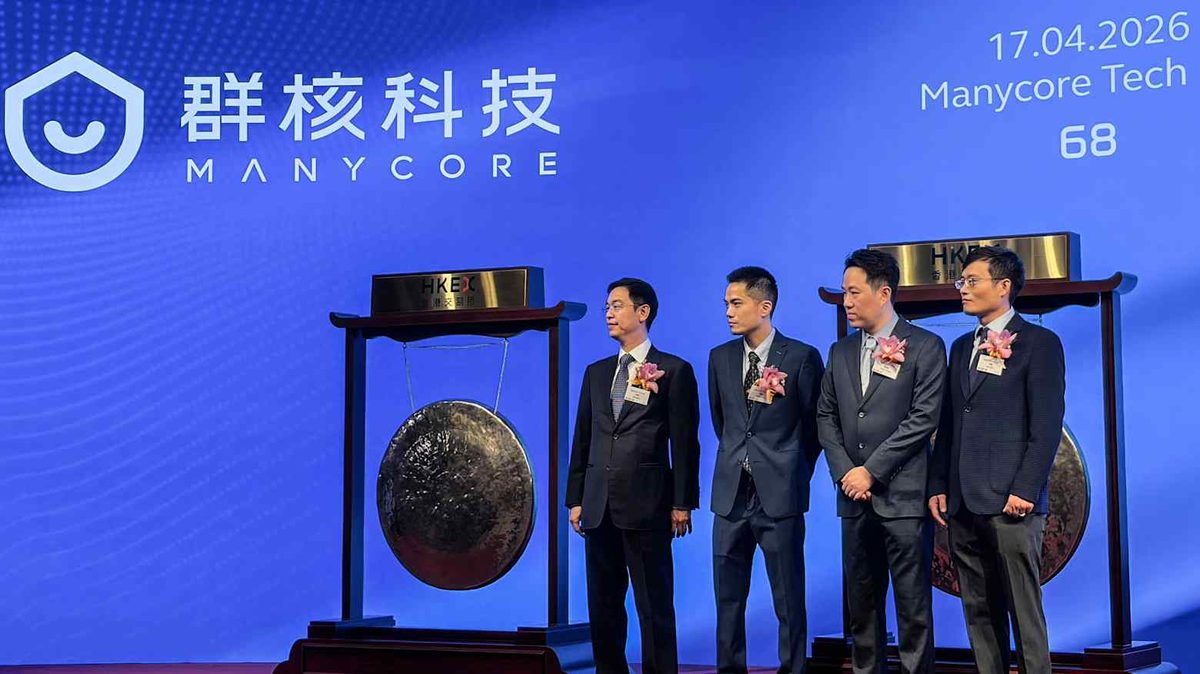
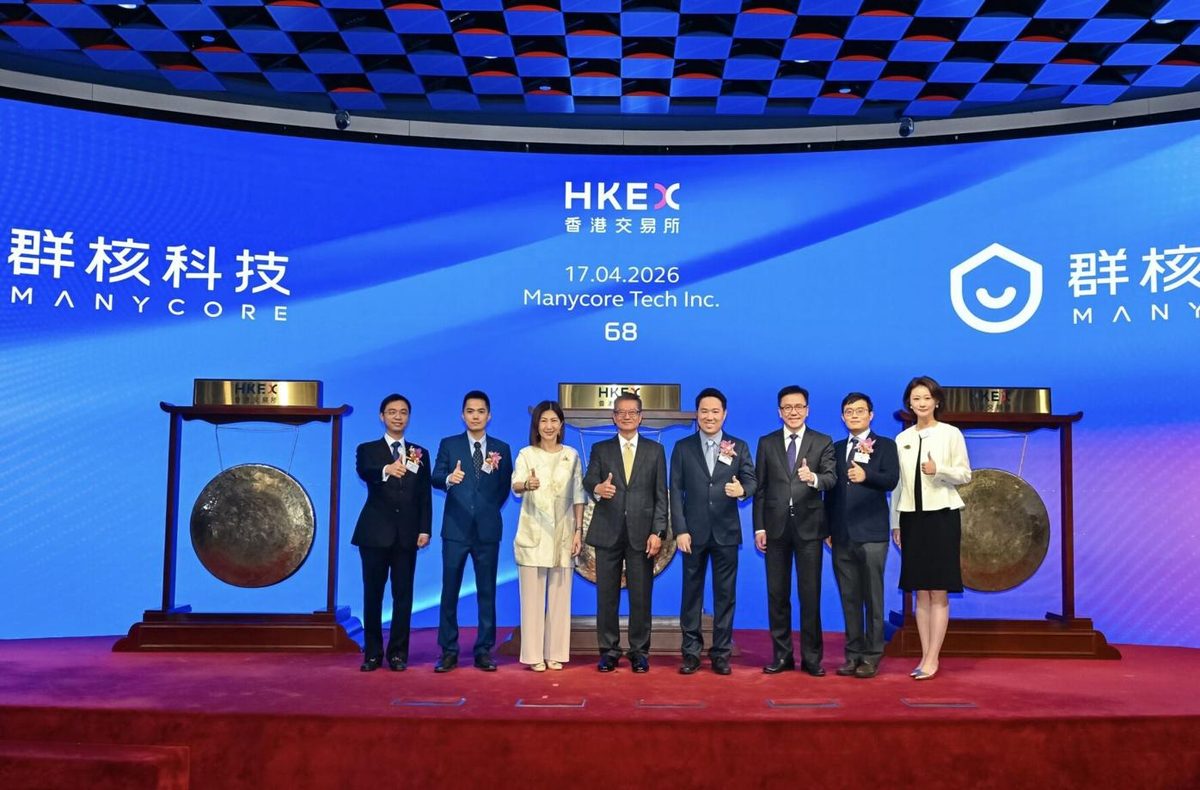
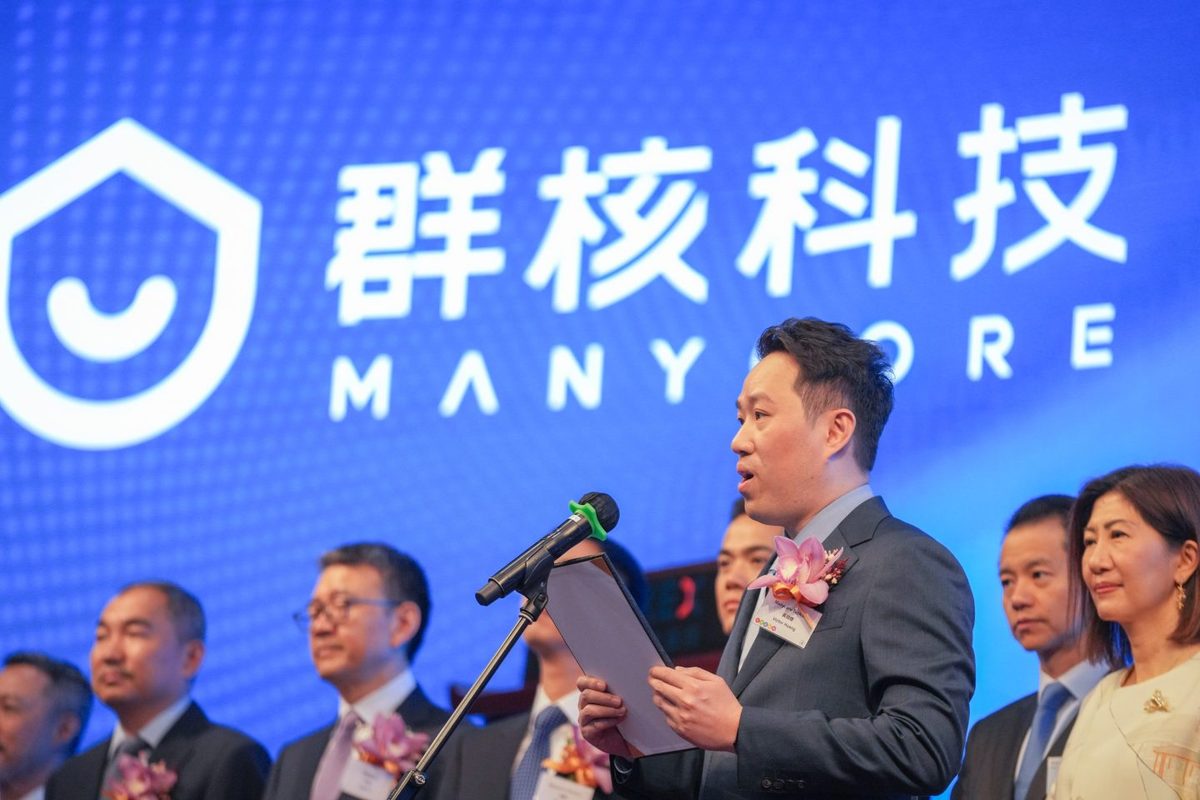
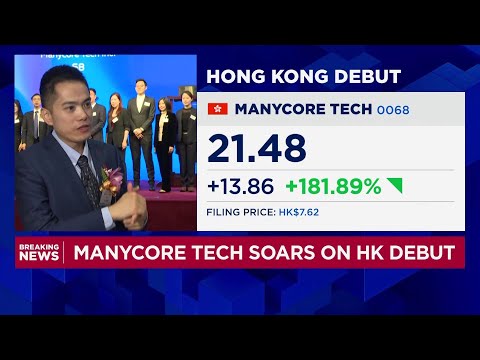
Manycore Tech, a Hangzhou company that builds AI tools for understanding and generating three-dimensional spaces, debuted on the Hong Kong Stock Exchange on April 17, 2026. Retail investors oversubscribed roughly 1,600 times, and shares nearly tripled, closing at HKD 18.60 — up 144% from its offer price of HKD 7.62. It's the world's first publicly listed 'spatial intelligence' company and the first of Hangzhou's 'Six Little Dragons' AI startups to reach public markets.
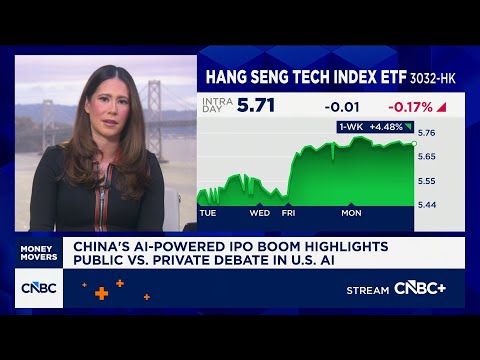
By April 21, shares had jumped an additional 60% intraday to HKD 29.80 — retail enthusiasm hadn't cooled a week after listing. The listing is part of a broader wave of Chinese tech companies choosing Hong Kong over New York. Since January 2026, chipmaker Biren Technology, language-model developer Zhipu AI, and video-generation startup MiniMax have all debuted on HKEX to strong first-day demand.
On April 23, Huaqin Technology (a manufacturer of smartphones, laptops, and data center equipment) completed a secondary listing on HKEX, rising 17% on debut and raising approximately HK$4.6 billion ($581 million). Seventeen cornerstone investors, including JPMorgan Asset Management and UBS Asset Management, took half the deal. Institutional appetite extends beyond pure-play AI: the city's specialist listing rules, Beijing's renewed support for private tech firms, and ongoing US-China chip-export tensions all make Hong Kong attractive.
Why it matters
A new class of AI companies is going public in Hong Kong, redirecting billions in tech capital away from US exchanges and into Chinese spatial and generative AI.
Questions about this story
Free account needed to ask — your question is kept and asked for you right after sign-up. Answers are public.
No questions yet — be the first to ask.
Key Indicators
1,591×
Retail oversubscription
Hong Kong retail investors bid for nearly 1,600 times the shares available to them
+144%
First-day closing gain
Shares closed at HKD 18.60 versus the offer price of HKD 7.62
~$156M
IPO proceeds
Manycore raised approximately HKD 1.22 billion in the offering
4
Major AI IPOs on HKEX in 2026
Biren, Zhipu AI, MiniMax, and now Manycore have all debuted this year
+110.5%
Q1 2026 AI revenue growth
Manycore's AI application revenue more than doubled year-over-year in Q1 2026
15 events
Latest: April 23rd, 2026 · 6 months ago
Showing 8 of 15
JK to step
Tap a bar to jump to that date
Jump to
April 2026
Huaqin Technology secondary listing on HKEX raises ~$581M
LatestIPO
Chinese intelligent-product company Huaqin Technology, with a market capitalization of approximately $14.5 billion, is scheduled to complete a secondary listing on the Hong Kong Stock Exchange on April 23, 2026, raising roughly $581 million. The listing adds momentum to HKEX's 2026 tech rally, which has already raised nearly $14 billion in Q1 alone.
Huaqin Technology's H shares opened 13.6% higher at HKD 87.55, touched a session high of HKD 90.95, and closed up 17% on their HKEX debut, raising approximately HK$4.6 billion (~$581M). Seventeen cornerstone investors—including JPMorgan Asset Management, UBS Asset Management, and Taikang Life—collectively subscribed to 50% of the offering, signaling broad institutional confidence in Hong Kong's 2026 tech rally.
Manycore shares jump a further 60% in post-IPO trading
Market
Manycore Tech (0068.HK) surged as much as 60% intraday to HKD 29.80 on the first Monday after its IPO, extending a total gain of more than 290% from its HKD 7.62 offer price. The continued rally reflected sustained retail demand and growing institutional recognition of spatial intelligence as a distinct AI investment category.
Manycore holds Day 1 gains in second-day trading
Market
Manycore Tech (00068.HK) traded at approximately HKD 18.70 on its second day, a marginal uptick from the Day 1 closing price of HKD 18.60, suggesting the 144% debut gain is holding rather than reversing.
Manycore Tech surges 144% in Hong Kong debut
IPO
Manycore Tech, the first of Hangzhou's Six Little Dragons to go public, lists on HKEX as the world's first spatial intelligence company. Retail investors oversubscribed the offering 1,591 times, and shares closed at HKD 18.60 versus the HKD 7.62 offer price.
March 2026
Shanghai Stock Exchange accepts Unitree Robotics' STAR Market IPO application
IPO
The Shanghai Stock Exchange formally accepted the IPO application of Unitree Robotics, one of Hangzhou's Six Little Dragons, to list on the technology-focused STAR Market, targeting a raise of approximately RMB 4.2 billion (~$608M). The filing makes Unitree the first of the Six to pursue a mainland listing rather than the Hong Kong route taken by Manycore and targeted by BrainCo.
January 2026
BrainCo files confidentially for Hong Kong IPO
IPO
BrainCo (Qiangnao), the brain-computer interface startup and second of Hangzhou's Six Little Dragons to enter the public-markets pipeline, confidentially filed for a Hong Kong IPO targeting several hundred million USD, with CICC and UBS as advisors.
MiniMax doubles on Hong Kong debut
IPO
Video-generation startup MiniMax lists on HKEX, raising HKD 4.8 billion. Institutional orders were halted early due to overwhelming demand, and shares doubled on the first day.
Zhipu AI lists on HKEX
IPO
Tsinghua University-backed large language model developer Zhipu AI debuts in Hong Kong, raising roughly $560 million and rising 13% on its first day.
Biren Technology kicks off HKEX's AI IPO wave
IPO
Chinese AI chip designer Biren Technology debuts as HKEX's first listing of 2026, raising $717 million and closing up 76% on its first day.
December 2025
Manycore's SpatialLM tops Hugging Face trends
Technical
Manycore's open-source spatial language model, SpatialLM, reaches the top three on Hugging Face's trending models list after being accepted at the NeurIPS conference, raising the company's profile ahead of its IPO.
May 2025
HKEX launches TECH Channel
Regulatory
Hong Kong's exchange introduces a streamlined listing pathway for specialist technology and biotech firms, cutting IPO timelines to as few as 65 business days.
February 2025
Xi Jinping hosts private tech entrepreneurs at symposium
Political
Chinese President Xi Jinping convenes a high-profile meeting with private-sector technology leaders, widely interpreted as a definitive signal that the regulatory crackdown era has ended and AI investment is encouraged.
January 2025
DeepSeek releases R1, shaking global AI assumptions
Industry
Hangzhou-based DeepSeek publishes its R1 reasoning model, demonstrating that Chinese labs can produce frontier-competitive AI at a fraction of US training costs. The release catalyzes investor enthusiasm for Chinese AI startups.
March 2023
HKEX opens door to pre-profit tech listings
Regulatory
Hong Kong's Chapter 18C listing rules take effect, creating a pathway for specialist technology companies—including AI firms—to go public without established profitability.
Scenarios
1
Hong Kong becomes the Nasdaq of Chinese AI
Likely
Discussed by: HKEX leadership, Goldman Sachs Asia equity research, Financial Times analysis
If Manycore and its predecessors sustain their post-IPO valuations and more of the Six Little Dragons follow suit—with Moonshot AI reportedly weighing an $18 billion listing—HKEX could consolidate its position as the primary global venue for Chinese AI capital formation. This scenario accelerates if US investment restrictions on Chinese AI firms tighten further, pushing companies that might have considered New York listings toward Hong Kong by default. The exchange's Chapter 18C and TECH Channel infrastructure was built precisely for this outcome.
2
AI IPO bubble pops as monetization lags
Possible
Discussed by: Short sellers, Caixin commentary, Bank of America Asia technology analysts
Several of these newly listed AI companies are pre-profit or early-revenue. If the gap between sky-high debut valuations and actual revenue growth widens—as happened with many 2020-2021 Hong Kong tech listings that later lost 70-90% of their value—a correction could stall the pipeline. Chinese consumers and businesses have shown a willingness to use AI tools but a reluctance to pay premium prices for them, compressing margins. A single high-profile post-IPO collapse could cool the entire wave.
3
Spatial intelligence emerges as the next major AI platform category
Possible
Discussed by: Fei-Fei Li (World Labs founder), NeurIPS research community, architecture and manufacturing industry analysts
If Manycore's spatial models and World Labs' competing American efforts both demonstrate commercially valuable applications—in architecture, robotics, digital twins for manufacturing, and urban planning—spatial intelligence could follow the trajectory of large language models from research curiosity to mainstream platform. Manycore's advantage is a decade of 3D design data from millions of Kujiale users; World Labs' advantage is over $1 billion in funding and Stanford research talent. The category's legitimacy as a public-market investment thesis depends on whether these tools generate real revenue beyond the initial hype.
4
Regulatory whiplash returns and freezes Chinese tech IPOs
Unlikely
Discussed by: Institutional investors burned by the 2021 crackdown, Asia-focused hedge funds, S&P Global sovereign risk analysts
Beijing's support for private AI companies is currently enthusiastic, but the 2021 precedent—when regulators halted Ant Group's $37 billion IPO two days before listing and launched sweeping crackdowns on ride-hailing, education, and gaming—looms over every Chinese tech investment. A political trigger, a data-security incident involving a listed AI firm, or a shift in leadership priorities could reverse the supportive stance quickly. International investors who remember losing billions in the last cycle may be quicker to sell at the first sign of regulatory change.
Historical Context
3 moments from history that rhyme with this story — and how they unfolded.
1 of 3
November 2020 – 2022
Ant Group IPO halt and Chinese tech crackdown (2020-2022)
Chinese regulators suspended Ant Group's $37 billion IPO—which would have been the world's largest—just two days before its scheduled dual listing in Hong Kong and Shanghai. The halt followed public comments by Ant's founder Jack Ma criticizing Chinese financial regulators. It triggered a broader crackdown on Chinese technology companies: Didi was forced to delist from the New York Stock Exchange months after its IPO, antitrust fines hit Alibaba and Meituan, and entire sectors (online tutoring, gaming) faced new restrictions.
Then
Chinese tech stocks lost hundreds of billions of dollars in market value. IPO pipelines froze. Foreign investors pulled capital from Chinese tech funds.
Now
Chinese tech companies largely abandoned US listings in favor of Hong Kong. HKEX introduced Chapter 18C specifically to rebuild its tech IPO pipeline. The episode left institutional investors with lasting wariness about Chinese regulatory risk.
Why this matters now
The current AI IPO wave is happening in the political window Beijing has deliberately opened after the crackdown era. Investors are watching for any sign that the regulatory cycle could turn again—making the sustainability of government support the key variable for this entire wave.
2 of 3
February 2021
Kuaishou's Hong Kong IPO and the 2021 tech listing frenzy (2021)
Short-video platform Kuaishou listed on HKEX and surged 194% on its first day, reaching a market capitalization of over $160 billion. The debut was oversubscribed more than 1,200 times by retail investors, echoing the frenzy now seen in Manycore's listing. The IPO was the centerpiece of a broader boom in Hong Kong tech listings.
Then
Kuaishou's market cap briefly exceeded that of Baidu. The euphoria drew more Chinese tech companies toward Hong Kong listings.
Now
Within a year, Kuaishou's stock had fallen more than 80% from its peak as the tech crackdown hit and growth expectations proved unrealistic. The collapse became a cautionary tale about first-day pops and oversubscription mania.
Why this matters now
Manycore's 1,591-times oversubscription and 144% first-day gain closely mirror Kuaishou's debut dynamics. Whether the spatial intelligence company avoids the same post-IPO decline depends on whether its revenue growth—up 110% year-over-year in Q1 2026—can sustain the valuation investors have assigned.
3 of 3
September 2024
World Labs launch and the 'spatial intelligence' category (2024)
Stanford professor Fei-Fei Li, known as the 'godmother of AI' for her foundational work on the ImageNet dataset, launched World Labs with the explicit mission of building 'spatial intelligence'—AI that understands and generates three-dimensional physical environments. The company raised over $1 billion from investors including Andreessen Horowitz and NEA, reaching a valuation above $5 billion before shipping a product.
Then
World Labs legitimized 'spatial intelligence' as a named AI category distinct from language models and image generators, attracting both research talent and investor attention.
Now
The company's Marble model demonstrated real-time generation of navigable 3D environments, establishing a technical benchmark. The category now has a US research-led entrant and a Chinese commercially-led public company, setting up a parallel competition.
Why this matters now
Manycore's IPO makes it the publicly traded counterpart to World Labs in spatial AI. While World Labs approaches the problem from foundational research with massive private funding, Manycore comes from a decade of commercial deployment with millions of real-world 3D design datasets—two different bets on the same thesis that AI must move beyond flat text and images into understanding physical space.