



Pull to refresh
Logo
China's space station sets record for coldest human-made matter

China's space station sets record for coldest human-made matter

New Capabilities

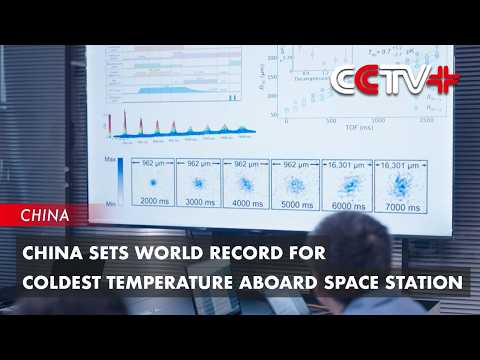
A rubidium Bose-Einstein condensate reached 9.7 picokelvins and stayed observable for 7 seconds, four times colder than the previous record

Overview

Updated 2 hours ago

A cloud of rubidium atoms inside China's space station has reached 9.7 picokelvins, about 9.7 trillionths of a degree above absolute zero. The result is four times colder than the previous record and the coldest human-made matter ever measured.

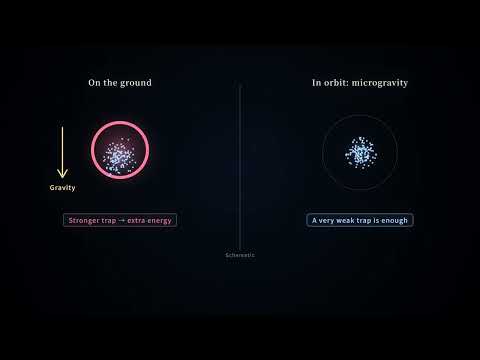
The atoms formed a Bose-Einstein condensate, a state in which they merge into a single quantum wave. Because the station is in free fall, the team could release the cloud and watch it expand for 7 seconds, far longer than any ground or orbital experiment before it.

Why it matters

Long free-fall observation times give physicists a cleaner platform for gravity tests, atomic clocks, and quantum simulation than any ground lab can offer.

Questions about this story

Free account needed to ask — your question is kept and asked for you right after sign-up. Answers are public.

No questions yet — be the first to ask.

Key Indicators

9.7 pK
Equivalent temperature of the rubidium cloud
Measured from how fast the released cloud expands, not by a direct thermometer.
7.0 s
Free-expansion observation time
Ground experiments manage about 0.05 seconds; the International Space Station about 1 second.
20,000
Atoms in the final condensate
The figure reported in the Science paper for the Bose-Einstein condensate.
38 pK
Previous coldest record
Set by a German team in 2021 using atom-chip magnetic traps in microgravity.
0.7 m³
Volume of the orbital experiment rack
Compressed from a ground system of about 20 cubic meters and 10 tonnes.

Voices

Curated perspectives — historical figures and your fellow readers.

Sign up to generate historical perspectives on this story.

People Involved

Organizations Involved

Timeline

1924 November 2026

9 events Latest: 2 days ago
Tap a bar to jump to that date
  1. Paper 'Quantum gases below 10 picokelvin in space' published

    Latest Scientific paper

    The peer-reviewed study appears in Science, reporting 20,000 atoms and a 7-second free expansion.

  2. Science reports the 9.7-picokelvin record

    Publication

    Science publishes a news report on China's space-station result, four times colder than the 2021 mark.

  3. China launches CAPR with the Mengtian module

    Space mission

    The Cold Atom Physics Rack arrives at the China Space Station aboard the Mengtian module.

  4. German team sets 38-picokelvin record

    Scientific result

    Ernst Rasel's group records the previous coldest temperature using atom-chip magnetic traps in microgravity.

  5. Orbital lab reaches 52 picokelvins

    Scientific result

    NASA's Cold Atom Laboratory produces a rubidium condensate at 52 picokelvins.

  6. NASA launches Cold Atom Laboratory to the space station

    Space mission

    NASA sends a remote-controlled cold-atom lab to the International Space Station.

  7. Nobel Prize and the atom chip

    Scientific milestone

    The condensate work wins the Nobel Prize in Physics; a team then miniaturizes the apparatus onto a microchip.

  8. First Bose-Einstein condensates created

    Scientific milestone

    Two US teams produce the first condensates, one from rubidium-87 and one from sodium-23.

  9. Bose and Einstein predict a new state of matter

    Scientific theory

    Satyendra Nath Bose and Albert Einstein predict that certain atoms could collapse into a single quantum wave at very low temperatures.

Scenarios

1

An international team runs its own experiment on CAPR

Possible Resolves by Q2 2028

Discussed by: Weibiao Chen of the Shanghai Institute of Optics and Fine Mechanics

CAPR physicists say the rack is open to outside researchers. If a non-Chinese-led team wins time and publishes, it would mark the station's shift from a national lab to a shared facility. China has not yet published an access process or schedule.

2

CAPR team publishes optical-lattice quantum simulation results

Likely Resolves by End of 2027

Discussed by: Xiaoji Zhou of Peking University

Zhou says optical-lattice results already exist but were left out of the record paper. Publishing them would move CAPR from a cooling milestone to doing quantum simulation, where laser spots mimic a crystal and atoms mimic electrons.

3

An independent group reproduces sub-10-picokelvin temperatures

Uncertain Resolves by End of 2029

Discussed by: Independent science outlets noting the result awaits replication

The 9.7-picokelvin figure is an equivalent temperature inferred from how fast the cloud expands, not a direct thermodynamic reading. A second group reaching a similar mark would confirm the optical-trap method rather than a one-off measurement.

4

An orbital atom interferometer tests the equivalence principle

Possible Resolves by End of 2029

Discussed by: Holger Mueller of UC Berkeley and Ernst Rasel of Leibniz University Hannover

Seven seconds of free fall is long enough for atom interferometry that checks whether gravity pulls all atoms equally, as general relativity predicts. Mueller and Rasel both point to long free-fall times as the record's main scientific value.

Historical Context

3 moments from history that rhyme with this story — and how they unfolded.

1995

First Bose-Einstein condensate (1995)

Two US teams cooled rubidium-87 and sodium-23 until the atoms collapsed into a single quantum wave, confirming a prediction made 71 years earlier. The work won the 2001 Nobel Prize in Physics.

Then

Physicists gained a new state of matter to study and a platform for precision measurement.

Now

Cold-atom research became a global field, later miniaturized onto chips and flown into space.

Why this matters now

This record is the latest step in a three-decade push to make condensates colder, longer-lived, and more useful for tests of fundamental physics.

2018-2020

NASA Cold Atom Laboratory on the ISS (2018-2020)

NASA sent a remote-controlled cold-atom lab to the International Space Station. In 2020 it produced a rubidium condensate at 52 picokelvins, using microgravity to avoid the heating caused by gravity.

Then

It showed that ultracold atom experiments could run continuously in orbit.

Now

It set the template that China's CAPR followed, and its 52-picokelvin mark stood until the German and Chinese results.

Why this matters now

CAPR is the direct successor to the NASA lab, and its optical-trap method is the main technical departure from that earlier design.

2021

German 38-picokelvin record (2021)

Ernst Rasel's team at Leibniz University Hannover recorded a temperature of 38 picokelvins using atom-chip magnetic traps in microgravity, then the coldest ever achieved.

Then

It reset the benchmark for space-based cold-atom experiments.

Now

It stood for five years until the Chinese optical-trap result, which Rasel himself publicly welcomed.

Why this matters now

The new record roughly quadruples the previous mark, and the shift from magnetic to optical traps is what made the improvement possible.

Sources

(7)