
Pull to refresh
Logo
Cognition lets its Devin agent build and host private web apps

Cognition lets its Devin agent build and host private web apps

New Capabilities

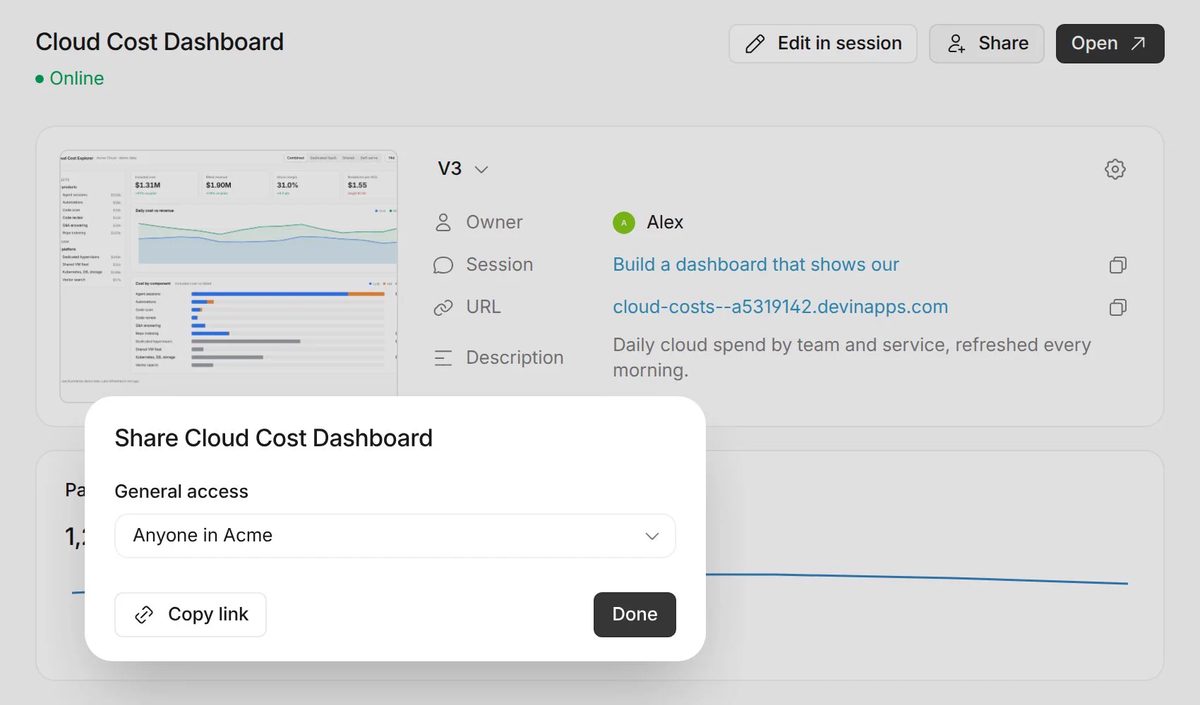
Devin Apps run on Devin's own cloud machine at a fixed address, require a Devin sign-in, and sleep when nobody is using them

Overview

Updated 43 minutes ago

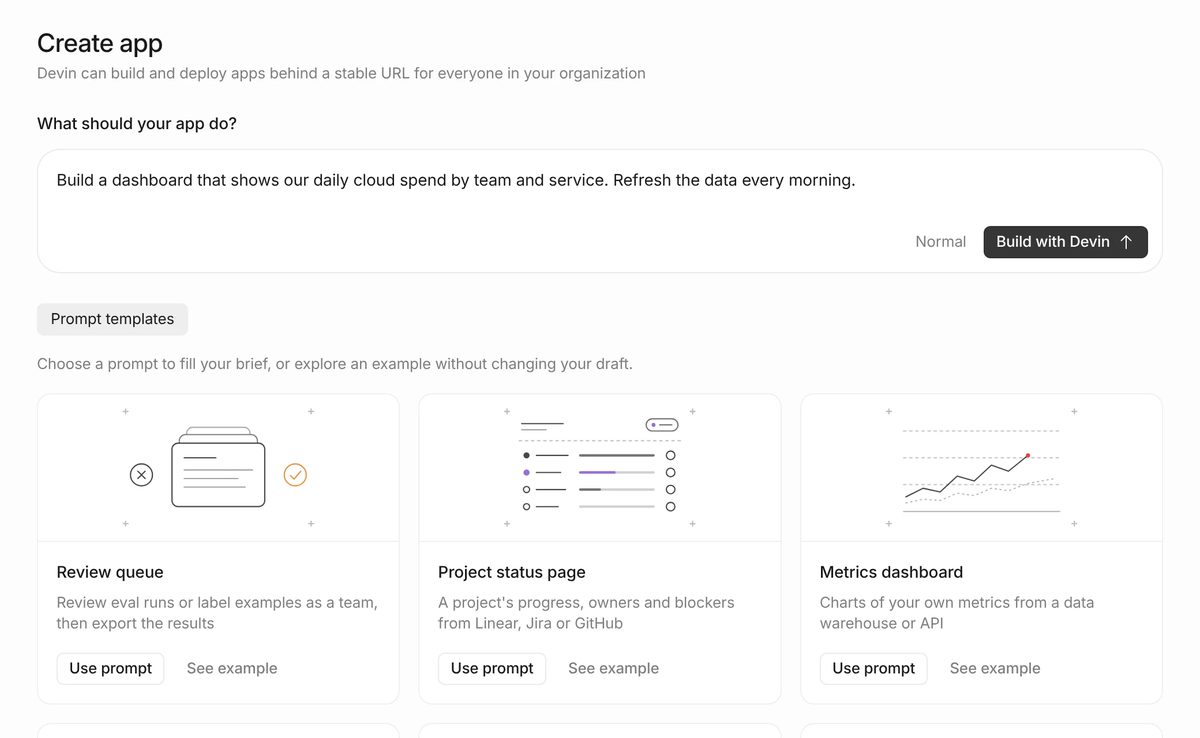
Since 2024, Cognition's Devin has written code inside a session that ends when the job is done. On November 13, 2026, the company gave that code somewhere to live: describe a tool, and Devin builds it as a private web app, hosts it on its own cloud machine, and hands back a link that stays up.

The apps are private by design. Visitors sign in to Devin, access is set per app, and the machine sleeps five minutes after the last request. That points the feature at internal tools like admin panels and approval queues, not customer-facing sites.

Why it matters

A working internal tool now takes a sentence instead of a sprint, which moves the bottleneck from engineering time to knowing what to ask for.

Questions about this story

Free account needed to ask — your question is kept and asked for you right after sign-up. Answers are public.

No questions yet — be the first to ask.

Key Indicators

5 min
Idle time before an app's machine sleeps
The machine wakes on the next visit, and the first load after a sleep can take a few seconds.
3
Sharing levels for an app
Only people with access, the whole organization, or the entire enterprise.
1
Machines an app runs on
Cognition's documentation calls this a fit for internal tools, not high-traffic production services.
0
Public apps allowed
Every visitor must sign in to Devin, so no app can be opened by an unauthenticated visitor.

Voices

Curated perspectives — historical figures and your fellow readers.

Sign up to generate historical perspectives on this story.

People Involved

Organizations Involved

Timeline

March 2024 November 2026

4 events Latest: Yesterday
Tap a bar to jump to that date
  1. Rollout stays gradual

    Latest Rollout

    Apps appear in the sidebar for some accounts; Cognition says the feature is being turned on gradually.

  2. Cognition announces Devin Apps

    Product launch

    Users can describe a tool, have Devin build it, and open it from a link on the preview.devinapps.com domain.

  3. Devin Apps documentation goes up

    Documentation

    Product docs describe private apps at fixed addresses, signing in, sharing levels, and awake-time billing.

  4. Cognition introduces Devin

    Product launch

    Devin is pitched as an AI software engineer that works in its own sandbox, separate from the developer's editor.

Scenarios

1

Devin Apps stay internal as Cognition declines to offer public hosting

Likely Resolves by Nov 30, 2027

Discussed by: Cognition's own documentation, which states apps cannot be made public, and early coverage noting the login requirement limits unauthenticated demos

Every visitor must sign in to Devin, so an app built for customers or the open web stays out of reach. The documentation frames apps as internal tools, beta and staging copies, and dashboards, and sharing stops at the enterprise level. The trigger for a change would be a public tier or a way to serve anonymous visitors, and neither has been announced.

2

Gradual rollout finishes and Apps ships to every Devin account

Likely Resolves by Feb 28, 2027

Discussed by: Cognition's documentation, which carries a note that the feature is rolling out gradually and is absent from some sidebars

The feature is live but not universal. Accounts without Apps in the sidebar simply have not been switched on yet. The measurable end state is the disappearance of that caveat and a general-availability listing in the docs, which would also make adoption numbers meaningful for the first time.

3

Cognition adds an always-on mode to remove the cold start

Possible Resolves by May 31, 2027

Discussed by: Cognition's documentation, which flags the first-load delay after sleep and bills by how long the machine is awake

Sleeping machines keep costs down but make the first visit slow, which is a poor fit for a dashboard someone checks in a hurry. An always-on option, a pre-warm schedule, or a cheaper wake path would resolve the tension. Nothing in the launch materials promises one, so this is a bet on customer pressure rather than an announced plan.

Historical Context

3 moments from history that rhyme with this story — and how they unfolded.

2007-2010

Heroku's push-to-deploy (2007)

Heroku launched in 2007 as a hosting platform where pushing code to a repository built and deployed a working web application. Developers who had never configured a server could put a Rails app online in one step.

Then

Small teams shipped applications without an operations staff, and the platform handled builds, deploys, and restarts.

Now

Salesforce bought Heroku in 2010, and bundling build with hosting became a standard shape for developer platforms.

Why this matters now

Devin Apps collapses building and hosting into one step the same way, with one difference that defines the product: the result sits behind a Devin login instead of the open internet.

November 2014

AWS Lambda and the cold start (2014)

Amazon Web Services introduced Lambda at its re:Invent conference. Code ran only when a request arrived, and the first invocation after an idle period took longer while the environment started up.

Then

Teams stopped paying for idle servers but had to design around latency on the first request.

Now

The tradeoff became a standard part of serverless architecture and a recurring complaint from users of interactive tools.

Why this matters now

Devin Apps uses the same sleep-on-idle, wake-on-request design. Cognition's documentation describes the same visible cost: the first load after a sleep can take a few seconds.

2017 onward

Retool and the internal-tools market (2017)

Retool was founded in 2017 to let teams assemble admin panels and internal dashboards from prebuilt components connected to their own databases. The pitch was that internal software was worth building, just not worth a full engineering project.

Then

Operations and support teams built tools that had previously sat in spreadsheets or gone unbuilt.

Now

Internal tooling became its own software category, with a set of vendors selling to teams outside engineering.

Why this matters now

That demand is what Devin Apps targets. The difference is assembly versus generation: the app comes from a written description and is hosted by the same system that wrote it.

Sources

(8)