Anchor

Ontario lowers colorectal cancer screening age to 45
Rule ChangesOntario is the second Canadian province to open at-home colon cancer testing to residents in their late 40s.
July 1st, 2026: Ontario lowers screening age to 45New here? Follow stories to track developments over time. Create a free account to get updates when stories you care about change.
Overview
Updated Jul 1Starting July 1, 2026, an Ontarian who turns 45 can order a colon cancer test and do it at home. Until now, they had to wait until 50.
The change opens routine screening to hundreds of thousands more people. Colorectal cancer is rising among adults under 50, and catching it early can mean a minor procedure instead of chemotherapy.
Why it matters
Screening five years earlier means more Ontarians catch colorectal cancer while it is still curable, instead of after it spreads.
Questions about this story
Free account needed to ask — your question is kept and asked for you right after sign-up. Answers are public.
No questions yet — be the first to ask.
Key Indicators
45
New screening start age
Down from 50, matching guidance already adopted in the United States.
2nd
Province to make the change
Prince Edward Island moved first, in March 2026.
90%
Cure rate when caught early
About nine in ten colorectal cancers can be cured if found at an early stage.
Hundreds of thousands
Newly eligible residents
Ontarians aged 45 to 49 who can now request the test.
Related Media

Colorectal cancer concept using Scrabble tiles on a light blue background.

Scrabble tiles spell 'Colorectal Cancer' on a light blue background for cancer awareness.
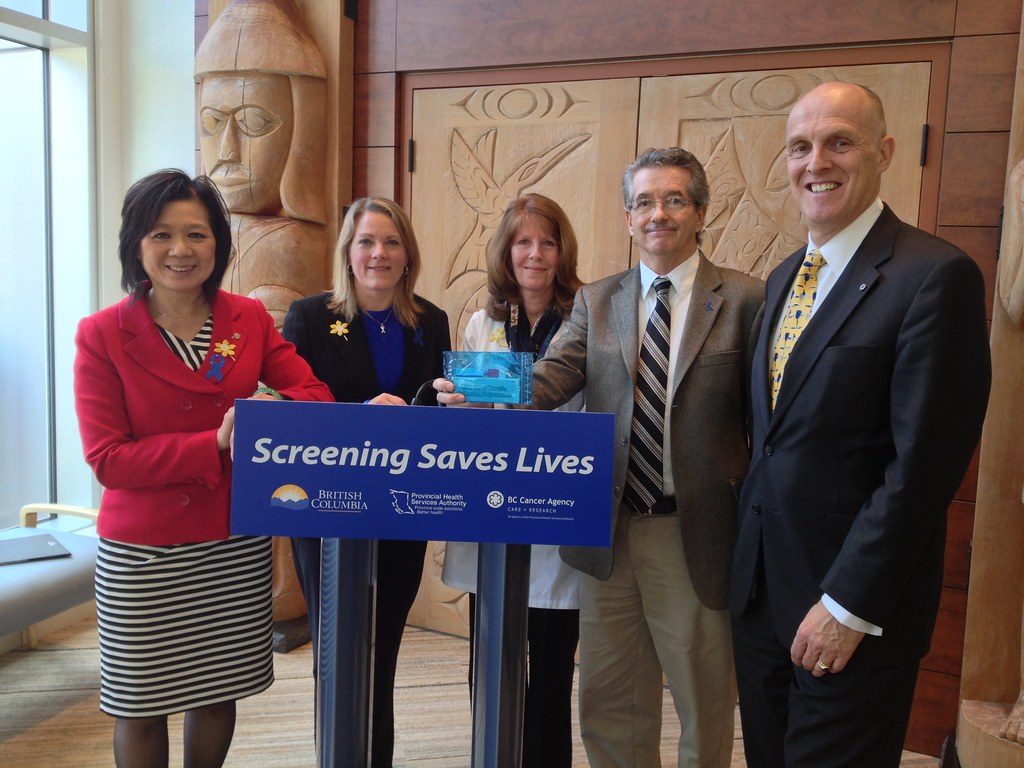
B.C.'s colon cancer screening program moves forward
307 views
4:17
Ontario lowers colorectal cancer screening age to 45, but ...
CBC News Toronto

1.3K views
4:46
Ontario lowering age for colorectal screening
CP24
1.6K views
2:03
Ontario to become second province to lower colorectal ...
CTV News
Images from Openverse under Creative Commons licenses. Videos from YouTube.
Voices
Curated perspectives — historical figures and your fellow readers.
Play
Exploring all sides of a story is often best achieved with Play.
Most of these play right now — no account needed. Sign up to save scores, keep a streak, and unlock Debate and Predict.
Log in
Sign Up
Higher or Lower
A number from this story, against one from elsewhere in the news — guess which is bigger, then keep the chain going. 5 rounds, 3 strikes; a miss costs a strike and resets your streak.
Example
Anchor
EU tariff revenue
$52B
Big for this kind of number
Mystery
Pentagon AI contract
?
Round 1
Streak: 0
Mystery
?
Keyboard: ↓/L lower · ↑/H higher
0 pts
Best streak: 0 · Rounds: 0
0 points — sign up to put that on the leaderboard.
Now try on this story
Connections
Sixteen names from the news. Find the four hidden groups of four. Four mistakes max.
Loading today's puzzle…
0/4 groups
Mistakes
Sign up to keep a daily streak — a new puzzle lands every day.
Now try on this story
Exit debate?
Your progress in this debate will be lost.
How it works
- 1 Two AI personas square off on this story.
- 2 You predict who'll win each round — correct picks earn XP.
- 3 One crossfire question is yours to fire. Pick it carefully.
Couldn't generate a topic
Select Your Champions
Choose one persona for each side of the debate
DEBATE TOPIC
Choose personas with different perspectives for a more dynamic debate.
SIDE A (PRO)
Select debater for this side:
No debate personas available right now.
SIDE B (CON)
Select debater for this side:
No debate personas available right now.
VS
Get ready to make your prediction...
Round of
Claim
Evidence
Stakes
Crossfire Answer
Closing Statement
Claim
Evidence
Stakes
Crossfire Answer
Closing Statement
Your Crossfire Question
Generating arguments...
Who's Got This Round?
Make your prediction before the referee scores
The referee scores both sides on
Correct predictions earn +20 XP
· Press 1 or 2 to pick
Evidence
40%
Logic
30%
Detail
20%
Style
10%
Round Results
Your Pick
Not this time
(%)
Overall Score
/10
Your Pick
Not this time
(%)
Overall Score
/10
Set the Crossfire
Pick the question both personas must answer in the final round
Crafting crossfire questions...
Choosing a question earns +10 XP crossfire bonus
🏆
Total XP Earned
Cred Change
Predictions
Debate Oracle! You called every round!
Sharp Instincts! You know your debaters!
The Coin Flip Strategist! Perfectly balanced!
The Contrarian! Bold predictions!
Inverse Genius! Try betting the opposite next time!
XP Breakdown
Base completion
+20 XP
Rounds played ( rounds x 5 XP)
+ XP
Correct predictions ( correct x 20 XP)
+ XP
Crossfire bonus
+10 XP
Accuracy
%
Prediction History
Round
You picked:
✓
✗
Now try on this story
Keep debating to level up your credibility and unlock achievements
People Involved
Barry Stein
President, Colorectal Cancer Canada
Advocating for the same screening age across all provinces
Trish Riley
Colorectal cancer survivor, Ottawa
Recovered after surgery and chemotherapy
Elizabeth Holmes
Director of health policy, Canadian Cancer Society
Backing wider adoption of the lower age
Organizations Involved
Ontario Health
Provincial health agency
Running the expanded screening program
The provincial agency that runs ColonCancerCheck, Ontario's organized colorectal screening program.
Colorectal Cancer Canada
Patient advocacy organization
Pushing for a uniform national screening age
A national advocacy group pressing every province to start screening at 45.
Canadian Cancer Society
National charity
Backing the lower screening age
The national cancer charity lobbying provinces to screen at 45.
Timeline
May 2021 July 2026
3 events
Latest: July 1st, 2026 · 2 months ago
-
Ontario lowers screening age to 45
Latest PolicyOntario opens the at-home FIT test to residents aged 45 to 49. Doctors can order it immediately; invitation letters go out in phases.
-
Prince Edward Island goes first
PolicyP.E.I. becomes the first Canadian province to lower its routine screening age from 50 to 45. Residents 45 to 49 can request mailed stool tests.
-
U.S. task force lowers its recommended age to 45
GuidelineThe U.S. Preventive Services Task Force recommends starting colorectal cancer screening at 45, citing rising cases in younger adults.
Historical Context
3 moments from history that rhyme with this story — and how they unfolded.
March 2000
The 'Couric effect' (2000)
Journalist Katie Couric had a colonoscopy broadcast on national television after losing her husband to colon cancer at 42. She wanted to strip the stigma from the procedure. Millions watched.
Then
Colonoscopy rates jumped in the months that followed, an effect researchers later measured and named after her.
Now
It showed that public awareness, not just policy, drives whether people actually get screened.
Why this matters now
Ontario's lower age only helps if people act on it; the Couric case shows uptake depends on awareness as much as eligibility.
August 2020
Chadwick Boseman's death (2020)
The actor Chadwick Boseman died of colon cancer at 43. He had been diagnosed at 39 and kept it private while continuing to work. His death drew wide attention to cancer striking people far below the old screening age.
Then
Searches for colon cancer symptoms and screening spiked in the weeks after his death.
Now
His case became a reference point in the push to screen younger adults.
Why this matters now
It put a recognizable name on the trend Ontario is responding to: colorectal cancer in people under 50.
May 2021
U.S. lowers colorectal screening age to 45 (2021)
The U.S. Preventive Services Task Force cut its recommended screening age from 50 to 45. It cited a steady rise in colorectal cancer among adults in their 40s. The American Cancer Society had already made the same call in 2018.
Then
Insurers were required to cover screening at 45, and testing among people in their late 40s climbed.
Now
The 45 threshold became the North American benchmark that Canadian provinces are now adopting one by one.
Why this matters now
Ontario's change follows the same evidence and lands on the same age the U.S. adopted five years earlier.
Sources
(5)Related Stories
Colorectal cancer takes younger lives as public figures sound the alarm
New Capabilities
Updated May 27
The race to detect cancer from a blood draw
New Capabilities
Updated Aug 13
The battle to protect firefighters from occupational cancer
Rule Changes
Updated May 19
The blood test revolution in Alzheimer's diagnosis
New Capabilities
Updated 9 hours ago
The “free mammogram” gets bigger: plans must cover follow–up imaging, pathology, and cancer navigation
Rule Changes
Updated May 15
Mayo Clinic AI detects pancreatic cancer years before diagnosis
New Capabilities
Updated May 31