Pull to refresh
Logo
Daily Brief
Following
Why
Genomic study reveals predictable patterns in how animals conquered land

Genomic study reveals predictable patterns in how animals conquered land

New Capabilities
By Newzino Staff |

Largest-ever comparative genomics study finds 11 independent terrestrialization events converged on similar genetic solutions

November 12th, 2025: 154-Genome Terrestrialization Study Published

Overview

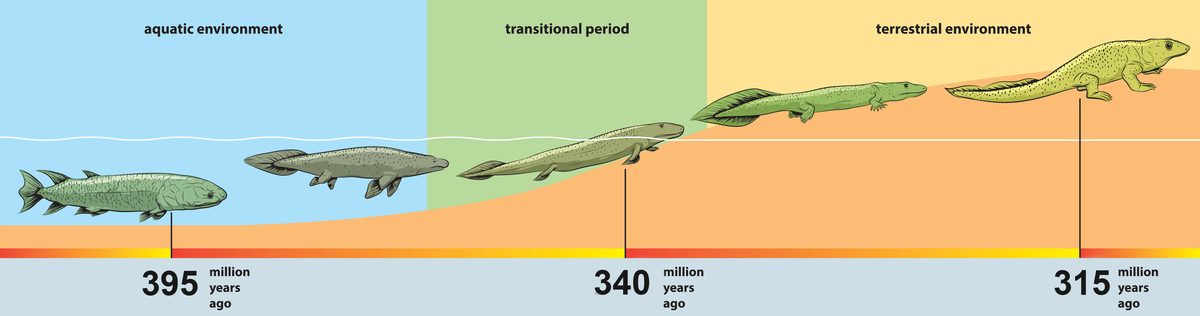
In 1989, paleontologist Stephen Jay Gould argued that if you could rewind evolution and play it again, the results would be utterly different—humanity was a cosmic accident. A study published in Nature on November 12, 2025 offers the most comprehensive counterargument yet: when 11 different animal lineages independently crawled out of the water across 487 million years, they repeatedly evolved the same genetic solutions.

Key Indicators

154
Genomes analyzed
Largest comparative genomics dataset ever assembled for studying land colonization
21
Animal phyla represented
Spanning nearly the full breadth of animal diversity, from arthropods to chordates
11
Independent terrestrialization events
Separate occasions when aquatic lineages evolved to survive on land
487M
Years of evolution studied
Timeline spanning from the earliest land-dwelling animals to the present

Interactive

Exploring all sides of a story is often best achieved with Play.

Dorothy Parker

Dorothy Parker

(1893-1967) · Jazz Age · wit

Fictional AI pastiche — not real quote.

"Evolution, it seems, is rather like the New York literary set—limited imagination, endless repetition, and an annoying tendency to arrive at the same tedious conclusions no matter how many millions of years you give them to think of something original."

Ever wondered what historical figures would say about today's headlines?

Sign up to generate historical perspectives on this story.

Sign Up

Debate Arena

Two rounds, two personas, one winner. You set the crossfire.

People Involved

Jialin Wei
Jialin Wei
Lead Author, Doctoral Researcher (PhD student at University of Bristol)
Jordi Paps Montserrat
Senior Author, Associate Professor (Associate Professor at University of Bristol)
Marta Álvarez-Presas
Senior Author, Project Co-Lead (Researcher at University of Barcelona)
Stephen Jay Gould
Stephen Jay Gould
Historical Figure, Paleontologist (Deceased (2002))

Organizations Involved

University of Bristol
Research University
Status: Lead institution for study

A major UK research university whose School of Biological Sciences led this comparative genomics study.

University of Barcelona
Research University
Status: Partner institution for study

Spain's largest public university, whose Faculty of Biology and Biodiversity Research Institute co-led this study.

Nature
Nature
Scientific Journal
Status: Publisher of the study

One of the world's most prestigious scientific journals, which published this study on November 12, 2025.

Timeline

  1. 154-Genome Terrestrialization Study Published

    Research

    Nature publishes the largest comparative genomics study of land colonization, analyzing 154 genomes across 21 animal phyla and finding strong convergent evolution across 11 independent terrestrialization events.

  2. Zoonomia Reveals Mammalian Evolution Patterns

    Research

    Special issue in Science presents Zoonomia findings: at least 10% of the human genome is highly conserved across mammals, with convergent evolution in traits like hibernation and brain size.

  3. Zoonomia Project Launches Major Resource

    Research

    The Zoonomia consortium releases 240 mammalian genomes, creating a comparative genomics resource that identifies evolutionary constraints and accelerated regions across mammals.

  4. Echolocation Convergence Study Published

    Research

    Nature publishes a landmark study showing that echolocating bats and dolphins independently evolved similar mutations in nearly 200 genes, including hearing-related prestin gene.

  5. Conway Morris Counters with Life's Solution

    Publication

    Simon Conway Morris publishes Life's Solution: Inevitable Humans in a Lonely Universe, arguing that convergent evolution demonstrates evolution's predictability and inevitability.

  6. Gould Publishes Wonderful Life

    Publication

    Stephen Jay Gould argues that evolution is fundamentally contingent in his influential book about the Burgess Shale fossils. The 'tape of life' thought experiment becomes a touchstone for debates about evolutionary predictability.

Scenarios

1

Convergent Evolution Becomes Central to Evolutionary Theory

Discussed by: Evolutionary biologists at Bristol, Barcelona, and genomics research centers

The accumulating evidence for predictable genomic changes across major evolutionary transitions leads to a revised understanding of evolution that emphasizes both contingency and constraint. Textbooks update to present convergence not as a curiosity but as a fundamental principle governing how life responds to environmental challenges.

2

Functional Genomics Identifies 'Universal' Terrestrial Adaptation Genes

Discussed by: Comparative genomics researchers and synthetic biologists

Follow-up studies use the convergent gene families identified in this study—particularly those related to osmoregulation and stress response—to develop functional experiments testing their necessity for terrestrial life. This could enable engineering organisms for novel environments.

3

Astrobiology Incorporates Convergence Predictions

Discussed by: Astrobiology researchers, NASA, and SETI scientists

If evolution repeatedly arrives at similar solutions on Earth, this strengthens predictions about what traits might arise on other planets with similar environmental pressures. The study's findings inform biosignature research and expectations for extraterrestrial life.

4

Critics Challenge Statistical Methods

Discussed by: Evolutionary biologists skeptical of convergence claims

Some researchers question whether the convergent patterns reflect true adaptive similarity or methodological artifacts from comparing distantly related genomes. Debate continues about distinguishing genuine convergence from chance similarities in large datasets.

Historical Context

Echolocation Convergence in Bats and Dolphins (2013)

September 2013

What Happened

Researchers compared genomes of echolocating bats and dolphins—mammals separated by 80 million years—and found nearly 200 genes with convergent signatures. The hearing gene prestin showed identical amino acid changes in both lineages. Analysis of 805,053 amino acids across 22 mammals revealed convergence was widespread, not restricted to a few genes.

Outcome

Short Term

Established that molecular convergence operates at genome-wide scale, not just in isolated cases.

Long Term

Demonstrated that natural selection can drive identical genetic solutions in response to identical challenges, even across vast evolutionary distances.

Why It's Relevant Today

This study showed convergence in a single trait (echolocation); the new terrestrialization study extends the principle to an entire lifestyle transition across 11 lineages.

Zoonomia Consortium Mammalian Genome Comparison (2020-2023)

November 2020 – April 2023

What Happened

An international consortium sequenced and compared 240 mammalian genomes, representing more than 80% of mammalian families. The project identified that at least 10% of the human genome is conserved across all mammals, pinpointed regions associated with exceptional traits like hibernation, and linked mutations to human diseases.

Outcome

Short Term

Created a publicly available resource enabling researchers to identify conserved and rapidly evolving genomic regions.

Long Term

Established comparative genomics at scale as a standard tool for understanding evolutionary constraints and adaptations.

Why It's Relevant Today

Zoonomia compared mammals; the new study expands comparative genomics to span 21 animal phyla, enabling detection of convergence across the animal kingdom.

Gould's Wonderful Life and the Contingency Debate (1989)

1989

What Happened

Paleontologist Stephen Jay Gould published Wonderful Life, using the bizarre Cambrian fossils of the Burgess Shale to argue that evolution is fundamentally unpredictable. His thought experiment—'replay the tape of life and outcomes would differ every time'—became the central metaphor for evolutionary contingency.

Outcome

Short Term

The book became a bestseller and finalist for the Pulitzer Prize, reshaping public understanding of evolution.

Long Term

Sparked a 35-year scientific debate between contingency and convergence camps that continues today.

Why It's Relevant Today

The new study provides the most comprehensive genomic evidence yet for the convergence position, though researchers emphasize that both forces shape evolutionary outcomes.

Sources

(9)