The 99% drop: how humanity became almost disaster-proof
New Capabilities
A century of early warning systems, building codes, and agricultural science has transformed natural disasters from civilization-ending events to manageable crises
A century of early warning systems, building codes, and agricultural science has transformed natural disasters from civilization-ending events to manageable crises
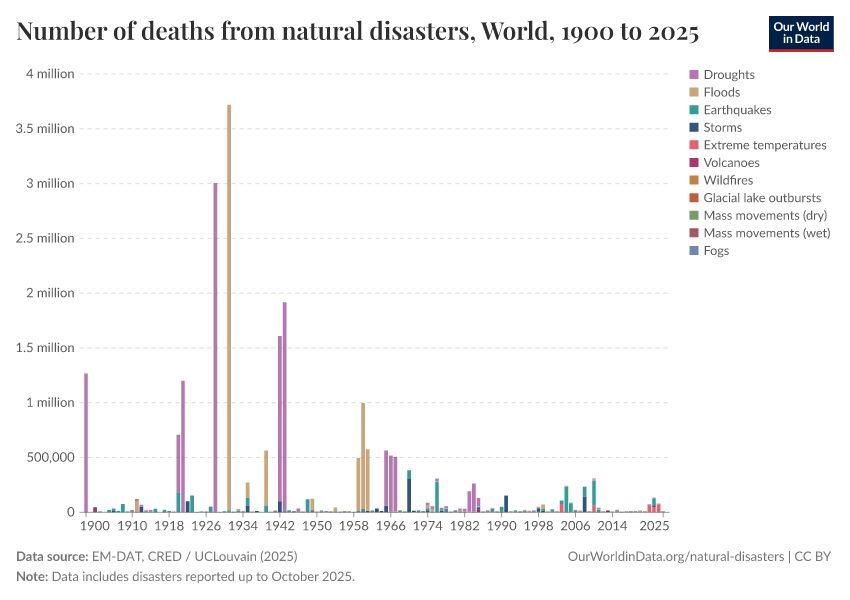
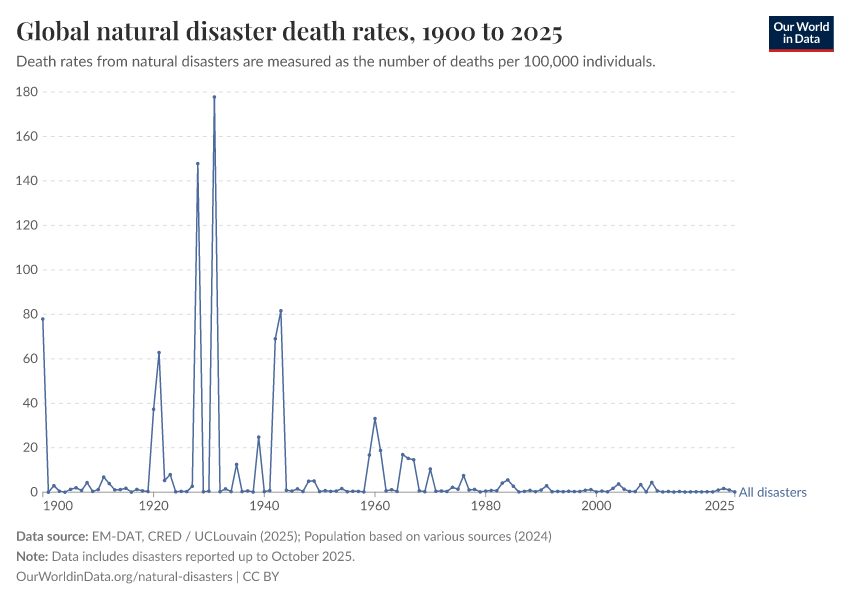
In the 1920s, natural disasters killed an average of 500,000 people per year. Today, with four times the global population, that number has dropped to roughly 45,000—a 99% decline in the per-capita death rate. The transformation happened not through divine intervention or luck, but through a century of investment in weather satellites, building codes, early warning networks, and agricultural science that turned existential threats into manageable emergencies.
The mechanisms behind this shift are concrete and replicable: Bangladesh cut cyclone deaths 100-fold through a volunteer warning network and concrete shelters. Japan's 1981 building code revision meant structures that survived the 2011 tsunami were almost exclusively post-code buildings.
The Green Revolution ended the famine cycle that once killed millions during droughts. Each of these interventions created durable protection that compounds over time.
Questions about this story
Free account needed to ask — your question is kept and asked for you right after sign-up. Answers are public.
No questions yet — be the first to ask.
Key Indicators
99%
Decline in per-capita disaster deaths
From 208 deaths per million people (1930s) to 5.4 per million (2000s)
99.8%
Decline in drought/famine deaths
From 472,400 annual deaths (1920s) to under 1,000 (2020s)
1,400
Indian Ocean sea-level monitors
Up from 1 station before the 2004 tsunami catalyzed global warning investment
5-7 min
Tsunami detection time
Down from 15-20 minutes in 2004, enabling faster evacuations
20 events
Latest: March 29th, 2023 · 4 years ago
Showing 8 of 20
JK to step
Tap a bar to jump to that date
Jump to
March 2023
Data Confirms 99% Decline in Natural Disaster Death Rates Since 1920s
LatestAnalysis
Comprehensive analysis of EM-DAT data shows probability of dying in a natural catastrophe has fallen by nearly 99% over a century despite quadrupling of global population.
February 2023
Turkey-Syria Earthquakes Kill 50,000+: Building Code Enforcement Failure
Disaster
M7.8 earthquake destroys 185,000 buildings in Turkey. Government building code amnesties since 2018 had allowed non-compliant construction. Demonstrates that codes without enforcement don't save lives.
November 2022
UN Launches 'Early Warnings for All' Initiative
Policy
COP27 initiative aims to cover entire world with multi-hazard early warning systems by 2027. Currently only half of countries have such systems.
March 2011
Tohoku Earthquake and Tsunami Validates Japanese Building Codes
Test
M9.1 earthquake and tsunami kill 19,759. But most deaths from tsunami, not building collapse. Post-1981 structures survived shaking at rates far exceeding older buildings.
November 2007
Cyclone Sidr Kills 4,234 in Bangladesh
Test
Category 5 cyclone makes landfall. Deaths down 97% from 1991 despite similar intensity. CPP network, concrete shelters, and improved forecasting demonstrate system effectiveness.
January 2005
UN Kobe Conference Mandates Indian Ocean Warning System
Policy
Hyogo Framework for Action adopted. Within 18 months, initial Indian Ocean tsunami warning system becomes operational.
December 2004
Indian Ocean Tsunami Kills 235,000 With No Warning
Disaster
M9.1 earthquake generates tsunami reaching 16 countries. No warning system existed in Indian Ocean; Pacific system detected event but had no way to alert affected nations.
April 1991
Bangladesh Cyclone Kills 140,000—Down From 500,000 in 1970
Test
Similar intensity to 1970 Bhola cyclone, but CPP volunteers provided 2-3 days warning. Deaths still catastrophic but 70% lower. Triggers further investment in shelters and reforestation.
January 1985
USAID Creates Famine Early Warning System (FEWS)
Early Warning
Response to 1983-85 Ethiopian famine. Satellite monitoring of crop and vegetation patterns enables drought detection before food shortages become famines.
January 1981
Japan's 'Shin-Taishin' Building Standard Takes Effect
Infrastructure
Post-1978 Miyagi earthquake code revision. Buildings constructed to this standard will show dramatically higher survival rates in the 1995 Kobe and 2011 Tohoku earthquakes.
July 1976
Tangshan Earthquake Kills 242,000+ in China
Disaster
M7.8 earthquake destroys industrial city of 1 million. 85% of buildings collapse—no seismic codes existed. Prompts China's first national earthquake building standard (1978).
January 1974
India Achieves Cereal Self-Sufficiency
Agricultural
Green Revolution succeeds despite Paul Ehrlich's 1968 prediction that 'India couldn't possibly feed two hundred million more people by 1980.'
Joint government-Red Crescent network begins building volunteer warning system. Will eventually reach 42,000 volunteers with transceivers.
November 1970
Bhola Cyclone Kills 300,000-500,000 in East Pakistan
Disaster
Deadliest tropical cyclone on record. Storm surge floods Ganges Delta islands with minimal warning. Catalyzes Bangladesh's cyclone preparedness program.
January 1968
Pakistan Achieves Wheat Self-Sufficiency
Agricultural
Three years after importing Borlaug's seeds, Pakistan's wheat yields double from 4.6M to 7.3M tons. Famine threat recedes.
January 1965
Pacific Tsunami Warning System Established
Early Warning
UNESCO's Intergovernmental Oceanographic Commission creates first regional tsunami warning system. Would remain the only such system for 40 years.
January 1956
Mexico Achieves Wheat Self-Sufficiency
Agricultural
Borlaug's dwarf wheat varieties transform Mexican agriculture. The model will be exported to Asia within a decade.
June 1931
China Floods Kill Up to 4 Million
Disaster
The deadliest natural disaster in recorded history. Yangtze and Huai rivers flood an area the size of England; 53 million affected. Deaths from drowning, famine, and cholera estimated at 850,000 to 4 million.
January 1924
Japan Adopts First Modern Seismic Building Code
Infrastructure
Following the 1923 Great Kantō earthquake (100,000+ deaths), Japan requires buildings to resist horizontal forces equal to 10% of building weight. First codified seismic standard.
January 1920
Baseline Era: 500,000 Average Annual Disaster Deaths
Baseline
Global disaster mortality peaks. Droughts alone kill an average of 472,000 people per year. No early warning systems, minimal building codes, pre-Green Revolution agriculture.
Scenarios
1
Universal Early Warning Coverage Achieved by 2030
Possible
Discussed by: UN Office for Disaster Risk Reduction, World Meteorological Organization
The 'Early Warnings for All' initiative succeeds in extending multi-hazard warning systems to the 50% of countries currently without coverage. Investment of $800 million in developing nations prevents $3-16 billion in annual losses. Drought and cyclone deaths in Africa and South Asia continue their decline toward negligible levels.
2
Climate Change Overwhelms Adaptation Gains
Uncertain
Discussed by: IPCC, World Bank disaster risk researchers
Increasing frequency and intensity of extreme weather events outpaces infrastructure and warning system improvements, particularly in low-income countries. Disaster death rates plateau or reverse their decline. The 2023 spike to 95,000 deaths (highest since 2010) proves to be a new baseline rather than an anomaly.
The Turkey-Syria earthquake pattern repeats: countries adopt seismic codes but don't enforce them, particularly during construction booms or political pressure. Future earthquakes in rapidly urbanizing regions with weak governance produce death tolls similar to pre-code eras despite nominal regulations.
4
Famine Returns Amid Conflict and Climate Stress
Possible
Discussed by: World Food Programme, famine researchers including Alex de Waal
The 'antifamine political contract' breaks down in multiple regions simultaneously. Conflict-driven famines (like Yemen, Ethiopia's Tigray) multiply, while climate-driven crop failures compound food insecurity. Drought death rates begin climbing from their near-zero levels.
Historical Context
3 moments from history that rhyme with this story — and how they unfolded.
1 of 3
June-August 1931
1931 China Floods: The Deadliest Disaster in Recorded History
After severe drought followed by record monsoon rains, the Yangtze and Huai rivers flooded an area the size of England. An estimated 53 million people were affected. Deaths from drowning, subsequent famine, and cholera epidemics reached somewhere between 850,000 and 4 million—the uncertainty itself a marker of the era's limited disaster response capacity.
Then
Cholera epidemic through summer 1932. Widespread reports of cannibalism in famine zones. International relief arrived slowly and incompletely.
Now
Largely forgotten even in China. But the event represents the baseline against which modern disaster response should be measured: a death toll that would be unthinkable today with weather satellites, flood control infrastructure, and emergency grain reserves.
Why this matters now
The 99% decline in disaster deaths is measured against an era when events like this were possible. Modern China experiences severe floods but deaths typically number in hundreds, not millions.
2 of 3
November 1970 - November 2007
Bangladesh Cyclone Mortality: From 500,000 (1970) to 4,234 (2007)
The 1970 Bhola cyclone killed 300,000-500,000 people in what was then East Pakistan, making it the deadliest tropical cyclone on record. The disaster catalyzed both Bangladesh's independence movement and the creation of the Cyclone Preparedness Programme. By 2007, Cyclone Sidr—a Category 5 storm of similar intensity—killed 4,234 people.
Then
After 1970, Bangladesh established a 42,000-volunteer warning network equipped with transceivers. After 1991 (140,000 deaths), the government built concrete cyclone shelters and implemented coastal reforestation.
Now
Bangladesh became a global model for low-cost disaster risk reduction. The same geography that made it vulnerable—low-lying delta, dense population—now hosts one of the world's most effective early warning systems.
Why this matters now
Bangladesh demonstrates that the 99% decline isn't about avoiding disasters but about transforming the relationship between hazards and deaths. The cyclones didn't stop; the deaths did.
3 of 3
1965-1974
Green Revolution: Defying the Famine Predictions (1960s-1970s)
Paul Ehrlich's 1968 book 'The Population Bomb' predicted that 'hundreds of millions of people will starve to death' and that India 'couldn't possibly feed two hundred million more people by 1980.' Instead, Norman Borlaug's high-yield wheat varieties enabled India to achieve cereal self-sufficiency by 1974. Pakistan got there by 1968.
Then
Indian wheat production rose from 12.3 million tons (1965) to 20.1 million tons (1970). The subcontinent avoided predicted mass famines.
Now
Drought-related deaths dropped 99.8% from 1920s levels. Famines became political failures (Ethiopia 1984, Yemen 2020s) rather than inevitable consequences of weather.
Why this matters now
The decline in disaster deaths is largely a story about ending famine. The Green Revolution severed the link between drought and mass death that had defined human history.