

Pull to refresh
Logo
Databricks lets advertisers send predicted customer value to ad platforms

Databricks lets advertisers send predicted customer value to ad platforms

New Capabilities

CustomerLake Conversions pushes model-scored purchases through ad platform conversion APIs and returns campaign results to the warehouse

Overview

Updated 43 minutes ago

Advertisers send ad platforms a simple signal: a purchase happened. On November 19, Databricks began offering a narrower one. A brand can now send Google, Meta or TikTok a purchase from a customer its own model predicts will buy again, delivered through each platform's conversion API.

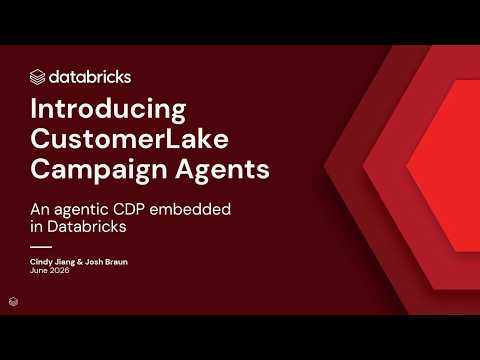
The capability, CustomerLake Conversions, runs inside CustomerLake, the customer data platform Databricks announced in June and built on its own data platform. Campaign results come back into the same system, so a brand and its agency can judge ad spend against customer value instead of a count of checkouts.

Why it matters

Ad platforms optimize toward whatever signal they are fed, so changing the signal changes which customers a brand's budget chases.

Questions about this story

Free account needed to ask — your question is kept and asked for you right after sign-up. Answers are public.

No questions yet — be the first to ask.

Key Indicators

12
Launch partners
Ad platforms and agencies named at launch, from Google and Meta to Omnicom and Epsilon.
9
Ad platforms named among partners
Amazon Ads, Google, LinkedIn, Meta, Microsoft Ads, Reddit, Snapchat, The Trade Desk and TikTok.
3
Agency and identity partners
Epsilon, Merkle and Omnicom get governed access to client customer data without copying it.

Voices

Curated perspectives — historical figures and your fellow readers.

Sign up to generate historical perspectives on this story.

People Involved

Organizations Involved

Timeline

June 2026 November 2026

2 events Latest: Today
  1. CustomerLake Conversions goes live with twelve partners

    Today Product launch

    Databricks adds a Conversions tab that sends model-scored purchase events to ad platforms through conversion APIs, and returns campaign insights via OpenSharing and Lakeflow Connect.

  2. Databricks announces CustomerLake

    Product launch

    At its Data + AI Summit, Databricks announces an agentic customer data platform built on its own platform, with agents that build audiences in plain language.

Scenarios

1

Conversions leaves preview and ships to all Campaign Agents customers

Likely Resolves by Q2 2027

Discussed by: Databricks' own launch post, which says the capability will be available to all Campaign Agents customers but gives no date

The launch post describes the Conversions tab as coming, not shipped to everyone. If general availability lands in the first half of 2027, the tab becomes a standard part of the Campaign Agents workflow rather than a named pilot with a dozen logos attached.

2

An agency partner publishes a named client case study

Possible Resolves by Q3 2027

Discussed by: Databricks, which built the launch around agency access, and marketing trade coverage of the shared-governance pitch

Epsilon, Merkle and Omnicom are the distribution channel. If the delegated-access model works, one of them will put a named client's purchase data through the tab and publish the outcome. If it does not, the partners stay on the logo list and quiet.

3

Per-destination consent controls arrive before broad rollout

Uncertain Resolves by Q1 2027

Discussed by: Early reviews of the launch, which note that documentation on consent handling may still be incomplete

Sending predicted customer value to nine ad platforms raises a question the launch post answers only partly: which customer consented to what. Brands in finance and health will want enforcement at the destination level, not a policy statement. Documented controls would open that pipeline; their absence keeps regulated advertisers in pilot.

4

A published study uses campaign data returned through OpenSharing

Possible Resolves by End of 2027

Discussed by: Databricks, which frames the return path as the measurement half of the product, and agency measurement teams

The activation half is easy to demonstrate; the measurement half is not. Databricks says campaign insights flow back so teams can run marketing mix models and incrementality tests against customer value. A published study using that returned data would show the loop closes. Without one, the product is a better signal sender and nothing more.

Historical Context

3 moments from history that rhyme with this story — and how they unfolded.

April 2021

Apple's App Tracking Transparency (2021)

Apple began requiring iPhone users to opt in to cross-app tracking. Most declined. The identifier advertisers had used to tie a purchase back to an ad impression became scarce, and pixel-based measurement on iOS degraded.

Then

Advertisers moved budgets toward platforms that could still measure, and rushed to send conversion data server-to-server instead of from the browser.

Now

Conversion APIs from Meta, Google, TikTok and others became standard plumbing, and the quality of the signal a brand could supply became a competitive advantage.

Why this matters now

CustomerLake Conversions is built for the world ATT created. When browser signals shrank, whoever could deliver rich first-party signals from a governed store gained leverage over ad platforms.

2021-2023

The composable CDP and reverse ETL wave (2021-2023)

A group of startups argued that the customer data platform did not need to be a separate system of record. Customer data already sat in warehouses like Snowflake and Databricks; tools such as Hightouch and Census pushed that data out to marketing tools instead of asking companies to copy it into a CDP.

Then

Reverse ETL became a product category, and established CDP vendors added warehouse-native options to keep accounts.

Now

The warehouse became an accepted source for marketing activation, though most brands still bought a marketing-facing interface on top.

Why this matters now

Databricks is now shipping that argument as its own product, with agency distribution attached, rather than leaving the activation layer to partners.

October 2020

Twilio acquires Segment (2020)

Twilio bought Segment, the best-known independent customer data platform, betting that a single governed view of the customer belonged next to communications tools. The deal made CDP consolidation a board-level topic across marketing software.

Then

Other platform companies looked for CDP assets, and pricing for customer data infrastructure rose.

Now

The standalone CDP survived as a category, sold on marketer-friendly interfaces and packaged connectors rather than on data storage.

Why this matters now

The competitive question Conversions poses is whether that interface layer is worth buying separately once the warehouse vendor ships activation itself.

Sources

(5)