


Pull to refresh
Logo
DeepL's Aure carries tone and pace into live translation

DeepL's Aure carries tone and pace into live translation

New Capabilities

A single end-to-end voice model replaces the transcribe-translate-speak pipeline in eight languages

Overview

Updated 44 minutes ago

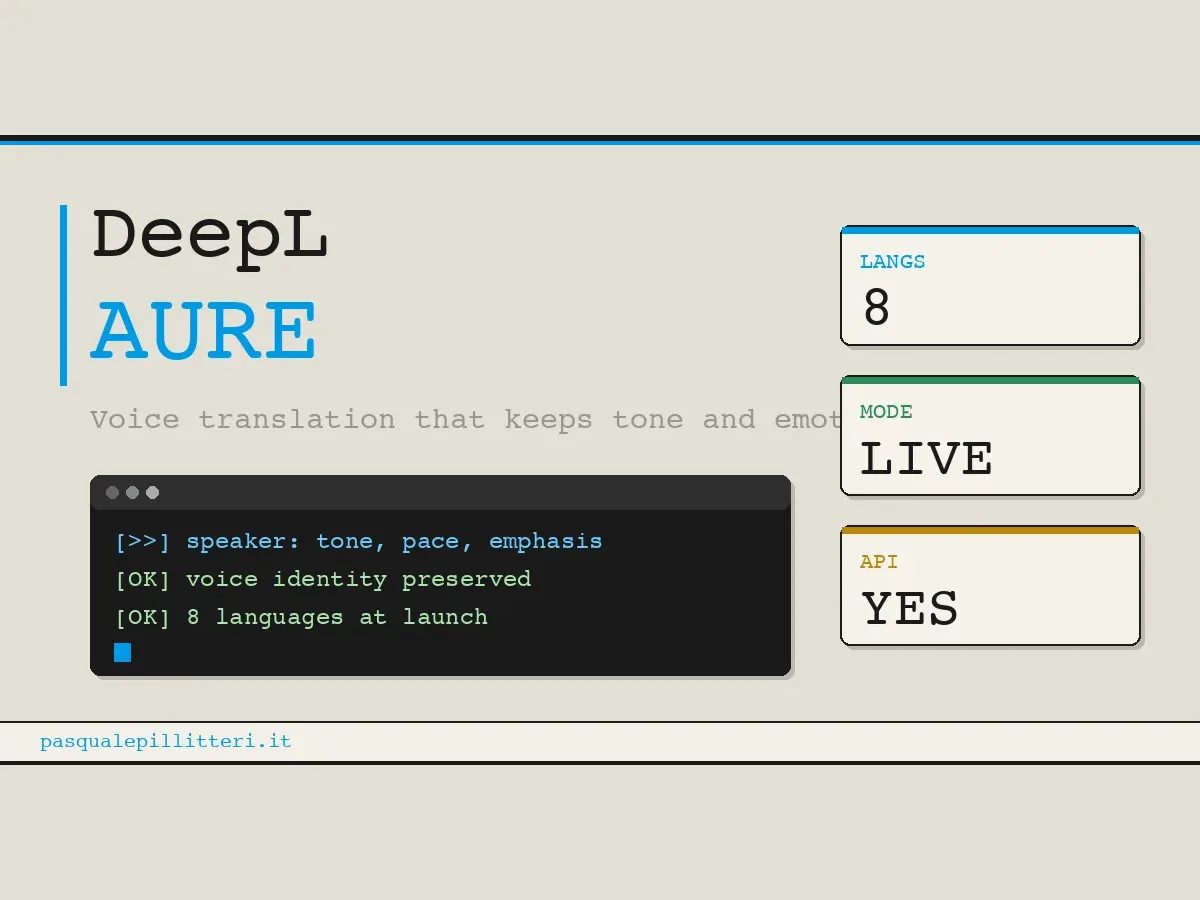
DeepL's live translation used to hold a speaker's voice for the first few seconds of a call, then let the delivery drift. A joke landed flat. A warning lost its edge. Aure, the voice model DeepL announced this week, keeps tracking tone, pace and emphasis for the length of a conversation.

The change is architectural. Older systems turned speech into text, translated the text, then generated audio. Aure works end to end, reading the source audio alongside the translation. It ships in eight languages with no setup, and DeepL says it stores no voice profile.

Why it matters

Deals and diagnoses happen across languages every day. A translator that carries emphasis changes who is understood, not just what is said.

Questions about this story

Free account needed to ask — your question is kept and asked for you right after sign-up. Answers are public.

No questions yet — be the first to ask.

Key Indicators

8
Launch languages
English, German, Spanish, French, Italian, Japanese, Portuguese and Korean at launch.
0
Stored voice profiles
DeepL says Aure matches a voice live in memory and deletes the data when a session ends.
3
Speech layers separated
Voice identity, prosody and spoken content are trained apart, then recombined in the target language.

Voices

Curated perspectives — historical figures and your fellow readers.

Sign up to generate historical perspectives on this story.

People Involved

Organizations Involved

Timeline

September 2026 November 2026

3 events Latest: Today
  1. DeepL unveils Aure

    Today Product launch

    Aure tracks tone, pace and emphasis continuously across eight languages, with no setup and no stored voice profile.

  2. Engineering chief flags word-order limits

    Statement

    Vikram Singh says Korean and similar languages force the system to wait for sentence-final meaning before translating.

  3. DeepL adds voice preservation

    Product

    DeepL Voice begins carrying a speaker's own recognizable voice across languages instead of a generic synthetic one.

Scenarios

1

DeepL adds Mandarin to Aure

Likely Resolves by End of 2027

Discussed by: Chinese technology press, which noted the launch excluded Chinese

DeepL's text translator has long supported Chinese, but Aure launched without it. Adding Mandarin would require handling a language whose meaning often resolves late in a sentence, the same problem Singh described for Korean. A launch would most likely appear first in DeepL's own product documentation.

2

A rival ships continuous tone-adaptive speech translation

Possible Resolves by Q2 2027

Discussed by: Voice AI trade coverage tracking Google, Microsoft and OpenAI

DeepL's advantage is narrow if larger rivals match it. The test is whether a competitor announces live speech translation that adjusts to a speaker's tone or pace mid-sentence, rather than fixing a voice at the start of a session. Google and Microsoft already sell real-time translation in meetings; neither has described continuous prosody transfer.

3

DeepL keeps Voice enterprise-only

Likely Resolves by End of 2027

Discussed by: DeepL's own product positioning, which targets meetings, in-person conversations and an API

Aure ships inside DeepL Voice for Online Meetings, DeepL Voice for In-Person Conversations and the Voice API. None of those is a consumer app. DeepL could keep it that way, selling seats to companies rather than individuals, which would limit how many people encounter the model directly.

Historical Context

3 moments from history that rhyme with this story — and how they unfolded.

December 2014 - 2015

Skype Translator preview (2014-2015)

Microsoft demonstrated near-real-time spoken translation inside Skype, first English to Spanish, later adding more pairs. It ran on a three-stage pipeline: recognize speech, translate the text, synthesize a voice.

Then

The preview drew attention but the synthesized voice sounded flat and the lag made conversation awkward.

Now

The pipeline became the standard architecture for live speech translation for the next decade, and its limits, flat delivery and turn-taking delays, defined the problem Aure targets.

Why this matters now

Aure's main technical claim is that it abandons that pipeline for a single end-to-end model, which is what allows it to follow a speaker mid-sentence.

January 2019

Google Interpreter Mode (2019)

Google turned its Assistant into a live interpreter on smart displays and speakers, aimed at hotel front desks, airports and retail counters. It handled one speaker at a time, translating each turn aloud.

Then

The feature rolled out to a limited set of hotels and airports and worked best for short, transactional exchanges.

Now

It established the turn-based model for consumer translation, where each person speaks, waits, and hears a neutral voice read the result.

Why this matters now

Turn-based translation discards the speaker's delivery by design. Aure is aimed at the continuous, overlapping conversations that model cannot handle.

August 2017

DeepL enters machine translation (2017)

A Cologne startup released a translation service and claimed its output read more naturally than Google Translate, then the dominant tool. It started with a handful of European languages.

Then

DeepL gained users among translators and businesses who cared about phrasing rather than sheer language count.

Now

The company built a paid business on document translation and enterprise glossaries, positioning itself on quality rather than scale.

Why this matters now

DeepL is following the same playbook in voice: entering after larger rivals, with a narrower language list and a claim about naturalness.

Sources

(8)