

Pull to refresh
Logo
Charred curse papyri in a temple dump push Egypt's Apophis ritual back 1,000 years

Charred curse papyri in a temple dump push Egypt's Apophis ritual back 1,000 years

New Capabilities

Forty burned scraps from Thutmose III's temple at Thebes are the first physical proof that priests destroyed images of the serpent Apophis by fire — and that they mass-produced them

Overview

Updated Yesterday

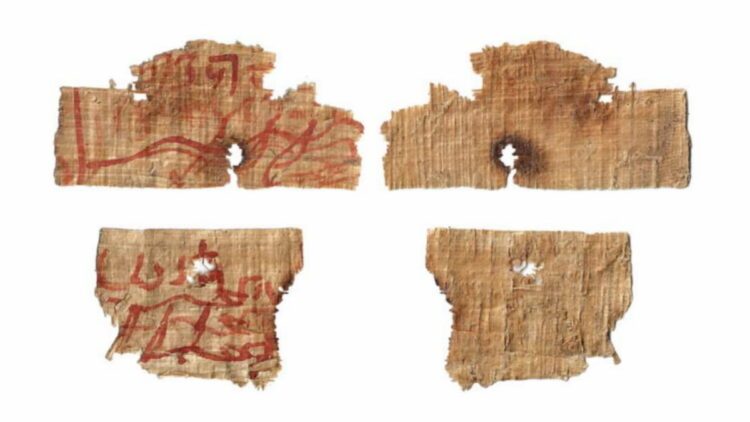
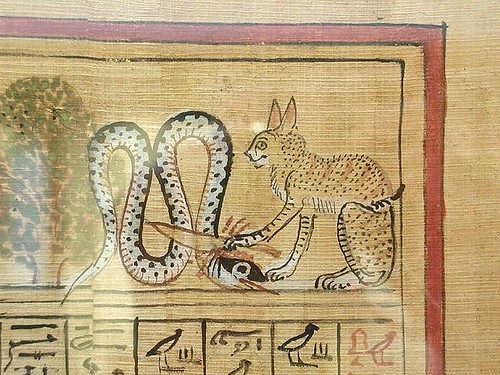
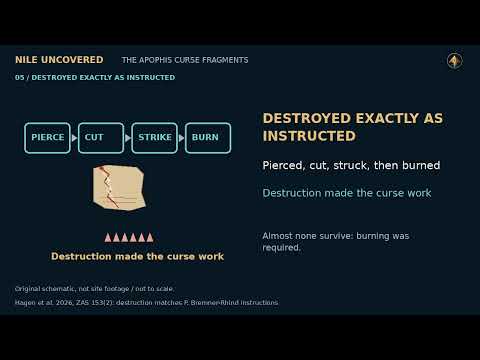
Egyptian priests drew the serpent Apophis in red ink on a fresh sheet of papyrus, spat on it, stabbed it and burned it. Destroying the drawing was the point of the ritual, which is why almost nothing of it survived. Then, between 2014 and 2025, excavators sifting a temple garbage dump at Thebes pulled out about 40 scraps that had been pierced and scorched but not fully consumed.

Each scrap is smaller than half a postage stamp. Together they are the earliest physical evidence that the Apophis curse was actually carried out, roughly 3,400 years ago. They also match, step for step, a ritual manual copied about 1,000 years later, and they show the curse was mass-produced: images were drawn in grids on large sheets, then cut apart for repeated use.

Why it matters

Priests did not curse Egypt's snake god once. Forty burned scraps show a rite that was mass-produced, routine and probably common outside temples too.

Questions about this story

Free account needed to ask — your question is kept and asked for you right after sign-up. Answers are public.

No questions yet — be the first to ask.

Key Indicators

40
Papyrus fragments recovered
Charred, pierced scraps found in the temple dump, none larger than half a postage stamp.
20
Minimum ceremonies implied
Based on one square of each design per performance; many more would have burned to nothing.
3,400
Age of the fragments, in years
Pottery alongside them dates the deposit to the mid-to-late 18th Dynasty into the early 19th.
1,000
Years earlier than the previous copy
The only known ritual manual, the Bremner-Rhind papyrus, dates to about 305 BC.

Voices

Curated perspectives — historical figures and your fellow readers.

Sign up to generate historical perspectives on this story.

People Involved

Organizations Involved

Timeline

2008 November 2026

4 events Latest: 4 days ago
Tap a bar to jump to that date
  1. University of Copenhagen announces the find and the peer-reviewed study

    Latest Publication

    The paper appears in the Zeitschrift für Ägyptische Sprache und Altertumskunde, with a public release the same week.

  2. Fragment recovery in the dump ends with about 40 pieces

    Excavation

    Twelve show Apophis, 14 show the Children of the Rebel, about 16 are too damaged to assign.

  3. First charred papyrus scraps turn up in the temple dump

    Discovery

    Excavators find burnt fragments outside the north enclosure wall; recovery continues through 2025.

  4. Egyptian-Spanish mission starts digging at Thutmose III's temple

    Excavation

    The joint project begins work at the mortuary temple on Thebes' west bank.

Scenarios

1

Full fragment catalogue confirms the curse as routine temple work

Likely Resolves by End of 2028

Discussed by: Fredrik Hagen and the paper's authors, who describe at least 20 ceremonies from the surviving pieces

The team has published only part of the set so far. A complete catalogue, with drawings, scribal hands and counts, would firm up the claim that the rite ran regularly at Thutmose III's temple rather than on rare occasions. Hagen's own framing is careful: the counts suggest regularity, not necessarily a daily ritual.

2

A second site yields Apophis curse papyri

Possible Resolves by End of 2029

Discussed by: Hagen, who argues the ritual was widely used outside temples, and the paper's more cautious discussion of that reach

The press release goes further than the paper on how common the curse was outside temple walls. A find at another site, such as a private house or a different temple dump, would settle it. Burned papyri are rare because the ritual required their destruction, so this depends on another lucky garbage deposit.

3

A museum storeroom re-identifies an uncut Apophis sheet

Uncertain Resolves by Q2 2028

Discussed by: The authors, who note the Metropolitan Museum's complete five-square sheet from Deir el-Bahri as the model for the cut-down Theban pieces

The ritual's products were drawn in grids and cut apart, so uncut sheets should exist in collections, catalogued as generic serpent drawings. A re-identification would widen the map of where the practice was used without a new excavation. The Met sheet, with its mirror-image hieratic, is the template.

Historical Context

3 moments from history that rhyme with this story — and how they unfolded.

Around 305 BC

Bremner-Rhind papyrus (c. 305 BC)

A Theban priest acquired a ritual manual that set out, step by step, how to curse Apophis: draw the serpent in red ink on a new sheet of papyrus, then put the drawing on the fire. The roll ended up in the British Museum.

Then

It preserved the only detailed instructions for the rite known to modern scholars.

Now

For over two millennia it stood as the sole evidence of the procedure, with no proof anyone actually performed it.

Why this matters now

The Theban scraps match its instructions closely enough that the manual now reads as a record of practice, not just theory.

26th Dynasty, c. 664-525 BC

Uncut serpent sheet from Deir el-Bahri (26th Dynasty)

A complete papyrus sheet carrying five serpent squares, each about 4 by 2 centimeters and captioned with the same epithets, survived and entered the Metropolitan Museum of Art. The squares sit side by side, uncut, framed by thin red lines.

Then

It showed the drawings were produced in bulk, in rows, and cut apart for use.

Now

It became the reference object for recognizing the format of later fragment finds.

Why this matters now

The Theban pieces carry the same frame lines, which is how the authors know they were mass-produced rather than one-offs.

Ramesside period

Ramesside statue and stela carrying Apophis passages

A royal statue and a stela from the Ramesside era preserved passages of the same ritual, carved in stone rather than written on perishable papyrus.

Then

They kept the spell text alive after the papyrus copies burned.

Now

They left scholars arguing over when the ritual was first composed, with one recent analysis allowing an origin as early as the Old Kingdom.

Why this matters now

Text had survived before; physical proof of the burning had not. The dump fragments fill that gap.

Sources

(8)