


Pull to refresh
Logo
Durvalumab and enfortumab vedotin before bladder surgery improve survival in cisplatin-ineligible patients

Durvalumab and enfortumab vedotin before bladder surgery improve survival in cisplatin-ineligible patients

New Capabilities

The VOLGA trial's two-drug arm cut the risk of death by 42% and of cancer events by 49%. A three-drug version missed on overall survival.

Overview

Updated 58 minutes ago

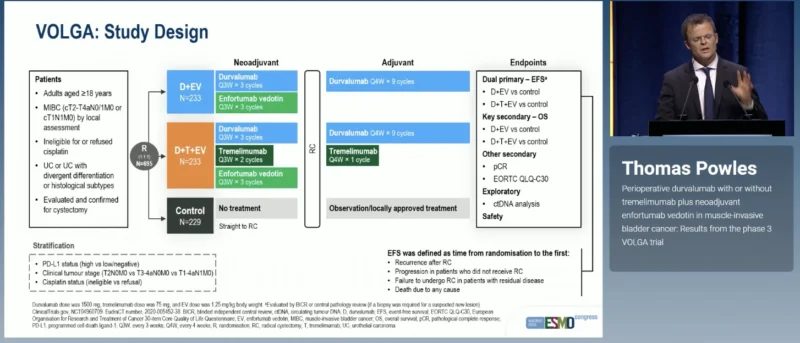
About half of people with muscle-invasive bladder cancer cannot receive cisplatin, the chemotherapy normally given before surgery to reduce the chance the cancer returns. Those patients have generally gone straight to bladder removal. A 695-patient international trial now shows a chemotherapy-free drug pair given before surgery lowers the risk of death by 42%.

The pair is durvalumab, an immunotherapy, and enfortumab vedotin, which carries a cancer-killing drug to tumor cells. At two years, 78.4% of patients who received them were alive, compared with 69.4% who had surgery alone. A three-drug version added tremelimumab and improved event-free survival but did not show a statistically significant overall survival benefit.

Why it matters

Half of muscle-invasive bladder cancer patients cannot take cisplatin. This gives them a pre-surgery option that keeps more of them alive.

Questions about this story

Free account needed to ask — your question is kept and asked for you right after sign-up. Answers are public.

No questions yet — be the first to ask.

Key Indicators

42%
Lower risk of death
Hazard ratio 0.58 for overall survival with durvalumab plus enfortumab vedotin versus surgery alone.
49%
Lower risk of cancer events or death
Hazard ratio 0.51 for event-free survival, which counts recurrence, progression, death and missed planned surgery.
78.4%
Alive at two years, combination arm
Estimated overall survival for patients given durvalumab and enfortumab vedotin before surgery.
69.4%
Alive at two years, surgery alone
Estimated overall survival in the control arm, which could receive other approved treatment after surgery.
45.1%
No detectable tumor at surgery
Pathological complete response in the combination arm, against 9.6% in the surgery-alone arm.
695
Patients enrolled
Randomized across 229 medical centers in 25 countries between the two drug arms and surgery alone.
71.1%
Severe or worse adverse events, combination arm
Grade 3 or higher events from any cause, versus 50.2% with surgery alone; 30.7% were judged treatment-related.

Voices

Curated perspectives — historical figures and your fellow readers.

Sign up to generate historical perspectives on this story.

People Involved

Organizations Involved

Timeline

2023 November 2026

4 events Latest: 3 days ago
Tap a bar to jump to that date
  1. VOLGA results reported and published

    Latest Clinical trial

    The 695-patient trial reported 78.4% two-year survival with durvalumab plus enfortumab vedotin versus 69.4% with surgery alone.

  2. KEYNOTE-905 tests a rival chemotherapy-free regimen

    Clinical trial

    The EV-303/KEYNOTE-905 trial evaluated perioperative enfortumab vedotin plus pembrolizumab in the same cisplatin-ineligible population.

  3. Perioperative durvalumab becomes a standard for cisplatin-eligible patients

    Clinical trial

    NIAGARA paired durvalumab with chemotherapy before surgery and durvalumab alone after, improving event-free and overall survival.

  4. Enfortumab vedotin plus pembrolizumab beats chemotherapy in advanced disease

    Clinical trial

    The EV-302 trial made the antibody-drug conjugate plus immunotherapy a standard first-line option for advanced urothelial cancer.

Scenarios

1

FDA approves perioperative durvalumab plus enfortumab vedotin

Likely Resolves by Q2 2028

Discussed by: Trial investigators and the UCLA Health and Barts Cancer Institute release teams, who note the regimen needs regulatory approval before routine use

The two-drug arm produced the strongest result in the trial: a 42% reduction in the risk of death and a pathological complete response rate nearly five times the control arm's. That combination is the obvious filing package. Approval would make a chemotherapy-free pre-surgery regimen available to patients who currently go straight to bladder removal.

2

Guidelines list the regimen as a preferred option before regulators act

Possible Resolves by End of 2027

Discussed by: Oncology guideline panels and the trial investigators who have emphasized the unmet need in cisplatin-ineligible patients

US practice often shifts on guideline text before a drug is formally approved for a new use. The National Comprehensive Cancer Network could list the perioperative combination as a preferred choice for cisplatin-ineligible disease, which would let cancer centers adopt it off-label. That step is faster than a regulatory review and would decide whether community practices follow academic centers.

3

A head-to-head trial against the pembrolizumab regimen is launched

Unlikely Resolves by End of 2028

Discussed by: Barts Cancer Institute researchers, who wrote that VOLGA cannot show which approach offers the best balance of survival and side effects

KEYNOTE-905 tested enfortumab vedotin with pembrolizumab in the same cisplatin-ineligible group and also improved survival. VOLGA never compared the two directly, so doctors have no randomized answer on which is better. A sponsor would need to fund a trial that puts them side by side, and neither company has an obvious incentive to run one against a competitor's drug.

Historical Context

3 moments from history that rhyme with this story — and how they unfolded.

2023

EV-302 (2023)

Enfortumab vedotin plus pembrolizumab was tested against platinum-based chemotherapy in people with previously untreated advanced urothelial cancer. The drug pair beat chemotherapy on progression-free and overall survival.

Then

The combination became a standard first-line option for advanced bladder cancer.

Now

It established the antibody-drug conjugate plus immunotherapy pairing that later trials moved into earlier-stage disease.

Why this matters now

VOLGA uses one half of that pairing, enfortumab vedotin, and swaps the immunotherapy partner. The earlier trial is why the drug was available to test before surgery.

2024

NIAGARA (2024)

Durvalumab was given with gemcitabine-cisplatin before bladder removal surgery, then alone afterward, in patients who could receive cisplatin. The regimen improved event-free and overall survival.

Then

It became a new standard for cisplatin-eligible patients.

Now

It split the field: cisplatin-eligible patients got chemotherapy plus immunotherapy, while cisplatin-ineligible patients still had no proven pre-surgery drug option.

Why this matters now

VOLGA is the cisplatin-ineligible counterpart to NIAGARA, using the same immunotherapy with a non-chemotherapy partner.

2025

KEYNOTE-905 / EV-303 (2025)

Enfortumab vedotin plus pembrolizumab was tested around surgery in patients who could not receive cisplatin or declined it. The combination improved survival.

Then

It gave the cisplatin-ineligible group its first positive perioperative immunotherapy result.

Now

It created a direct comparison problem: two regimens now work in the same patients, and they have never been tested against each other.

Why this matters now

Barts researchers noted VOLGA did not compare its regimen with this one, so the choice between them remains unanswered.

Sources

(7)