



Pull to refresh
Logo
FDA approves Instylla's Embrace hydrogel embolic for peripheral arterial bleeds

FDA approves Instylla's Embrace hydrogel embolic for peripheral arterial bleeds

New Capabilities

Expanded clearance adds a clotting-independent way to stop arterial bleeds, 14 months after the device's first approval for tumor embolization.

Overview

Updated 43 minutes ago

The FDA on October 29 approved Instylla's Embrace hydrogel embolic system for a second indication: stopping peripheral arterial bleeds in vessels up to 6 millimeters. It is the first liquid embolic cleared for both arterial bleeding and hypervascular tumor embolization, and it is on the US market now.

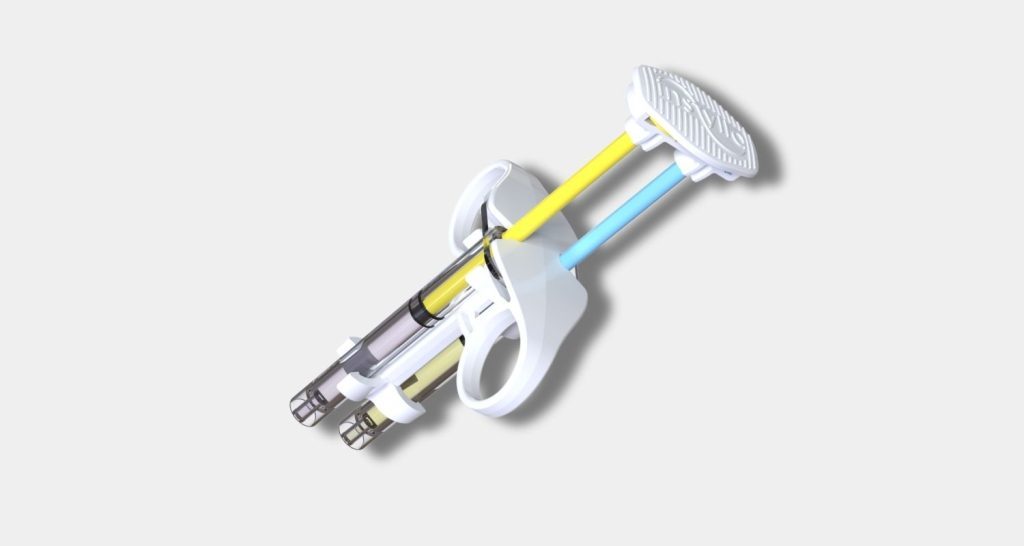
Embrace is a two-part water-based liquid delivered through a microcatheter. The two components combine in the vessel to form a hydrogel plug that blocks blood flow without relying on the patient's clotting system. That matters because hemorrhage is the leading cause of potentially preventable death after trauma, and embolization coils, the standard tool, can fail in patients whose blood won't clot.

The expanded approval rests on the HALT study, a 130-patient trial at 22 US sites that reported 100% freedom from major adverse events and 90.0% clinical success at 30 days. The hydrogel dissolves on its own via hydrolysis after roughly 11 months.

Why it matters

Trauma hemorrhage is the leading preventable cause of death after injury — Embrace gives interventional radiologists a clotting-independent way to stop arterial bleeds.

Questions about this story

Free account needed to ask — your question is kept and asked for you right after sign-up. Answers are public.

No questions yet — be the first to ask.

Key Indicators

90.0%
Clinical success at 30 days
No rebleeding from the target lesion in the HALT study of 130 patients.
100%
Freedom from major adverse events
Reported across the full HALT study cohort.
130
Patients enrolled in HALT
Prospective, multicenter, single-arm trial conducted at 22 US sites.
~11 months
Hydrogel dissolution time
Embrace dissolves via hydrolysis after roughly 11 months.

Voices

Curated perspectives — historical figures and your fellow readers.

Sign up to generate historical perspectives on this story.

People Involved

Organizations Involved

Timeline

August 2025 October 2026

4 events Latest: Today
Tap a bar to jump to that date
  1. FDA expands Embrace approval to peripheral arterial bleeds

    Today Regulatory Approval

    Instylla announced FDA approval of the expanded indication covering embolization of peripheral arterial bleeds in vessels up to 6 mm, citing the HALT study's 100% freedom from major adverse events and 90.0% clinical success at 30 days.

  2. FDA records approval of PMA supplement S008

    Regulatory Approval

    FDA's database records an approved PMA supplement S008 for the Embrace Hydrogel Embolic System on this date.

  3. Instylla announces PMA and begins commercial launch

    Company Announcement

    Instylla announced the FDA approval and started the US commercial launch of Embrace.

  4. FDA grants first premarket approval for Embrace HES

    Regulatory Approval

    FDA approved Embrace for embolization of hypervascular tumors in peripheral arteries up to 5 mm, based on a 150-patient randomized trial versus standard of care.

Scenarios

1

FDA's official record posts the bleed indication

Likely Resolves by End of 2026

Discussed by: Novapharmanews, which noted on October 26 that the FDA's public PMA page had not yet shown the bleed indication

Instylla announced the expanded approval on October 29, but the FDA's public premarket approval page had not yet posted the bleed indication when checked on October 26. The Innolitics FDA database record for supplement S008 shows an approval date of October 23, 2026. This resolves when the FDA's primary PMA page for P250003 explicitly lists peripheral arterial bleeds in its approval order.

2

HALT study results published in a peer-reviewed journal

Likely Resolves by End of 2027

Discussed by: Standard practice for pivotal device trials; the HALT data are currently company-reported only

The 90.0% clinical success and 100% freedom from major adverse events are company-reported figures from data on file. Peer review would validate the results independently. Interventional radiology journals such as the Journal of Vascular and Interventional Radiology are the likely venue.

3

FDA approves new Embrace indications

Possible Resolves by End of 2028

Discussed by: Instylla leadership, which described Embrace as a platform for 'the many vascular conditions still ahead'

Instylla frames Embrace as a platform technology rather than a single-indication product. Possible expansions include non-variceal upper gastrointestinal bleeding, solid-organ bleeds, or vessels larger than 6 mm. Each would require a new PMA supplement supported by clinical data.

4

Instylla acquired by a larger medical device company

Possible Resolves by End of 2028

Discussed by: Common trajectory for venture-backed device startups after FDA approval; no specific buyer named publicly

With two FDA-approved indications and a platform technology, Instylla is a plausible acquisition target for larger players in embolization or interventional radiology. Companies with embolization portfolios include Boston Scientific, Medtronic, and Merit Medical. An acquisition or majority investment would signal commercial validation of the platform.

Historical Context

2 moments from history that rhyme with this story — and how they unfolded.

September 1995

Guglielmi detachable coil approval (1995)

The FDA approved the Guglielmi detachable coil for cerebral aneurysms, the first endovascular treatment that could be delivered and retrieved through a microcatheter. The coil is packed into an aneurysm and relies on the patient's blood clotting around it to seal off flow.

Then

Coil embolization became a mainstay of aneurysm treatment, often replacing open surgery.

Now

Coils remain a standard embolization tool, but their dependence on the clotting cascade limits them in coagulopathic patients.

Why this matters now

Embrace's core design feature — blocking flow without relying on the patient's clotting — directly addresses the coils' key limitation in trauma patients whose blood won't clot.

July 2005

Onyx liquid embolic approval (2005)

The FDA approved the Onyx liquid embolic system for brain arteriovenous malformations. It was a non-adhesive liquid polymer delivered through a microcatheter that solidified in the vessel, the first of its kind in the US.

Then

Onyx established liquid embolics as a treatment category in neurointervention.

Now

Onyx's solvent, DMSO, can cause pain and vessel spasm, and the polymer can trap the catheter — risks Embrace avoids with a water-based, non-adhesive formula.

Why this matters now

Embrace extends the liquid-embolic approach to peripheral arterial bleeds without DMSO and without catheter adhesion.

Sources

(8)