



Pull to refresh
Logo
Pig kidneys bridge first patients to human transplants

Pig kidneys bridge first patients to human transplants

New Capabilities

eGenesis reports five patients treated with engineered pig kidneys; two went on to receive human donor organs

3 days ago: eGenesis reports five patients treated; two bridged to human transplants

Overview

Updated 1 hour ago

Tim Andrews went 271 days without dialysis after receiving a genetically engineered pig kidney in January 2025. In January 2026, he received a human donor kidney — the first time a pig organ has bridged a patient to a human transplant.

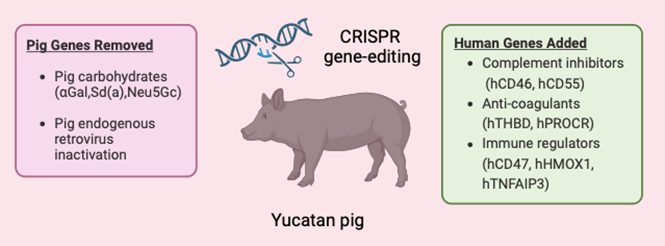
eGenesis reported on September 4 that five patients have received its EGEN-2784 pig kidneys since March 2024. Three have sustained kidney function beyond eight months, and two have transitioned to human donor kidneys. The company plans a 33-patient trial starting in early 2027.

Why it matters

If pig kidneys can keep patients off dialysis while they wait for human organs, it could change how 800,000 Americans with kidney failure are treated.

Questions about this story

Free account needed to ask — your question is kept and asked for you right after sign-up. Answers are public.

No questions yet — be the first to ask.

Key Indicators

5
Patients who received pig kidney transplants
Since March 2024 under FDA Expanded Access at Mass General Brigham.
271
Days Andrews lived without dialysis on pig kidney
Longest dialysis-free survival after porcine kidney xenotransplant in a living human.
2
Patients bridged to human donor transplants
First reported transitions from xenotransplantation to allotransplantation.
28,000
Kidney transplants performed in US in 2024
Against more than 800,000 Americans with end-stage kidney disease.
60%
Five-year mortality rate on dialysis
Higher than mortality rates for the most common cancers.

Voices

Curated perspectives — historical figures and your fellow readers.

Ever wondered what historical figures would say about today's headlines?

Sign up to generate historical perspectives on this story.

Play

Exploring all sides of a story is often best achieved with Play.

Most of these play right now — no account needed. Sign up to save scores, keep a streak, and unlock Debate and Predict. Log in Sign Up
Predict 3 ways this could play out. Back the one you believe — contrarian picks score more when a scenario has a resolution date. Log in to play

People Involved

Organizations Involved

Timeline

March 2024 September 2026

5 events Latest: 3 days ago
Tap a bar to jump to that date
  1. eGenesis reports five patients treated; two bridged to human transplants

    Latest Clinical update

    eGenesis announced that five patients received EGEN-2784 kidneys since March 2024. Three sustained function beyond eight months; two transitioned to human donor kidneys. The Lancet published Andrews' case. FDA cleared the 33-patient RESTORE trial.

  2. Andrews receives human donor kidney

    Procedure

    Andrews received a deceased-donor human kidney with immediate graft function and no evidence of sensitization during follow-up.

  3. Andrews' pig kidney removed after 271 days

    Medical event

    The xenotransplant developed microvascular injury and inflammation after immunosuppression was reduced. The kidney was removed; Andrews went on dialysis for 82 days.

  4. Tim Andrews receives engineered pig kidney

    Procedure

    Andrews received an EGEN-2784 pig kidney under an FDA Expanded Access Investigational New Drug application. The kidney functioned immediately.

  5. First pig kidney xenotransplant to living human

    Medical milestone

    Massachusetts General Hospital performed the world's first porcine kidney xenotransplant to a living human. The patient survived 52 days before death from cardiac causes unrelated to the transplant.

Historical Context

3 moments from history that rhyme with this story — and how they unfolded.

December 1954

First successful kidney transplant (1954)

Joseph Murray transplanted a kidney between identical twins at Peter Bent Brigham Hospital in Boston, now part of Mass General Brigham. The recipient, Richard Herrick, lived eight more years.

Then

The success proved organ transplantation was possible, leading to the development of immunosuppressive drugs.

Now

Kidney transplantation became the gold standard for end-stage kidney disease, but donor shortages persist.

Why this matters now

The same institution that pioneered human kidney transplantation is now testing pig kidneys as a bridge to human transplants.

December 1967

First human heart transplant (1967)

Christiaan Barnard transplanted a human heart into Louis Washkansky in Cape Town, South Africa. Washkansky lived 18 days before dying of pneumonia.

Then

The procedure sparked global interest, but early survival rates were poor.

Now

Heart transplantation became standard treatment over the following decades, with one-year survival now above 90%.

Why this matters now

Early xenotransplants face similar skepticism and technical challenges to early heart transplants, which took years to become routine.

December 1982

Jarvik-7 artificial heart (1982)

Barney Clark, a 61-year-old dentist, received the Jarvik-7 artificial heart at the University of Utah. He lived 112 days with the device, which was powered by an external air compressor.

Then

Clark died from multiple organ failure, but the device proved mechanical hearts could sustain life.

Now

The Jarvik-7 was later used as a bridge to transplant, and ventricular assist devices became standard for patients awaiting heart transplants.

Why this matters now

Like the Jarvik-7, pig kidneys are being tested as a bridge to human transplantation, with the open question of whether they can become destination therapy.

Sources

(9)