



Pull to refresh
Logo
Daily Brief
Following
Why Ranks Sign Up
EPA extends installation deadline for higher-GWP HFC refrigerant equipment

EPA extends installation deadline for higher-GWP HFC refrigerant equipment

Rule Changes

One-year reprieve for variable refrigerant flow systems under the AIM Act phasedown

Today: Rule published in Federal Register

Overview

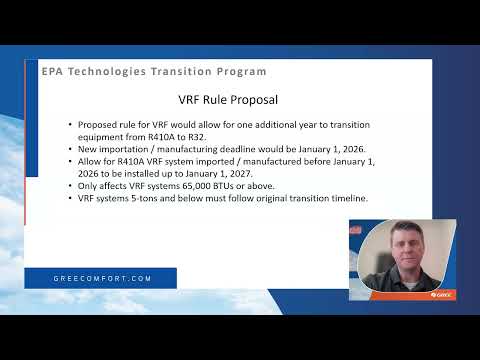
The Environmental Protection Agency gave HVAC contractors an extra year on Tuesday to install commercial air-conditioning equipment that uses older, higher-warming refrigerants. The final rule covers variable refrigerant flow systems manufactured or imported before January 1, 2026, and pushes the installation cutoff out to January 1, 2027.

The broader HFC phasedown stays in place. The AIM Act still requires an 85% national cut by 2036. The change targets one industry complaint: complex multi-zone HVAC systems already built around older refrigerants would be stranded by a deadline manufacturers said they could not meet.

Why it matters

Commercial HVAC projects scheduled for late 2026 can now use refrigerant equipment already on order instead of scrapping it for redesigned lower-GWP units.

Key Indicators

1 year
Installation extension
How much longer pre-2026 VRF equipment can be installed under the new rule.
85%
AIM Act HFC reduction target by 2036
Mandatory national HFC phasedown from 2011-2013 baseline levels.
$2.4B
Claimed cost savings
EPA Administrator Lee Zeldin's figure for total savings from the broader refrigerant rule reforms.
350,000
Jobs cited by EPA
Administrator Zeldin's estimate of jobs protected by easing the refrigerant transition timeline.

Voices

Curated perspectives — historical figures and your fellow readers.

Ever wondered what historical figures would say about today's headlines?

Sign up to generate historical perspectives on this story.

Play

Exploring all sides of a story is often best achieved with Play.

Log in to play. Track your picks, climb the leaderboards. Log in Sign Up
Predict 4 ways this could play out. Contrarian picks score more — points lock when the scenario resolves. Log in to play
Higher or Lower Two numbers from this story. Guess which is bigger. 5 rounds to set a streak. Log in to play
Timeline Five events from this story — drag them oldest to newest. Log in to play
Connections Sixteen names from the news. Find the four hidden groups of four. Log in to play

People Involved

Organizations Involved

Timeline

December 2020 May 2026

8 events Latest: Today
Tap a bar to jump to that date
  1. Rule published in Federal Register

    Today Regulation

    EPA publishes the final rule, making the one-year VRF installation extension effective. Projects with building permits issued before October 5, 2023, get until January 1, 2028.

  2. Zeldin signs final VRF extension rule

    Regulation

    EPA Administrator Lee Zeldin signs the final rule extending VRF installation to January 1, 2027 for equipment made or imported before January 1, 2026.

  3. Industry submits comments seeking longer extensions

    Public Comment

    AHRI, ACCA, Daikin, and the Alliance for Responsible Atmospheric Policy file comments arguing the January 2026 VRF cutoff would strand legally manufactured equipment and disrupt projects already designed around higher-GWP systems.

  4. EPA opens reconsideration of technology transitions rules

    Regulation

    EPA proposes reopening multiple installation deadlines set under the Biden-era technology transitions program, signaling willingness to push back compliance dates.

  5. Trump returns to office

    Political

    Trump begins his second term. Lee Zeldin is confirmed weeks later as EPA Administrator and begins reviewing Biden-era climate rules.

  6. Biden EPA publishes VRF rule

    Regulation

    Administrator Michael Regan finalizes a rule banning installation of new variable refrigerant flow systems using HFCs above 700 GWP starting January 1, 2026.

  7. First technology transitions rule finalized

    Regulation

    EPA finalizes the first restrictions under the AIM Act's technology transitions program, banning use of high-GWP HFCs in new equipment across most refrigeration and air-conditioning subsectors.

  8. Trump signs AIM Act into law

    Legislation

    President Trump signs the American Innovation and Manufacturing Act as part of an end-of-year omnibus package. The law directs EPA to phase down HFC production and consumption by 85% from 2011-2013 baselines by 2036.

Historical Context

3 moments from history that rhyme with this story — and how they unfolded.

September 1987 onward

Montreal Protocol CFC phaseout (1987-2010)

196 countries agreed in Montreal to phase out chlorofluorocarbons, which destroyed atmospheric ozone. Developed countries banned new CFC production by 1996. The full phaseout for service refrigerants finished in 2010.

Then

Refrigerant manufacturers shifted production first to HCFCs, then to HFCs over two decades. The ozone hole stopped growing.

Now

The HFC replacements turned out to be powerful greenhouse gases. The Kigali Amendment added HFCs to Montreal in 2016, setting up the current phasedown.

Why this matters now

Today's AIM Act phasedown is the third major refrigerant transition in 40 years. Each one has produced the same fight between regulators and industry over stranded equipment and installation cutoffs.

January 2010 - January 2020

R-22 refrigerant phaseout (2010-2020)

EPA banned production and import of new equipment using R-22, an HCFC, starting in 2010, then ended R-22 production entirely in 2020. Existing systems could still be serviced with recycled refrigerant.

Then

Servicing costs spiked. Recycled R-22 prices rose from about $5 per pound in 2010 to over $100 by 2018.

Now

Most homeowners replaced rather than serviced old units. The industry adopted R-410A, which is itself now being phased down under the current AIM Act rules.

Why this matters now

The R-22 transition shows the pattern in practice: manufacturing stops, then installation stops, then service prices rise. VRF contractors are watching the same curve approach R-410A.

August 2017

Mexichem Fluor v. EPA (2017)

The D.C. Circuit struck down EPA's 2015 SNAP Rule 20, which would have phased down HFCs under the Clean Air Act. The court ruled EPA lacked statutory authority to require HFC substitutes when companies had already moved off ozone-depleting refrigerants.

Then

EPA's only HFC regulatory tool was gone. Industry had already invested in lower-GWP alternatives in anticipation of the rule.

Now

The decision forced Congress to act. The AIM Act in 2020 gave EPA explicit statutory authority over HFCs, the same authority underlying today's VRF rule.

Why this matters now

The current rule rests on the statute Congress wrote after Mexichem. Any court challenge to the extension will run into the same authority question that drove the AIM Act's passage.

Sources

(8)