


Pull to refresh
Logo
FDA approves first new herpes drug mechanism in nearly 30 years

FDA approves first new herpes drug mechanism in nearly 30 years

New Capabilities

Hovilpri (pritelivir) heals persistent HSV sores in immunocompromised adults who stopped responding to standard antivirals

7 days ago: FDA approves Hovilpri for refractory HSV lesions

Overview

Updated 44 minutes ago

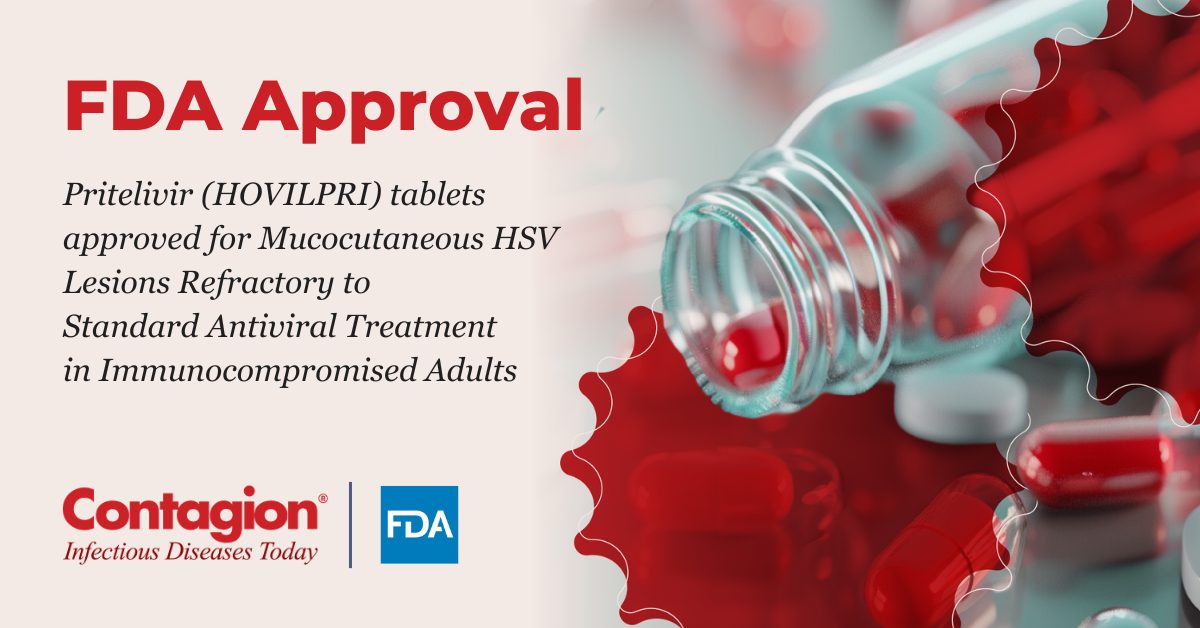
The Food and Drug Administration approved Hovilpri (pritelivir) on October 9 for persistent herpes sores in adults with weakened immune systems. It is the first herpes treatment with a new mechanism of action in nearly 30 years.

The oral drug attacks strains that no longer respond to the standard antivirals acyclovir, valacyclovir, and famciclovir. In the pivotal trial, 63% of patients saw all lesions heal within 28 days, versus 34% on existing treatment options — which until now meant an intravenous drug.

Why it matters

Patients with drug-resistant herpes now have an oral option that heals sores in nearly twice the share of patients as existing care.

Questions about this story

Free account needed to ask — your question is kept and asked for you right after sign-up. Answers are public.

No questions yet — be the first to ask.

Key Indicators

63% vs 34%
Lesions fully healed within 28 days (Hovilpri vs existing care)
Primary endpoint of the Phase 3 PRIOH-1 trial; adjusted treatment difference of 28.4 percentage points (p=0.0047).
~30 years
Years since a herpes drug with a novel mechanism
Hovilpri is the first FDA-approved HSV therapy with a new mechanism of action in nearly three decades.
15,000
Eligible US patients (company estimate)
Asahi Kasei's estimate of the immunocompromised patient population that could use the drug.
$400M+
Estimated peak annual sales, mid-to-late 2030s
Company projection for Hovilpri revenue, reported by Reuters.
101
Patients in the pivotal PRIOH-1 trial
Immunocompromised adults with HSV lesions refractory, with or without documented resistance, to standard antivirals.

Voices

Curated perspectives — historical figures and your fellow readers.

Ever wondered what historical figures would say about today's headlines?

Sign up to generate historical perspectives on this story.

People Involved

Organizations Involved

Timeline

April 2026 October 2026

2 events Latest: 7 days ago
  1. FDA approves Hovilpri for refractory HSV lesions

    Latest Regulatory Approval

    FDA cleared pritelivir for mucocutaneous herpes lesions in immunocompromised adults who failed standard antivirals. First new HSV mechanism in nearly 30 years.

  2. Asahi Kasei acquires pritelivir developer AiCuris

    Acquisition

    Asahi Kasei closed the roughly $920 million purchase of the German drugmaker that invented pritelivir.

Scenarios

1

Hovilpri reaches US patients by end of 2026

Likely Resolves by Jan 31, 2027

Discussed by: Asahi Kasei Therapeutics (company guidance)

The company told the FDA and investors it expects the drug to be available in the US before the end of 2026. Commercial rollout depends on manufacturing, distribution, and payer contracting. If any step slips, availability could move into early 2027.

2

Asahi Kasei seeks broader approval for pritelivir

Possible Resolves by End of 2029

Discussed by: Industry analysts, Fierce Pharma coverage

Pritelivir's mechanism bypasses the thymidine-kinase mutations that cause resistance to standard nucleoside drugs. If safety holds in wider use, Asahi Kasei could pursue approval for non-refractory or immunocompetent patients with recurrent oral or genital herpes — a far larger market than the roughly 15,000 refractory immunocompromised patients the drug now targets.

3

Pritelivir wins EU approval

Possible Resolves by End of 2029

Discussed by: Asahi Kasei Therapeutics (global operations)

Asahi Kasei runs European operations from its Cary, North Carolina headquarters and markets Hovilpri globally. Approval outside the US — in Europe or Japan — would widen access and push revenue toward the company's $400 million peak sales estimate for the mid-to-late 2030s.

Historical Context

2 moments from history that rhyme with this story — and how they unfolded.

Early 1980s

Acyclovir's arrival (early 1980s)

Acyclovir (Zovirax), introduced in the early 1980s, was the first selective anti-herpes drug. A viral enzyme called thymidine kinase activates it inside infected cells before it blocks viral DNA replication, making it a mainstay for cold sores, genital herpes, and shingles.

Then

It became the standard of care for herpes infections worldwide within a decade.

Now

Its nucleoside mechanism, along with related drugs valacyclovir and famciclovir, has dominated HSV treatment for four decades.

Why this matters now

Pritelivir targets a different viral protein, the helicase-primase complex, so it keeps working where thymidine-kinase mutations have made acyclovir-type drugs fail.

1990s

Drug-resistant HSV in the immunocompromised (1990s)

As transplant and HIV/AIDS patients lived longer on immunosuppressive therapy, doctors saw herpes strains harboring thymidine-kinase mutations that resisted acyclovir. The main fallback, foscarnet, had to be given intravenously and carried significant kidney toxicity; cidofovir, approved for cytomegalovirus, was borrowed off-label.

Then

Foscarnet became the standard rescue therapy for resistant HSV, but its IV route and toxicity made it a difficult option.

Now

No oral rescue therapy emerged for roughly three decades, leaving the problem unresolved.

Why this matters now

Hovilpri is the first oral alternative to foscarnet for this exact population.

Sources

(8)