
Pull to refresh
Logo
Fed hikes rates for first time since 2023 as Iran war drives inflation

Fed hikes rates for first time since 2023 as Iran war drives inflation

Money Moves

Unanimous 25-basis-point move to 3.75%-4% reverses last year's rate cuts

Today: FOMC hikes rates 25 basis points

Overview

Updated 1 hour ago

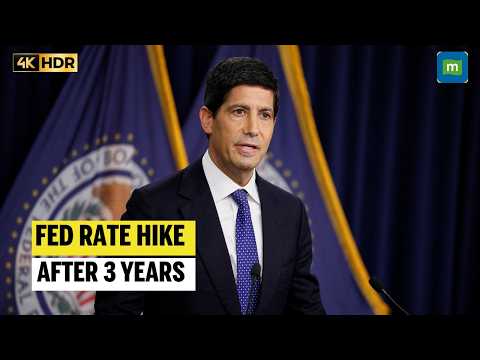
The Federal Reserve raised its benchmark interest rate by a quarter point on Wednesday, the first hike since July 2023. The unanimous 12-0 vote set the federal funds rate at 3.75%-4%, unwinding one of three cuts made last year.

The move reverses the Fed's course after inflation, driven by the Iran war and surging energy prices, stopped cooling. New Chair Kevin Warsh pushed rates higher against President Trump's demands for cuts, and officials project at least one more hike by year-end.

Why it matters

Rate hikes raise payments on mortgages, credit cards and business loans, just as $4.37 gasoline and record $6.31 diesel squeeze household budgets.

Questions about this story

Free account needed to ask — your question is kept and asked for you right after sign-up. Answers are public.

No questions yet — be the first to ask.

Key Indicators

3.75%-4%
Federal funds rate target range
Raised 25 basis points on Sept 16, the first hike since July 2023
3.4%
Annual inflation rate (August CPI)
Far above the Fed's 2% target and a key reason for the hike
$4.37/gal
Average US gasoline price
Up from $2.98 before the Iran war began in February
$6.31/gal
Record diesel price
Up 71% from a year ago, pushing up costs across the economy
16 of 18
Policymakers expecting another 2026 hike
Four of them see two more hikes possible; two expect rates to hold

Voices

Curated perspectives — historical figures and your fellow readers.

Ever wondered what historical figures would say about today's headlines?

Sign up to generate historical perspectives on this story.

People Involved

Organizations Involved

Timeline

July 2023 September 2026

6 events Latest: Today
Tap a bar to jump to that date
  1. FOMC hikes rates 25 basis points

    Today Monetary Policy

    Unanimous 12-0 vote sets the funds rate at 3.75%-4%, the first hike since July 2023.

  2. August CPI comes in at 3.4%

    Economic Data

    Annual inflation runs well above the Fed's 2% target, cementing the case for a hike.

  3. June FOMC meeting flags rising price pressures

    Monetary Policy

    Officials wrestle with inflation made worse by energy costs; data since then gets more challenging.

  4. Iran war begins, oil supply disrupted

    Geopolitical

    US-Israeli war with Iran starts, sending energy prices climbing and raising inflation pressures.

  5. Fed ends year with three rate cuts

    Monetary Policy

    Cut rates three times in 2025 as inflation cooled, supporting economic growth.

  6. Fed makes its last rate hike before the pause

    Monetary Policy

    Raised rates to a 5.25%-5.5% range, the peak of the 2022-2023 tightening cycle.

Scenarios

1

Fed hikes again in December

Likely Resolves by Dec 16, 2026

Discussed by: Goldman Sachs Asset Management, CBS News, the FOMC's own projections

Sixteen of 18 policymakers expect at least one more hike in 2026, and Goldman's Kay Haigh calls December the base case, contingent on CPI reports and energy prices. Another quarter-point move would put the funds rate at 4%-4.25%.

2

Fed pauses in December as inflation cools

Possible Resolves by Dec 16, 2026

Discussed by: The two FOMC members who expect rates to hold; analysts watching oil prices

If the Iran war de-escalates and energy prices fall, headline CPI could drop quickly, giving the Fed cover to pause. The two policymakers who see rates stable argue the September hike is enough for now.

3

Energy prices collapse, Fed pivots to cuts by mid-2027

Uncertain Resolves by Q2 2027

Discussed by: Analysts at Goldman Sachs and deVere Group who tie the path of hikes to energy prices

A ceasefire in the Middle East would likely send oil prices down and pull inflation toward target. The Fed's own projections already show cuts returning in 2028, signaling officials see this tightening as temporary. Weak CPI prints plus falling fuel prices could pull that forward.

Historical Context

3 moments from history that rhyme with this story — and how they unfolded.

1979-1980

Volcker-era oil shocks (1979-1980)

Oil price shocks drove US inflation to double digits. Fed Chair Paul Volcker raised rates to record highs, pushing the prime rate above 20%, and endured intense political pressure from the White House and Congress to stop.

Then

The economy fell into a deep recession in 1981-82.

Now

Inflation broke and stayed low for decades; Volcker's independence became the template for Fed chairs.

Why this matters now

The first energy-driven inflation crisis in which a Fed chair tightened against political pressure, the same dynamic playing out between Warsh and Trump.

2018-2019

Trump's pressure on Fed Chair Powell (2018-2019)

President Trump repeatedly attacked Fed Chair Jerome Powell, calling rate hikes 'crazy' and demanding cuts. The Fed hiked in December 2018 anyway, then cut three times in 2019 as growth slowed.

Then

Rates fell from 2.5% to 1.5%-1.75% over 2019.

Now

The episode cemented the norm that the Fed sets policy independently of the White House.

Why this matters now

A direct precedent for a president pressuring the Fed mid-cycle; Warsh's hike repeats the pattern of the chair resisting, though the economic backdrop now is inflation, not slowing growth.

March 2022 - July 2023

2022-2023 Fed tightening cycle

As pandemic-era stimulus met supply shocks, inflation hit a 40-year peak of 9.1%. The Fed hiked rates 11 times, from near zero to 5.25%-5.5%, the fastest tightening since the 1980s.

Then

Inflation cooled from the peak to around 3%-4%.

Now

Laid the basis for 2025 rate cuts that the Fed has now partly undone.

Why this matters now

Shows the scale of tightening the Fed is capable of; today's hike comes after a much smaller cut cycle, making it a partial reversal rather than a full new campaign.

Sources

(11)