
Pull to refresh
Logo
FERC approves MISO plan to speed its legacy interconnection queue

FERC approves MISO plan to speed its legacy interconnection queue

Rule Changes

Penalty-free withdrawals and a single restudy aim to unblock a 125 GW backlog.

Overview

Updated 1 hour ago

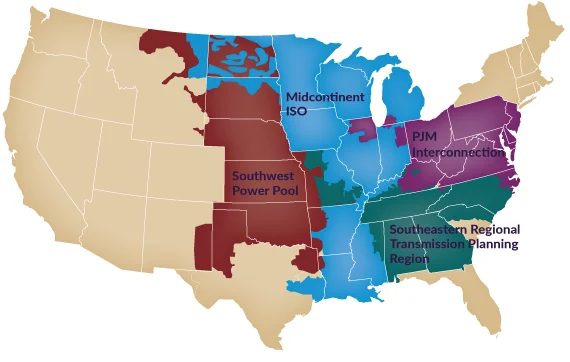
MISO's 2022 interconnection queue has been stuck for years. Projects that were no longer viable stayed in line to avoid withdrawal penalties. Each late exit forced the grid operator to restudy the whole cycle.

The Federal Energy Regulatory Commission approved a plan to let those projects leave penalty-free before a key decision point. It also limits restudies to one per cycle. The goal is to keep the 35-gigawatt DPP-2022 cycle from delaying the other three queues, which hold about 125 gigawatts combined.

Why it matters

The U.S. grid needs new power fast; a queue that takes years to process keeps solar, wind, gas and batteries from connecting.

Questions about this story

Free account needed to ask — your question is kept and asked for you right after sign-up. Answers are public.

No questions yet — be the first to ask.

Key Indicators

125 GW
Total MISO interconnection queue
Projects across four study cycles, including 44 GW solar and 25 GW batteries.
35 GW
DPP-2022 active projects
The legacy cycle FERC's order is meant to unblock.
18 months
Delay avoided
MISO said the DPP-2022 cycle would have slipped without the changes.
50%
Penalty-free withdrawal threshold
Up from 35% for projects that want to exit later in the process.
~600
Projects in MISO's queue
The queue spans four study cycles.

Voices

Curated perspectives — historical figures and your fellow readers.

Sign up to generate historical perspectives on this story.

Organizations Involved

Timeline

2025 November 2026

4 events Latest: Today
Tap a bar to jump to that date
  1. FERC approves MISO's queue cleanup

    Today Regulatory

    FERC approves the plan, rejecting challenges from Ranger Power and Pathway Power.

  2. Decision Point II passes

    Milestone

    DPP-2022 reaches the decision point for penalty-free withdrawals.

  3. MISO files DPP-2022 cleanup plan

    Filing

    MISO proposes penalty-free withdrawals before Decision Point II and one restudy per cycle.

  4. FERC accepts MISO queue cap

    Regulatory

    FERC accepts MISO's queue cap and exemptions; a 5th Circuit challenge follows.

Scenarios

1

MISO clears DPP-2022 without another restudy

Likely Resolves by End of 2027

Discussed by: MISO and FERC

If enough nonviable projects take the penalty-free exit, the 2022 cycle can finish its studies and move remaining projects to generator interconnection agreements. MISO says the one-restudy limit is meant to prevent a repeat of the cascading delays.

2

Withdrawal costs land on remaining developers and customers

Possible Resolves by Q2 2027

Discussed by: Organization of MISO States and RWE Americas

When projects leave, the network upgrades built for them may still be needed. OMS and RWE warn that the costs could be reassigned to projects that stay or to transmission customers. A follow-up filing would decide who pays.

3

Developer challenges the 50% threshold at FERC or in court

Unlikely Resolves by Q1 2027

Discussed by: Pathway Power and Ranger Power

Pathway Power and Ranger Power lost at FERC. They could ask for rehearing or appeal to the D.C. Circuit. A successful challenge would send MISO back to the 35% threshold or reopen the plan.

Historical Context

3 moments from history that rhyme with this story — and how they unfolded.

2025

MISO queue cap (2025)

FERC accepted MISO's plan to cap its interconnection queue and exempt certain projects, a response to years of backlog. A challenge followed at the 5th U.S. Circuit Court of Appeals in Louisiana Public Service Commission v. FERC.

Then

The challenge left the cap's implementation in litigation.

Now

The cap did not reach projects already in the 2022 cycle, so the legacy backlog remained.

Why this matters now

The DPP-2022 cleanup is a separate, retroactive fix for the same problem.

2022-2026

The DPP-2022 logjam (2022-2026)

MISO's 2022 study cycle predated its later interconnection reforms. Projects that were no longer viable stayed in queue because leaving meant paying a penalty, and late withdrawals triggered restudies that pushed the cycle years behind.

Then

MISO said the cycle would have slipped roughly 18 months without the changes.

Now

The delay cascaded into later study cycles, contributing to a queue of nearly 600 projects and 125 GW.

Why this matters now

FERC's approval is meant to break that cycle by letting projects exit before the costly restudy stage.

2023

The 50% threshold precedent (2023)

FERC approved a 50% network-upgrade-cost threshold for penalty-free withdrawals in MISO's 2023 study cycle. The 2022 cycle still used a 35% threshold.

Then

The 50% number became MISO's standard for newer cycles.

Now

When MISO sought to apply it retroactively to 2022, FERC pointed to the 2023 precedent to reject developer objections.

Why this matters now

The disputed 50% threshold is not new; the fight was about applying it backward.

Sources

(6)