

Pull to refresh
Logo
Generative AI writes quantum optimization circuits directly, cutting tuning costs

Generative AI writes quantum optimization circuits directly, cutting tuning costs

New Capabilities

IonQ, ORNL, NVIDIA, and UT Knoxville show a trained model can replace trial-and-error circuit tuning in hybrid quantum optimization

Yesterday: DQAOA-GPT presented at IEEE Quantum Week; wins best paper award

Overview

Updated Yesterday

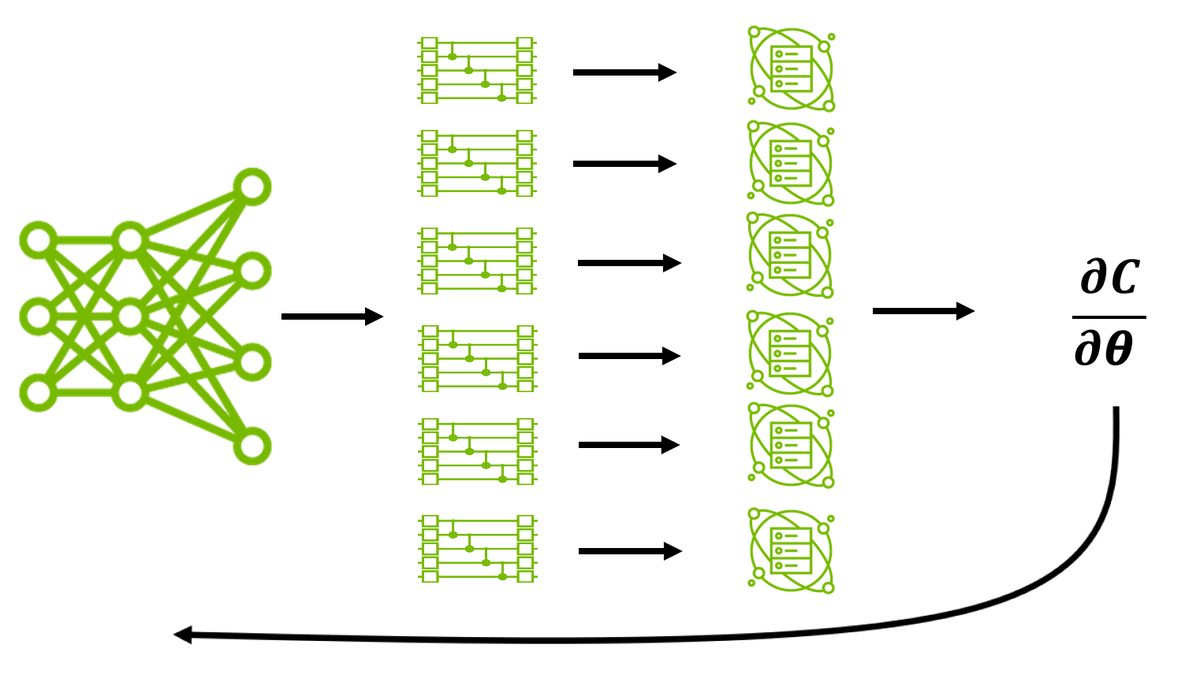
Hybrid quantum optimization has had a cost problem: solve a big problem by breaking it into pieces, and each piece needs a custom quantum circuit tuned by trial and error — run, measure, adjust, repeat, often hundreds of times. A joint research effort from IonQ, Oak Ridge National Laboratory (ORNL), NVIDIA, and the University of Tennessee, Knoxville (UT) shows a trained generative model can write those circuits in a single pass, eliminating the tuning loop entirely.

The measured difference is stark. On a 100-variable benchmark problem, the prior state-of-the-art method took about 34 seconds to find circuits on 4 qubits, rising to more than 11 minutes on 12 qubits. The generative approach held near 28 seconds across every size tested. As subproblems grew, solution quality roughly doubled. The team presented the work at IEEE Quantum Week in Toronto, where it won a best paper award.

Why it matters

The parameter-tuning tax has capped how large hybrid quantum optimization problems can get; removing it opens a path to problem sizes that were simply too expensive to attempt.

Questions about this story

Free account needed to ask — your question is kept and asked for you right after sign-up. Answers are public.

No questions yet — be the first to ask.

Key Indicators

28 seconds
Generative circuit-generation runtime across tested problem sizes
The DQAOA-GPT approach held near-constant runtime even as quantum subproblems grew from 4 to 12 qubits.
11 minutes
Prior method's runtime on 12-qubit subproblems
The prior trial-and-error tuning approach rose sharply from 34 seconds on 4 qubits to over 11 minutes on 12 qubits.
2x
Solution-quality improvement as subproblems grew
On a dense 100-variable benchmark, model-generated answer quality roughly doubled as subproblem size increased.
9
IonQ papers accepted at IEEE Quantum Week 2026
The DQAOA-GPT paper is one of nine IonQ papers at the conference and won a best paper award.

Voices

Curated perspectives — historical figures and your fellow readers.

Ever wondered what historical figures would say about today's headlines?

Sign up to generate historical perspectives on this story.

People Involved

Organizations Involved

Timeline

April 2025 September 2026

3 events Latest: Yesterday
  1. DQAOA-GPT presented at IEEE Quantum Week; wins best paper award

    Latest Conference

    IonQ, ORNL, NVIDIA, and UT detail the research at IEEE Quantum Week in Toronto. The paper wins a best paper award; IonQ earns four total best-paper awards at the conference.

  2. DQAOA-GPT paper posted to arXiv

    Publication

    The IonQ-ORNL-NVIDIA-UT collaboration posts the extended distributed version of the framework, applying generative circuit synthesis to distributed quantum approximate optimization algorithm (DQAOA) subproblems.

  3. QAOA-GPT preprint appears on arXiv

    Publication

    Researchers introduce QAOA-GPT, a GPT-based framework that synthesizes quantum circuits directly for MaxCut problems, bypassing iterative variational optimization. The work uses ADAPT-QAOA-generated training data in Julia and NVIDIA's CUDA-Q platform.

Scenarios

1

Generative circuit synthesis becomes the standard for hybrid quantum optimization

Likely Resolves by Sep 16, 2027

Discussed by: The research team (IonQ, ORNL), IonQ statement

ORNL researchers state they are extending the framework to real-world scientific and engineering applications and scaling it across larger HPC systems. If independent groups reproduce the runtime and quality gains on hardware (not just simulation), the generative approach could become the default way hybrid quantum optimization circuits are produced, letting researchers run subproblems at sizes previously deemed too expensive.

2

Simulation-only gains; hardware execution reveals new bottlenecks

Possible Resolves by Sep 16, 2027

Discussed by: IonQ's own statement that circuits were simulated, not run on hardware

Every circuit in the study was simulated using NVIDIA's cuQuantum SDK on a single H200 GPU, not executed on quantum hardware. Trapped-ion hardware (IonQ's platform) has gate errors, decoherence, and connectivity constraints that simulation ignores. If real-hardware execution erodes the quality gains, the approach may require additional error mitigation before it pays off in practice.

3

The method extends beyond QAOA to other hybrid quantum workflows

Possible Resolves by Sep 16, 2028

Discussed by: ORNL statement about extending to real-world scientific applications

The generative approach is a general technique: train a transformer on good circuit examples, then generate candidate circuits in a single forward pass. If it generalizes beyond quantum approximate optimization to other variational quantum algorithms, its impact broadens significantly. ORNL has already indicated plans to extend it to real-world problems and larger HPC systems.

Historical Context

2 moments from history that rhyme with this story — and how they unfolded.

2014–present

Variational Quantum Eigensolver bottleneck (2014–present)

Hybrid quantum-classical algorithms like the Variational Quantum Eigensolver (VQE) and Quantum Approximate Optimization Algorithm (QAOA) became the dominant near-term quantum approach. They rely on a classical optimizer iteratively adjusting circuit parameters, evaluating the quantum circuit each time. This outer loop is notoriously slow and can get stuck in local minima.

Then

Researchers could only run small problem instances on real hardware; the classical optimization overhead often dominated any quantum speedup.

Now

A large body of work — ADAPT-VQE, ADAPT-QAOA, and related methods — emerged to reduce the number of tuning iterations, but none eliminated the trial-and-error loop entirely.

Why this matters now

The DQAOA-GPT work directly attacks this long-standing bottleneck: instead of iteratively tuning circuit parameters, a transformer produces circuits in a single forward pass. The paper's QAOA-GPT precursor explicitly cites this motivation.

2000s–present

Neural network circuit optimization in HPC (2000s–present)

Classical compiler optimization — instruction scheduling, register allocation, loop unrolling — was historically solved with hand-crafted heuristics. Over the past two decades, researchers began training neural networks to make these decisions, replacing hard-coded rules with learned policies. Google's XLA and similar frameworks now use learned models for parts of the compilation pipeline.

Then

Early results were mixed; learned compilers often matched but rarely beat tuned heuristics.

Now

Modern frameworks increasingly use learned policies for specific optimization passes, especially where heuristics are hard to write by hand.

Why this matters now

The quantum circuit synthesis problem is structurally analogous: heuristics for circuit layout and parameter selection are expensive and hard to tune. The generative approach is essentially applying the learned-compiler playbook to quantum circuits.

Sources

(5)