
Pull to refresh
Logo
Glendale annexes 160 acres for data center campus and gas plant

Glendale annexes 160 acres for data center campus and gas plant

Built World

A 6-1 council vote moves a three-building, 700-megawatt project off county land and into the city, over objections from Surprise residents who live nearby.

Overview

Updated 1 hour ago

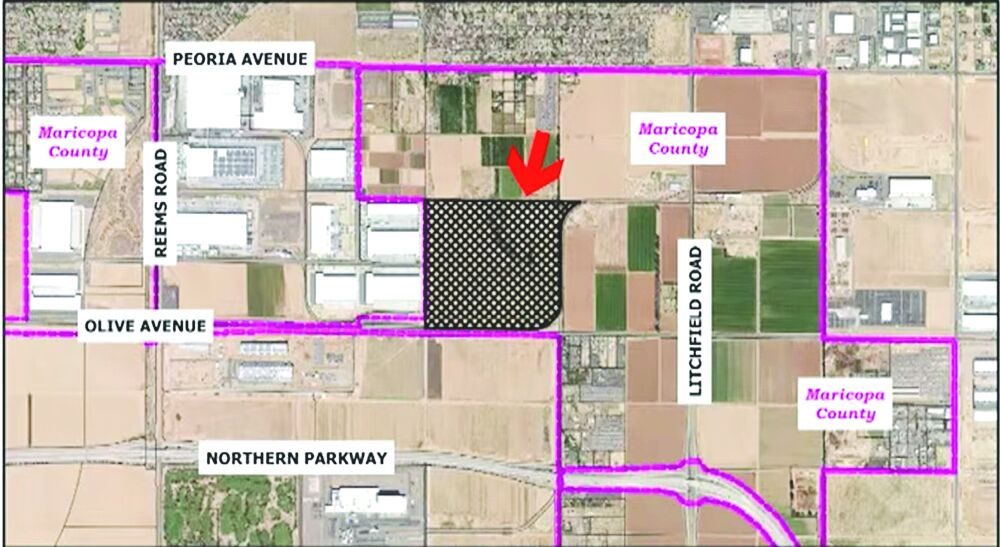
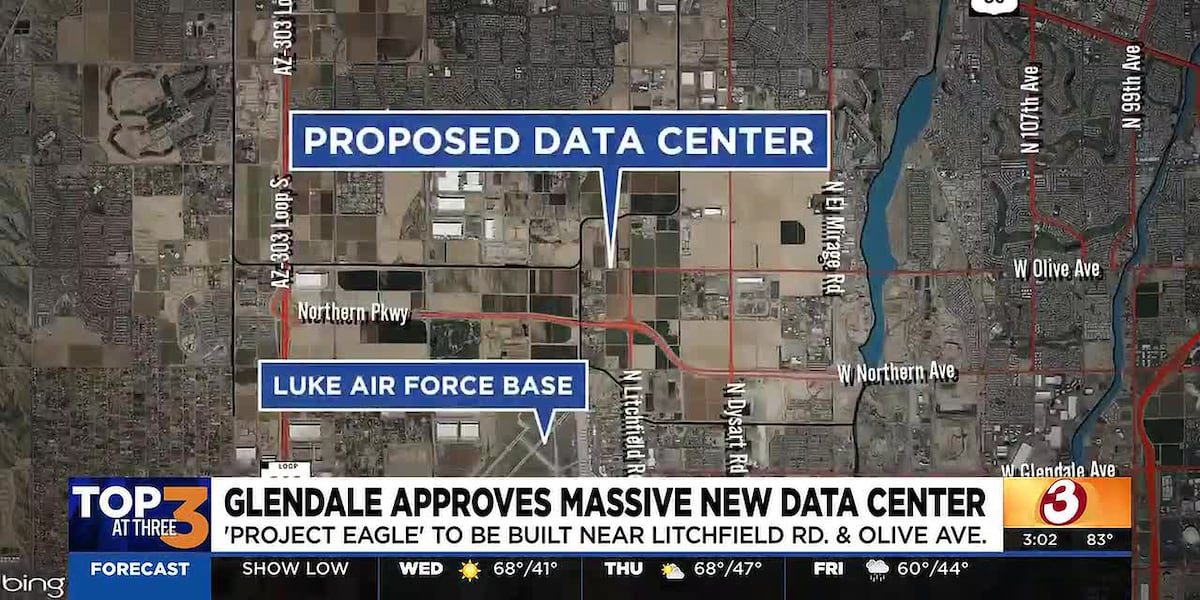
Residents of Surprise's Rancho Gabriela neighborhood live about a mile from 160 acres of farmland at Litchfield Road and Olive Avenue. On Oct. 27, the Glendale City Council voted 6-1 to annex that land and rezone it for three data centers and an 18-turbine natural gas plant. Most of the people who spoke against the project cannot vote for the council that approved it.

The site sits in unincorporated Maricopa County, just south of Surprise. Annexation brings it into Glendale, which gives neighbors the city's noise, light and nuisance ordinances to complain under. It also gives the developer a path to build. The project's two halves, a data center campus called Project Eagle and a power plant called Project Baccara, are now the subject of a county air-quality question: one source of pollution, or two?

Why it matters

Maricopa County is deciding whether a gas plant built to power a data center counts as one pollution source or two, a call that shapes how Arizona permits the next wave of data centers.

Questions about this story

Free account needed to ask — your question is kept and asked for you right after sign-up. Answers are public.

No questions yet — be the first to ask.

Key Indicators

160 acres
Land annexed
Farmland west of Litchfield Road and Olive Avenue, moved from Maricopa County into Glendale.
700.2 MW
Gas plant capacity
The figure the Arizona Corporation Commission used when it approved the plant's environmental certificate.
18
Natural gas turbines
72-foot-tall units that come online in phases as each data center building is finished.
1.1 million sq ft
Data center floor area
Three one-story buildings, per city staff.
30%
Cap on turbine run time
The Maricopa County air permit limits how often the turbines may operate.
25%
Water versus farming
The developer's attorney said the site would use about a quarter of the water used to farm the same acreage.

Voices

Curated perspectives — historical figures and your fellow readers.

Sign up to generate historical perspectives on this story.

People Involved

Organizations Involved

Timeline

November 2025 October 2026

9 events Latest: 3 days ago
Tap a bar to jump to that date
  1. County's one-source-or-two decision remains open

    Latest Regulatory

    The air quality department said it had made no final decision on whether the plant and data center count as one emissions source.

  2. Glendale council annexes and rezones the site

    Land use

    The council voted 6-1 on annexation and again on rezoning, with Leandro Baldenegro the only no vote.

  3. Planning commission recommends approval

    Land use

    A motion to recommend denial failed 2-4; the commission then voted 4-2 to recommend approval.

  4. Consultant asks county to split the two facilities

    Regulatory

    BlueScape Environmental argued the plant and data center have no direct relationship and should be permitted separately.

  5. Luke Air Force Base issues compatibility review

    Regulatory

    The base found the uses compatible only if the developer meets its conditions.

  6. County issues air permit for the gas plant

    Regulatory

    The Maricopa County Air Quality Department permitted the plant at the end of June.

  7. County supervisors approve military compatibility permit

    Regulatory

    The Maricopa County Board of Supervisors voted 4-1, with Supervisor Steve Gallardo opposed.

  8. State commission approves the plant's environmental certificate

    Regulatory

    The Arizona Corporation Commission voted 5-0 and described the plant as 700.2 megawatts.

  9. Surprise residents ask their council to oppose the project

    Public opposition

    Roy Dunbar told Surprise's council he spoke for an opposition group of more than 1,200 people, naming Rancho Gabriela, Greer Farms, Marley Park and Copper Canyon as the most affected neighborhoods.

Scenarios

1

County keeps Eagle and Baccara as one pollution source

Likely Resolves by Q2 2027

Discussed by: Maricopa County Air Quality Department, as reported by The Arizona Republic

The county has said it will count the plant and the data center as a single source because the plant exists mostly to serve the data center, matching federal policy against splitting projects to dodge a stricter pollution designation. If that holds, the two facilities share one cumulative emissions cap. The developer's consultant has argued against it, and the county says the designation could change if the facilities prove they are not dependent on each other.

2

County splits the plant and data center into separate sources

Possible Resolves by Q2 2027

Discussed by: BlueScape Environmental, consulting for the developer

In an August 2026 letter, BlueScape told the county there is no direct relationship between the facilities, because the plant sells power to the grid and the data center can draw from multiple sources. The county rejected that reasoning but left the door open: the projects could be treated separately if they prove they are not dependent on one another or under common control. Separate treatment would give each facility its own emissions cap.

3

Neighbors or an environmental group sue over the annexation

Uncertain Resolves by Oct 27, 2027

Discussed by: No filing reported as of Oct. 30, 2026

Residents have fought the project for more than a year, and the council that approved it represents none of them. A legal challenge would likely argue that Glendale's annexation or rezoning failed a procedural requirement, or that the county's air permitting was flawed. No suit had been reported when the council voted.

4

Construction starts before the data center air permit lands

Possible Resolves by Q2 2027

Discussed by: Developer statements reported by The Arizona Republic

Construction was slated to begin later in 2026, while the data center's air permit is not expected until the first quarter of 2027 or early in the second. The plant's permit is already in hand. If building permits issue first, the site work proceeds while the county's one-source question is still unresolved.

Historical Context

2 moments from history that rhyme with this story — and how they unfolded.

1976-1988

Palo Verde Nuclear Generating Station (1976-1988)

Three nuclear reactors were built in the desert about 50 miles west of Phoenix, on land that was then far from the metro area's subdivisions. Nearby residents and environmental groups opposed the project through years of construction and licensing.

Then

All three units came online between 1986 and 1988.

Now

Palo Verde became the largest nuclear plant in the United States by net generation, and Phoenix's growth eventually pushed suburbs toward it.

Why this matters now

It is the same land-use pattern now playing out at Litchfield and Olive: large generation sited in open desert, then surrounded by the people who did not want it.

2022

Greenidge Generation's bitcoin plant (2022)

A gas-fired power plant on Seneca Lake in upstate New York had been converted to run bitcoin mining servers on site. When the company sought to renew its air permit, state regulators examined the plant and the computing load as a linked operation.

Then

New York's environmental agency denied the permit renewal in 2022.

Now

The case became a reference point for how regulators treat on-site generation built to serve computing, rather than the grid at large.

Why this matters now

Project Baccara and Project Eagle raise the same question Maricopa County is now weighing: whether the power plant and the machines it feeds are one thing or two.

Sources

(8)