


Pull to refresh
Logo
GMS pitches Thunderbolt add-on modules as a cheaper way to upgrade military platforms

GMS pitches Thunderbolt add-on modules as a cheaper way to upgrade military platforms

New Capabilities

The rugged-computing vendor says plug-in modules can add AI, storage and networking without redesigning the host system or its chassis

Overview

Updated 1 hour ago

A military vehicle's mission computer is usually replaced when it needs new capability, not upgraded. General Micro Systems says it can bolt a graphics processor, 64 terabytes of storage or a 100-gigabit network switch onto an existing platform through a cable.

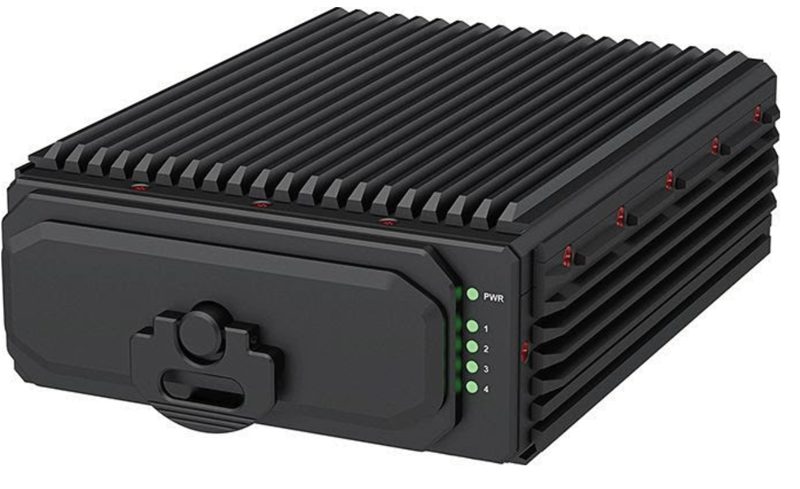
The Rancho Cucamonga, California, company unveiled a family of rugged add-on modules that connect over Thunderbolt, the high-speed interface found on consumer laptops. GMS argues this cuts the upgrade cycle from years of redesign and requalification to months of plugging in a box.

Why it matters

If plug-in upgrades work, militaries could add AI and new sensors to fielded vehicles in months instead of years.

Questions about this story

Free account needed to ask — your question is kept and asked for you right after sign-up. Answers are public.

No questions yet — be the first to ask.

Key Indicators

64 TB
Storage per canister module
Removable mission storage built from sealed quad-U.2 or octal-M.2 drives, with transfer rates up to 40Gbps.
12
Add-in I/O sites per docking station
The workstation I/O module accepts MIL-STD-1553, ARINC-429, CANbus, serial and other cards on Mini-PCIe or M.2.
4
100-gigabit fiber ports on the switch module
Paired with eight 10-gigabit copper ports for Layer 2/3 routing at the tactical edge.
2 kW
Power conditioning module rating
MIL-STD-1275-compliant AC/DC supply with Thunderbolt power delivery to other modules.
8–10×
GMS's cost estimate versus OpenVPX
Company claim from chief executive Ben Sharfi, not an independent benchmark.

Voices

Curated perspectives — historical figures and your fellow readers.

Sign up to generate historical perspectives on this story.

People Involved

Organizations Involved

Timeline

September 2023 October 2026

3 events Latest: Yesterday
  1. GMS unveils Thunderbolt Expansion modules

    Latest Product launch

    A family of standalone rugged peripherals, including an AI module with NVIDIA Jetson AGX Orin, a 12-slot I/O dock and a 64-terabyte storage canister.

  2. GMS also announces an OpenVPX system, the X10 GENESIS

    Product launch

    A three-slot 3U OpenVPX computer aimed at legacy programs. The same vendor sells both the standard it criticizes and its alternative.

  3. GMS launches the X9 Spider intelligent switch

    Product launch

    A palm-sized rugged switch with eight 10-gigabit and four 100-gigabit Ethernet ports. Expansion modules were first developed for the X9 Spider architecture.

Scenarios

1

A military program of record buys Expansion modules

Possible Resolves by Q3 2027

Discussed by: Defense trade coverage and GMS's own marketing, which says compatible fielded platforms can be upgraded without redesign

The line has no announced customer yet. The test is whether a service or prime contractor names a platform upgrade that uses the modules, rather than a demonstration. If one does, the plug-in model moves from trade-show pitch to procurement precedent, and smaller vendors get a template for selling upgrades that skip the chassis.

2

External Thunderbolt add-ons become a product category

Possible Resolves by End of 2027

Discussed by: Competitive positioning implied by GMS's open-interface argument

Thunderbolt is an open standard, so GMS cannot control who builds on it. Rival rugged-computing vendors could ship their own external modules, which would validate the approach while eroding GMS's first-mover advantage. The signal to watch is a competitor catalog page, not a press release about strategy.

3

Programs keep buying OpenVPX upgrades instead

Likely Resolves by Q3 2027

Discussed by: Existing defense acquisition practice, which GMS itself serves with the X10 GENESIS line

OpenVPX remains the established standard for high-performance embedded defense computing, with an installed base, trained integrators and qualification paperwork behind it. Requalifying a platform around an external peripheral is not free, and program offices often prefer a known chassis refresh. GMS selling both options is a hedge against this outcome.

Historical Context

3 moments from history that rhyme with this story — and how they unfolded.

June 1994

Perry's commercial off-the-shelf memo (1994)

Defense Secretary William Perry told the services to stop writing military-only specifications and buy commercial parts and standards wherever possible. The directive reversed decades of practice in which every component met a military standard.

Then

Programs began adopting commercial buses, processors and software, cutting unit costs and shortening some development cycles.

Now

COTS became the default for defense electronics, and the argument over which commercial standard to adopt has repeated with each generation of hardware.

Why this matters now

GMS is making the same case a generation later: that an open commercial interface beats a purpose-built military one on cost and speed.

2010

OpenVPX standardization (2010)

Embedded vendors agreed on a common set of 3U and 4U module profiles under the VITA 65 standard, giving military programs interchangeable boards from multiple suppliers.

Then

Interoperability improved and competition among board vendors widened.

Now

OpenVPX became the reference architecture for high-performance embedded defense computing, along with the chassis, backplanes and qualification cycles that come with it.

Why this matters now

OpenVPX is the system GMS is arguing against, and the reason its cost and weight comparisons land with program managers.

2015–2019

Modular open systems approach becomes policy (2010s)

The Pentagon pushed a modular open systems approach, or MOSA, as a requirement for new programs, and industry formed the Sensor Open Systems Architecture consortium to write common module standards.

Then

MOSA language appeared in requirements documents and contracts, though implementation varied by program.

Now

Openness became a scored requirement, which gave vendors an incentive to label products MOSA-compliant even when the modules stayed inside a proprietary chassis.

Why this matters now

GMS labels its modules MOSA-compliant, using a policy mandate as a selling point for an architecture that sits outside the chassis entirely.

Sources

(6)