Anchor

GE Aerospace Foundation expands Next Engineers STEM program to Grand Rapids
New Capabilities Grand Rapids, MI localCollege readiness program aims to reach 4,000 Grand Rapids students over four years as part of $20M expansion
Today: Grand Rapids announced as newest program siteNew here? Follow stories to track developments over time. Create a free account to get updates when stories you care about change.
Overview
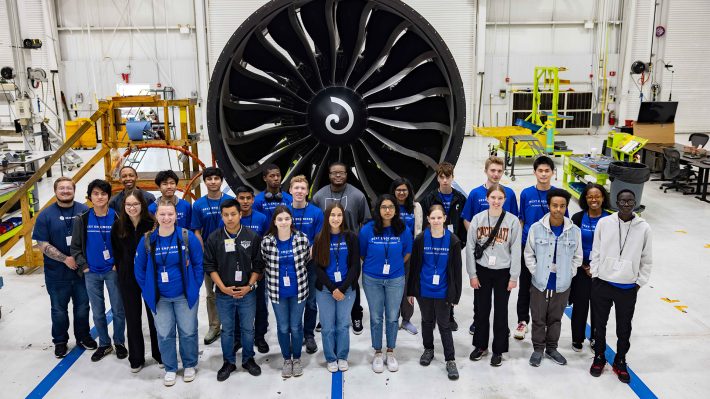
Updated 1 hour agoThe GE Aerospace Foundation picked Grand Rapids, Michigan as the newest site for its Next Engineers program, a college and career readiness initiative that introduces students ages 13 to 18 to engineering. The program will reach 4,000 students over four years, with programming starting in early 2027.
The announcement is part of a $20 million commitment the Foundation made in 2024 to expand Next Engineers to four new locations. The program already operates in seven cities across the US, UK, South Africa, Poland, and India, and has reached more than 32,000 students since 2021.
Why it matters
With only 32,000 students reached so far toward a 60,000 goal by 2034, GE Aerospace is betting its volunteer-heavy STEM model can address the engineering talent gap in a mid-sized manufacturing city.
Questions about this story
Free account needed to ask — your question is kept and asked for you right after sign-up. Answers are public.
No questions yet — be the first to ask.
Key Indicators
4,000
Students targeted in Grand Rapids over four years
Projected reach of Next Engineers programming in the new site.
32,000+
Students reached globally since 2021
Total Next Engineers participants across all locations worldwide.
$20M
2024 commitment for program expansion
New funding committed to expand Next Engineers to four new locations.
$3M+
Scholarships awarded globally
Cumulative scholarships awarded to Engineering Academy graduates.
7
Current program sites worldwide
Locations serving students: Cincinnati, Greenville, New York, Warsaw, Bengaluru, Staffordshire, Johannesburg.
Related Media
GE Aerospace Foundation launches Next Engineer program in Grand Rapids
Robotics Program - Grand Rapids Christian Schools
Next Engineers

37 views
27:23
Why GE Aerospace believes a sustainable future will be built ...
SimpliFlying
1.3K views
1:21
GE Aerospace is building a larger skilled workforce!
GE Aerospace
456 views
3:10
Introducing the GE Aerospace-Reagan Workforce Readiness ...
Ronald Reagan Presidential Foundation & Institute
Images from Openverse under Creative Commons licenses. Videos from YouTube.
Voices
Curated perspectives — historical figures and your fellow readers.
Play
Exploring all sides of a story is often best achieved with Play.
Most of these play right now — no account needed. Sign up to save scores, keep a streak, and unlock Debate and Predict.
Log in
Sign Up
Higher or Lower
A number from this story, against one from elsewhere in the news — guess which is bigger, then keep the chain going. 5 rounds, 3 strikes; a miss costs a strike and resets your streak.
Example
Anchor
EU tariff revenue
$52B
Big for this kind of number
Mystery
Pentagon AI contract
?
Round 1
Streak: 0
Mystery
?
Keyboard: ↓/L lower · ↑/H higher
0 pts
Best streak: 0 · Rounds: 0
0 points — sign up to put that on the leaderboard.
Now try on this story
Connections
Sixteen names from the news. Find the four hidden groups of four. Four mistakes max.
Loading today's puzzle…
0/4 groups
Mistakes
Sign up to keep a daily streak — a new puzzle lands every day.
Now try on this story
Exit debate?
Your progress in this debate will be lost.
How it works
- 1 Two AI personas square off on this story.
- 2 You predict who'll win each round — correct picks earn XP.
- 3 One crossfire question is yours to fire. Pick it carefully.
Couldn't generate a topic
Select Your Champions
Choose one persona for each side of the debate
DEBATE TOPIC
Choose personas with different perspectives for a more dynamic debate.
SIDE A (PRO)
Select debater for this side:
No debate personas available right now.
SIDE B (CON)
Select debater for this side:
No debate personas available right now.
VS
Get ready to make your prediction...
Round of
Claim
Evidence
Stakes
Crossfire Answer
Closing Statement
Claim
Evidence
Stakes
Crossfire Answer
Closing Statement
Your Crossfire Question
Generating arguments...
Who's Got This Round?
Make your prediction before the referee scores
The referee scores both sides on
Correct predictions earn +20 XP
· Press 1 or 2 to pick
Evidence
40%
Logic
30%
Detail
20%
Style
10%
Round Results
Your Pick
Not this time
(%)
Overall Score
/10
Your Pick
Not this time
(%)
Overall Score
/10
Set the Crossfire
Pick the question both personas must answer in the final round
Crafting crossfire questions...
Choosing a question earns +10 XP crossfire bonus
🏆
Total XP Earned
Cred Change
Predictions
Debate Oracle! You called every round!
Sharp Instincts! You know your debaters!
The Coin Flip Strategist! Perfectly balanced!
The Contrarian! Bold predictions!
Inverse Genius! Try betting the opposite next time!
XP Breakdown
Base completion
+20 XP
Rounds played ( rounds x 5 XP)
+ XP
Correct predictions ( correct x 20 XP)
+ XP
Crossfire bonus
+10 XP
Accuracy
%
Prediction History
Round
You picked:
✓
✗
Now try on this story
Keep debating to level up your credibility and unlock achievements
People Involved
Organizations Involved
GE Aerospace Foundation
Corporate Foundation
Funding and expanding Next Engineers globally
Independent charitable organization funded by GE Aerospace, focused on engineering education, workforce development, and disaster relief.
FHI 360
Nonprofit implementing partner
Global implementing partner for Next Engineers
Global development organization providing strategic planning, project management, technical assistance, and curricula for Next Engineers.
Timeline
January 2021 September 2026
5 events
Latest: Today
Tap a bar to jump to that date
-
Grand Rapids announced as newest program site
Today ExpansionFoundation announced Grand Rapids addition, targeting 4,000 students over four years; Cincinnati extended through 2035.
-
Cincinnati celebrates third cohort graduation
Milestone28 students graduated from the Academy program; over 100 total graduates in Cincinnati to date.
-
Foundation commits $20M to expand program
FundingGE Aerospace Foundation announced new funding to expand Next Engineers to four new locations globally.
-
Program expands to four international cities
ExpansionJohannesburg, Warsaw, Bengaluru, and the New York Capital Region joined the program.
-
Next Engineers launches in three cities
Program LaunchProgram began in Cincinnati, Greenville, and Staffordshire with Engineering Discovery and Engineering Academy tracks.
Historical Context
2 moments from history that rhyme with this story — and how they unfolded.
1957-1958
Sputnik and the National Defense Education Act (1958)
The Soviet launch of Sputnik shocked the US and prompted the National Defense Education Act, which poured federal money into science, math, and engineering education. Tens of thousands of students entered STEM fields in the years that followed.
Then
A surge in American STEM graduates throughout the 1960s.
Now
Established the US pattern of attaching STEM education funding to national competitiveness concerns.
Why this matters now
Next Engineers operates in a similar logic—building engineering pipelines—but relies on corporate rather than federal funding, showing how workforce development has shifted toward private-sector initiatives.
1940s-1950s
Bell Labs and the transistor era (1940s-1950s)
Bell Labs, the research arm of AT&T, invested heavily in fundamental science and engineering education. The transistor was invented there in 1947, and the labs trained generations of engineers who went on to define the semiconductor industry.
Then
Bell Labs produced a string of Nobel Prize winners and market-defining technologies.
Now
Set the template for corporate R&D labs as engines of both innovation and scientific workforce development.
Why this matters now
Shows how corporate investment in engineering talent pipelines can pay off for decades, but also that such investments depend on sustained corporate commitment.
Sources
(5)Related Stories
Root Functional Medicine opens Grand Rapids headquarters
Money Moves
Updated Yesterday
Grand Rapids backs volunteer snow-shoveling program for elderly residents
Built World
Updated 4 days ago
Grand Rapids pilot pays musicians as certified city vendors
Rule Changes
Updated Yesterday
Mary Free Bed expands Grand Rapids campus as rehab demand surges
Built World
Updated 4 days ago
DeVos Performance Hall announces October 2026 lineup with 8 shows
New Capabilities
Updated Aug 29
Grand Rapids Gold set 26 home dates at Van Andel Arena for 2026-27 season
Built World
Updated 6 days ago