



Pull to refresh
Logo
Henlius reports positive U.S. bridging trial results for lung cancer drug serplulimab

Henlius reports positive U.S. bridging trial results for lung cancer drug serplulimab

New Capabilities

Trial compared serplulimab plus chemo against Genentech's atezolizumab in extensive-stage small cell lung cancer

Today: Henlius reports positive ASTRIDE results at ESMO 2026

Overview

Updated 1 hour ago

A randomized U.S. trial in extensive-stage small cell lung cancer found patients on Henlius' serplulimab lived a median 12.4 months, versus 10.2 months for Genentech's atezolizumab. The 201-patient study was a bridging trial designed to test whether global evidence for serplulimab holds in a U.S. population.

The numbers favor serplulimab, but the study was descriptive, not powered to prove superiority. The hazard ratio of 0.82 carried a 95% confidence interval of 0.56 to 1.20, crossing 1.0. Henlius said the results support its earlier international ASTRUM-005 trial and position serplulimab for potential U.S. first-line use.

Why it matters

If the FDA clears serplulimab, U.S. extensive-stage small cell lung cancer patients gain a new first-line immunotherapy beyond atezolizumab and durvalumab.

Questions about this story

Free account needed to ask — your question is kept and asked for you right after sign-up. Answers are public.

No questions yet — be the first to ask.

Key Indicators

12.4 vs 10.2 months
Median overall survival, serplulimab vs atezolizumab
Differed by 2.2 months in favor of serplulimab in the intent-to-treat population.
0.82
Hazard ratio for death (95% CI 0.56–1.20)
Favorable numerical trend toward lower hazard of death with serplulimab; interval crosses 1.0.
201
Patients randomized across 63 U.S. sites
Randomized 1:1 between July 2022 and October 2025.
32.2% vs 17.6%
2-year overall survival, serplulimab vs atezolizumab
Estimated long-term survival advantage appeared more pronounced at 24 months.
14.1 months
Median follow-up as of data cutoff
Data cutoff was February 18, 2026.

Voices

Curated perspectives — historical figures and your fellow readers.

Ever wondered what historical figures would say about today's headlines?

Sign up to generate historical perspectives on this story.

People Involved

Organizations Involved

Timeline

July 2022 October 2026

6 events Latest: Today
Tap a bar to jump to that date
  1. Henlius reports positive ASTRIDE results at ESMO 2026

    Today Conference

    Company presents data showing numerically longer median overall survival for serplulimab versus atezolizumab.

  2. Data cutoff for ASTRIDE analysis

    Clinical Trial

    Median follow-up reaches 14.1 months; 50 of 101 serplulimab patients and 58 of 100 atezolizumab patients had died.

  3. Enrollment completed at 201 patients

    Clinical Trial

    Randomization finishes across 63 U.S. sites; 101 patients on serplulimab, 100 on atezolizumab.

  4. FDA approves lurbinectedin plus atezolizumab maintenance

    Regulatory

    U.S. regulator clears a newer maintenance combination, shifting the treatment landscape ASTRIDE did not evaluate.

  5. Protocol amended to speed enrollment

    Clinical Trial

    Newly diagnosed patients allowed to receive one cycle of chemotherapy before randomization, helping accrue U.S. patients.

  6. ASTRIDE trial begins enrolling U.S. patients

    Clinical Trial

    Henlius opens a 201-patient randomized U.S. study comparing serplulimab against atezolizumab, both with chemotherapy.

Scenarios

1

FDA approves serplulimab for first-line ES-SCLC

Possible Resolves by End of 2029

Discussed by: Henlius management; U.S. oncology community tracking regulatory filings

Henlius files a biologics license application to the FDA using ASTRIDE plus ASTRUM-005 data. Because ASTRIDE was descriptive rather than powered for superiority, the FDA may weigh the global confirmatory trial heavily. Approval would make serplulimab the first PD-1 inhibitor cleared for this indication in the U.S.

2

FDA requires additional confirmatory data before filing

Possible Resolves by Q2 2028

Discussed by: Oncologists noting the confidence interval crossing 1.0

Regulators ask for a larger randomized trial before accepting a BLA, given the descriptive design and wide confidence interval on the primary endpoint. Henlius launches a new U.S. phase III study, delaying any submission by several years.

3

Serplulimab stays outside the U.S. market

Possible Resolves by Q2 2028

Discussed by: Analysts weighing cost of a U.S. launch against comparable outcomes

Henlius declines to pursue a U.S. filing for this indication, focusing on markets where serplulimab is already approved through ASTRUM-005. The near-equal progression-free survival and response rates, with overlapping overall survival confidence intervals, may not justify the regulatory expense.

Historical Context

3 moments from history that rhyme with this story — and how they unfolded.

2019

IMpower133 trial (2019)

Atezolizumab plus carboplatin and etoposide became the first immunotherapy regimen approved for first-line extensive-stage small cell lung cancer, after the IMpower133 trial showed a survival benefit over chemotherapy alone.

Then

Atezolizumab plus chemo became a U.S. standard of care.

Now

Paved the way for durvalumab approval and established checkpoint blockade plus chemotherapy as the backbone in ES-SCLC.

Why this matters now

Atezolizumab is the active comparator in ASTRIDE, making this the benchmark serplulimab must match in U.S. practice.

2022

ASTRUM-005 global trial

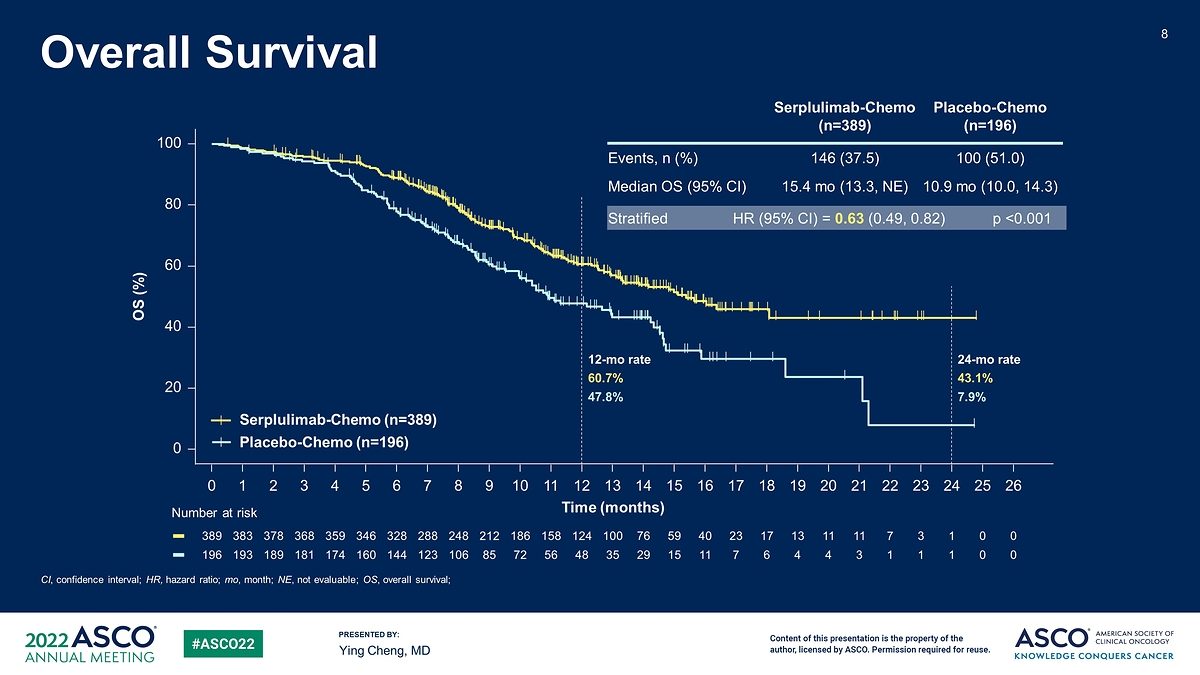
The international phase III ASTRUM-005 trial showed serplulimab plus chemotherapy improved median overall survival to 15.8 months versus 11.1 months with chemotherapy alone, a hazard ratio around 0.62.

Then

Established serplulimab's efficacy and led to approvals in China and other markets.

Now

Became the global evidence base that ASTRIDE was designed to bridge into the U.S.

Why this matters now

ASTRIDE tests whether that international benefit translates to a U.S. population, the key question for any FDA submission.

2019

BeiGene's zanubrutinib U.S. entry

BeiGene, a Chinese biopharmaceutical company, won FDA approval for the cancer drug zanubrutinib using global trial data supplemented by targeted studies, becoming a template for Chinese oncology companies entering the U.S. market.

Then

Established a regulatory pathway for Chinese-developed cancer drugs in the U.S.

Now

Showed that bridging and global data sets can support FDA clearance when efficacy is demonstrated.

Why this matters now

Serplulimab's path mirrors this playbook: international efficacy evidence plus a U.S. bridging study to satisfy FDA expectations.

Sources

(4)