


Pull to refresh
Logo
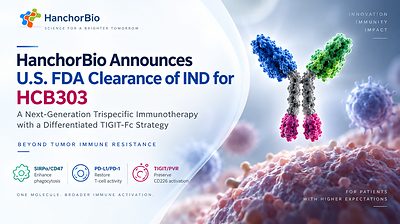
FDA clears HanchorBio's trispecific cancer drug HCB303 for human trials

FDA clears HanchorBio's trispecific cancer drug HCB303 for human trials

New Capabilities

HCB303 blocks TIGIT, PD-L1, and CD47 in one molecule, weeks after the TIGIT class's biggest trial failed

2 days ago: FDA clears HCB303 IND

Overview

Updated 1 hour ago

The U.S. Food and Drug Administration cleared HanchorBio's investigational new drug application for HCB303, a single fusion protein that blocks three immune pathways: TIGIT, PD-L1, and CD47. The October 5 clearance lets the Taipei-based biotech open a Phase 1 trial in patients with advanced solid tumors who have exhausted standard options.

The class is bruised. Roche's tiragolumab missed its endpoints in a 521-patient lung cancer study published in September, and CD47-directed drugs carry a history of on-target anemia. HanchorBio's answer is structural, a TIGIT-Fc ligand trap that preserves the CD226 activating signal, and Phase 1 will test doses from 0.03 to 30 mg/kg in about 150 patients.

Why it matters

The TIGIT class just failed its biggest Phase 3; if HCB303 works, it could revive a checkpoint family most companies abandoned.

Questions about this story

Free account needed to ask — your question is kept and asked for you right after sign-up. Answers are public.

No questions yet — be the first to ask.

Key Indicators

150
Estimated Phase 1 participants
Target enrollment for HCB303-ONC-101 in advanced solid tumors.
0.03–30 mg/kg
Dose escalation range
Thousandfold span from first cohort to top dose, given weekly by IV.
2027-02-28
Estimated trial start
Estimated first-patient date on the ClinicalTrials.gov record.
2
Trispecifics in clinical development
HCB301 (Phase 1 since April 2025) and HCB303 (cleared October 2026).

Voices

Curated perspectives — historical figures and your fellow readers.

Ever wondered what historical figures would say about today's headlines?

Sign up to generate historical perspectives on this story.

Organizations Involved

Timeline

April 2025 October 2026

4 events Latest: 2 days ago
Tap a bar to jump to that date
  1. FDA clears HCB303 IND

    Latest Regulatory

    HanchorBio announces clearance and registers Phase 1 study HCB303-ONC-101 (NCT07859228).

  2. Tiragolumab class readout published

    Clinical data

    Roche's tiragolumab misses its endpoints in a 521-patient lung cancer trial published in JCO.

  3. FDA gives pre-IND feedback on HCB303

    Regulatory

    Type B pre-IND written feedback; nonclinical package called sufficient, starting dose plan reasonable.

  4. First HanchorBio trispecific enters Phase 1

    Trial launch

    HCB301 (anti-PD-L1, TGF-beta, SIRP-alpha) opens its 50-patient Phase 1.

Scenarios

1

HCB303 trial opens on schedule, first patient dosed in spring 2027

Likely Resolves by Q2 2027

Discussed by: HanchorBio's own filings project a February 28, 2027 start on ClinicalTrials.gov

The conditions are already in place: FDA clearance, a 150-patient target, and a defined dose range. If manufacturing and site activation proceed without friction, the study moves from "not yet recruiting" to active enrollment with listed sites, and the first cohort receives the 0.03 mg/kg starting dose.

2

CD47 on-target toxicity forces a dose hold or redesign

Possible Resolves by Q2 2028

Discussed by: October 2026 trial coverage noting anemia is a recurring problem for CD47-directed agents

HCB303's CD47 component could bind red blood cells in humans as earlier CD47 drugs did. If anemia or hemolysis appears in early dose cohorts, the trial pauses or amends dosing. Nothing in HanchorBio's release addresses whether HCB303 bound red blood cells in preclinical work.

3

First-in-human data show activity and validate the TIGIT-Fc design

Unlikely Resolves by End of 2028

Discussed by: HanchorBio's claim that its TIGIT-Fc trap preserves CD226 signaling, unlike tiragolumab-style TIGIT drugs

If early cohorts show acceptable safety plus any confirmed responses in checkpoint-refractory solid tumors, the design thesis gains credibility. That would reopen the TIGIT class after SKYSCRAPER-01. Early dose escalation rarely shows benefit, so this is the longest shot of the three.

Historical Context

2 moments from history that rhyme with this story — and how they unfolded.

September 2026

Tiragolumab's SKYSCRAPER-01 readout (2026)

Roche's SKYSCRAPER-01 trial randomized 521 patients with previously untreated PD-L1-high advanced non-small cell lung cancer to tiragolumab plus atezolizumab or placebo plus atezolizumab. Median progression-free survival was 7.0 months against 5.6 months (hazard ratio 0.78), and median overall survival was 23.1 against 16.9 months (hazard ratio 0.87).

Then

Both endpoints were judged nonsignificant under the trial's testing plan; grade 3-4 adverse events ran higher in the tiragolumab arm (41.2% vs 33.8%).

Now

The readout marked the latest failure in the TIGIT class and sent researchers hunting for designs that avoid its mechanism's pitfalls.

Why this matters now

HCB303 answers this failure architecturally. Its TIGIT-Fc ligand trap is built to preserve the CD226 activating axis, a distinction HanchorBio says earlier TIGIT drugs lacked.

Reported October 2026

CD47 blockade and on-target anemia (recurring class problem)

Across the field, CD47-directed agents have repeatedly run into on-target anemia — the drug binds red blood cells as well as tumor cells. October 2026 trial coverage noted the pattern and flagged that HanchorBio's release did not say whether HCB303 bound red blood cells in preclinical work.

Then

Several CD47 candidates have had to modify dosing or pause development over hematologic toxicity.

Now

Red blood cell binding is now a standard question asked of any new CD47-directed molecule before it reaches humans.

Why this matters now

HCB303 blocks CD47, so the anemia question carries into its Phase 1. Scenario 2 in this file tracks exactly that risk.

Sources

(10)