

Pull to refresh
Logo
Hirebotics cobots add line tracking and linear rails to reach moving and oversized parts

Hirebotics cobots add line tracking and linear rails to reach moving and oversized parts

New Capabilities

Features unveiled at IMTS 2026 extend cobots from fixed-station work to conveyor painting and large assemblies, all within the no-code Beacon platform

Yesterday: Hirebotics formally rolls out both features

Overview

Updated 1 hour ago

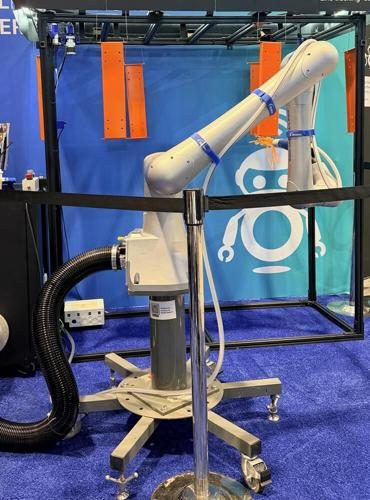
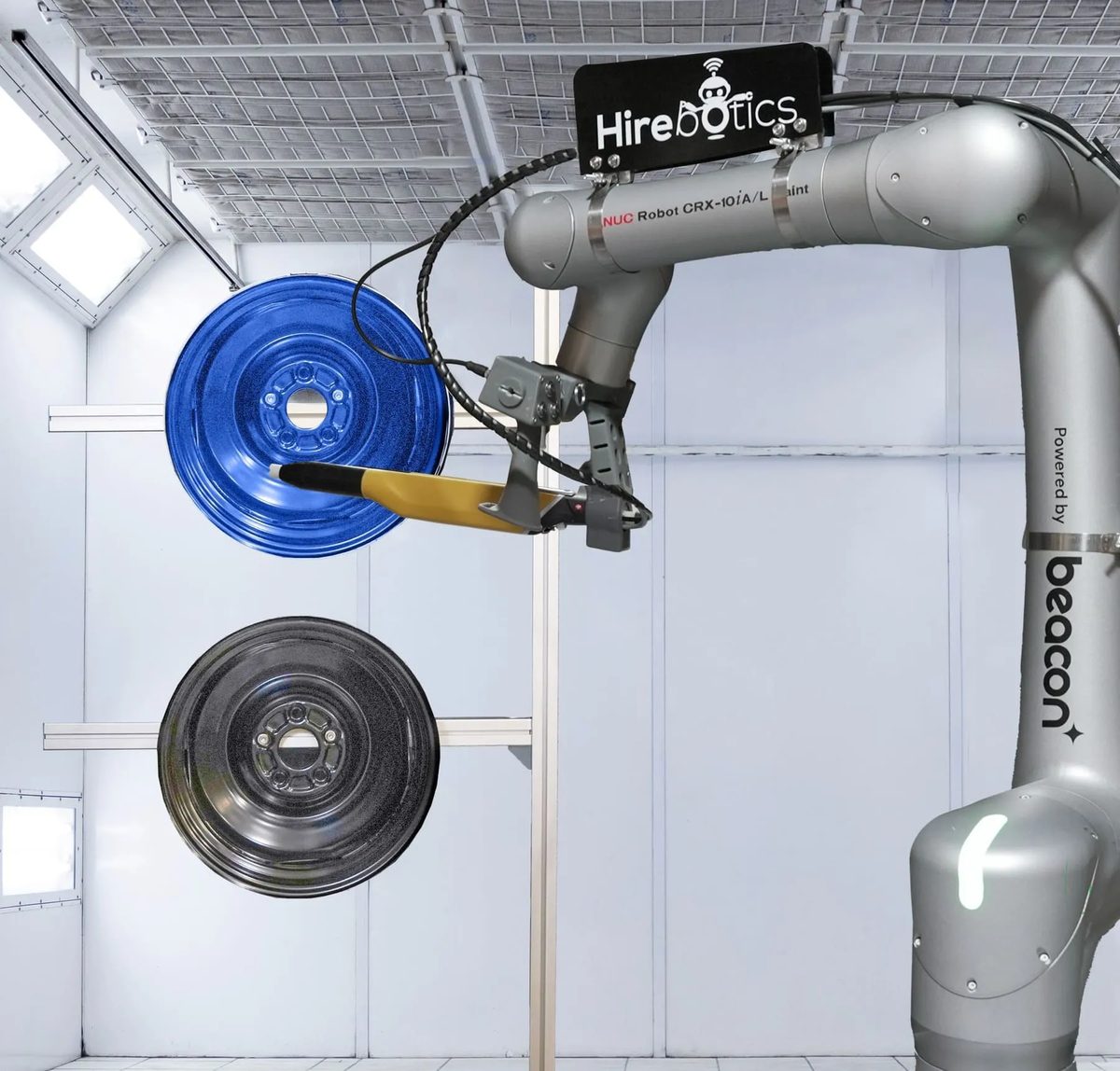
A Hirebotics cobot can now paint parts as they move along a conveyor, and ride a modular rail to reach workpieces far longer than its own arm, all programmed through the company's no-code Beacon platform. The company demonstrated both additions at IMTS 2026 in Chicago.

The two features remove constraints that pushed cobots out of many factories: stopping a production line to paint, and repositioning loads like 20-foot structural frames. Manufacturers in heavy fabrication, marine, and equipment building can now run continuous finishing lines and reach oversized parts without custom integration.

Why it matters

Small and mid-size factories can now paint moving parts and reach oversized workpieces with a no-code cobot, without stopping lines or repositioning loads.

Questions about this story

Free account needed to ask — your question is kept and asked for you right after sign-up. Answers are public.

No questions yet — be the first to ask.

Key Indicators

68.9 in
Cobot arm reach
Single-arm radial reach on Hirebotics' force- and power-limited cobot.
140 in
Extended fixed working envelope
Diameter of the working envelope, roughly double the arm's reach.
5 ft
Linear rail module length
Rail sold in 5-foot increments or custom lengths; multiple modules extend reach along a part.
2
New capabilities added
Line tracking for the Cobot Painter and modular linear rail across the cobot family.

Voices

Curated perspectives — historical figures and your fellow readers.

Ever wondered what historical figures would say about today's headlines?

Sign up to generate historical perspectives on this story.

People Involved

Organizations Involved

Timeline

2 events Latest: Yesterday
  1. Hirebotics formally rolls out both features

    Latest Announcement

    Company confirms the rail ships now with manual positioning and targets a fully automated, Beacon-controlled version for end of 2026.

  2. Hirebotics unveils line tracking and linear rail at IMTS

    Product Launch

    Hirebotics demonstrates both capabilities at IMTS 2026 in Chicago, extending cobots to conveyor-fed painting and large-part work.

Scenarios

1

Hirebotics ships the automated linear rail by year's end

Likely Resolves by End of 2026

Discussed by: The Robot Report and New Equipment Digest, reporting the company's stated end-of-2026 target

Hirebotics' plan is for Beacon to control rail movement automatically, turning the rail into a programmable seventh axis. Intermediate steps include position verification and operator prompts inside the Beacon interface. If the rollout holds, manufacturers get hands-free positioning without custom code or dedicated automation engineers.

2

Rail automation slips into 2027

Possible Resolves by Q1 2027

Discussed by: Integration complexity typical of adding a powered, safety-rated axis to a force-limited cobot

Motorized rail movement requires safety-rated controls, encoders, and emergency-stop integration. A delay past the announced target would leave the manual-position rail as the only option through the first quarter of 2027, with Beacon pausing the process and prompting operators to reposition the cobot by hand.

3

Line tracking expands to welding and cutting

Uncertain Resolves by Q2 2027

Discussed by: The Robot Report, noting the rail already works across welding, plasma cutting, and painting

Line tracking is currently limited to the Cobot Painter. If the encoder-and-sensor conveyor-following proves out on painting, the same approach could track seams for welding or parts for cutting, letting fabricators automate in-line operations rather than only finishing. This would extend the capability from the paint booth to the welding cell.

Historical Context

2 moments from history that rhyme with this story — and how they unfolded.

1980s

Automotive robotic paint line tracking (1980s)

In the 1980s, GM and other automakers installed robot paint lines that followed car bodies moving on conveyors, letting plants paint continuously without stopping production. Each system needed custom controls and teams of integration engineers.

Then

Auto plants raised throughput and paint quality, and line tracking became standard in mass production.

Now

The capability stayed confined to large plants with engineering budgets, out of reach for smaller shops.

Why this matters now

Hirebotics packages the same conveyor-following logic into a no-code cloud platform, making it available to manufacturers who could never justify a custom system.

1990s–present

Industrial robot linear tracks (1990s–present)

FANUC, KUKA, and ABB have sold motorized floor tracks for industrial robots for decades, letting arms travel along aircraft wings, truck frames, and other long assemblies. The tracks are standard in aerospace and heavy manufacturing, but they require dedicated control programming and significant capital.

Then

Plants gained a seventh axis of motion without moving the part.

Now

The mechanical concept is mature, but the cost and complexity of programming limited its spread beyond large plants.

Why this matters now

Hirebotics' rail extends the same idea to lightweight cobots, with manual positioning now and automated Beacon-controlled movement planned for end of 2026.

Sources

(10)