




Pull to refresh
Logo
Hitachi doubles US transformer production capacity in Mississippi

Hitachi doubles US transformer production capacity in Mississippi

Built World

$528 million plant targets grid bottleneck as transformer lead times stretch four years

2 days ago: Utility Dive reports transformer specifications

Overview

Updated 1 hour ago

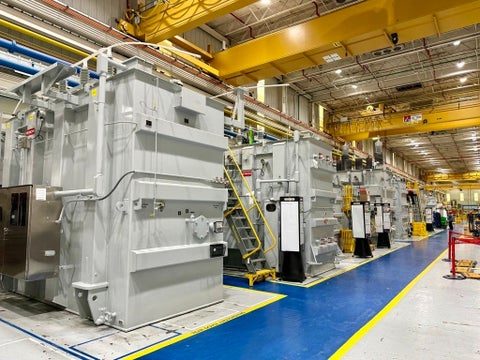
Hitachi Energy plans a $528 million transformer factory in Gallman, Mississippi, more than doubling its US production capacity for mid-sized power transformers. The plant, construction to begin late 2026 with production starting in 2029, will make transformers in the 10 to 160 MVA range at voltages up to 230 kV — the units that sit between transmission substations and industrial projects like data centers and semiconductor fabs. It completes a roughly $1.5 billion US manufacturing expansion, the largest in the industry.

That matters because transformer lead times now stretch as long as four years. Utilities, data center developers, and industrial plants are queued up waiting for the steel-and-copper boxes that change voltage, and every unit is spoken for long before it ships. Hitachi's new capacity won't relieve the queue in 2026 — the first Gallman units arrive about when a transformer ordered today would anyway — but it sets up a structural improvement in domestic supply by 2029 and beyond.

Why it matters

A US transformer shortage is delaying data centers, factories, and grid upgrades; this is the single biggest investment to date aimed at fixing it.

Questions about this story

Free account needed to ask — your question is kept and asked for you right after sign-up. Answers are public.

No questions yet — be the first to ask.

Key Indicators

$528 million
Investment in new Gallman facility
Hitachi Energy's largest single US investment, completing a ~$1.5 billion US expansion program.
700+
New jobs promised in Copiah County
More than double the 475 people currently employed at the nearby Crystal Springs facility.
10–160 MVA
Transformer rating range to be produced
Mid-range power transformers for voltages up to 230 kV, used by data centers and semiconductor plants.
4 years
Current transformer lead times
Utilities and developers order years ahead; the Gallman plant does not ship until 2029.

Voices

Curated perspectives — historical figures and your fellow readers.

Ever wondered what historical figures would say about today's headlines?

Sign up to generate historical perspectives on this story.

People Involved

Organizations Involved

Timeline

December 2020 December 2026

6 events Latest: 2 days ago
Tap a bar to jump to that date
  1. Construction expected to begin in Gallman

    Upcoming Construction

    Work on the 45-acre site at Copiah County Industrial Park slated for late 2026.

  2. Utility Dive reports transformer specifications

    Latest Reporting

    Plant will produce 10–160 MVA transformers up to 230 kV; official says capacity will help alleviate supply constraints.

  3. Reuters and Nikkei confirm project details

    Coverage

    Mid-range transformers in 10–160 MVA range, voltages to 230 kV, production starts 2029.

  4. Hitachi Energy announces $528 million Gallman plant

    Investment

    New Mississippi factory will double transformer production capacity, create 700+ jobs.,

  5. Transformer lead times begin stretching toward 4 years

    Market

    Data center boom and grid modernization outpace transformer supply, pushing order queues out years.

  6. Hitachi completes ABB power grid acquisition

    Corporate

    Forms Hitachi Energy from the former ABB power grids unit.

Scenarios

1

Gallman ramps on schedule, US transformer supply accelerates by 2029

Likely Resolves by Q2 2029

Discussed by: Hitachi Energy, Mississippi Development Authority; coverage in Utility Dive and TD World

Construction finishes on time, production starts 2029, and Hitachi's Crystal Springs workforce transitions to Gallman. Transformer output in the mid-range class increases as lead times begin to compress for data center and industrial customers. Hitachi's $1.5 billion program across Pennsylvania, Virginia, Tennessee, and Mississippi also comes online in phases.

2

US transformer shortages persist into 2030 despite new capacity

Possible Resolves by Q2 2030

Discussed by: mgrid.org analysis; transformer buyers via pv magazine USA reporting

Critics note the Gallman plant targets mid-range transformers, while the severe shortages are in large, high-voltage units. The new plant, heavily subscribed before it opens, adds capacity to a bottleneck that continues to limit data center interconnection. Lead times stay above three years as demand grows at 5 percent annually.

3

Hitachi expands US footprint further with additional plants

Possible Resolves by Q2 2028

Discussed by: Industry analysts cited by Nikkei Asia and MarketScreener

The $1.5 billion program proves out, and Hitachi announces additional US capacity targeting large power transformers—the class where the shortage is most acute. The company leverages its existing Pennsylvania, Virginia, and Tennessee facilities and adds a second facility in the South.

Historical Context

2 moments from history that rhyme with this story — and how they unfolded.

1950–1980

GE and Westinghouse US transformer manufacturing (1950s–1980s)

GE, Westinghouse, and Allis-Chalmers supplied virtually all US transformer demand. Their Ohio and Pennsylvania plants employed tens of thousands and produced the large units that underpinned the post-war grid build-out.

Then

US transformer capacity peaked in the 1970s and then contracted as the market matured.

Now

By the 1990s most US transformer manufacturing had moved abroad or shut. The exit left a domestic manufacturing gap that became a supply constraint decades later.

Why this matters now

Hitachi's expansion is rebuilding a manufacturing base that GE and Westinghouse abandoned—reversing one of the most consequential industrial relocations of the late 20th century.

2018–2024

Transformer trade tariff policy shifts (2018–2024)

The Trump administration imposed tariffs on imported transformers to boost domestic manufacturing. The US admitted only about 15,000 transformers worth $1.7 billion in 2023—and that with many tariff exemptions granted due to hardware shortages.

Then

Tariffs raised prices domestically and made US-built units more competitive but did not immediately add supply.

Now

The long lead time between tariff policy and factory output explains why the 2026 bottleneck persists.

Why this matters now

Hitachi's investment is a direct result of this policy push, though its 2029 timing underlines how long it takes to translate trade policy into manufacturing capacity.

Sources

(11)