
Pull to refresh
Logo
Michigan courts keep citizenship voting measure off November ballot

Michigan courts keep citizenship voting measure off November ballot

Rule Changes Holt, MI local

Signature sample fell three short of the required minimum; supporters vow a 2028 retry

3 days ago: Michigan Supreme Court declines to force citizenship voting proposal onto the ballot

Overview

Updated 1 hour ago

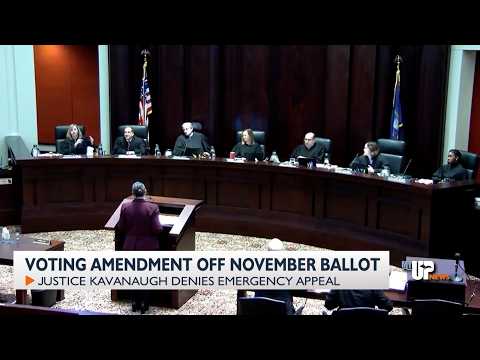
Michigan voters will not see a proof-of-citizenship voting requirement on the November ballot. The Michigan Supreme Court on Thursday declined to force certification, hours after U.S. Supreme Court Justice Brett Kavanaugh rejected the same emergency request without explanation.

The decision ends a challenge where a random check of 1,000 signatures found 626 valid — three short of the 629 needed to qualify. Supporters gathered more than 700,000 signatures and spent over $3 million on the drive, but the deadlocked Board of State Canvassers kept the measure off the ballot. ACV leaders say they will try again in 2028.

Why it matters

Michigan's registration rules stay unchanged for 2026, but the 700,000-signature drive shows the citizenship voting push has momentum for 2028.

Questions about this story

Free account needed to ask — your question is kept and asked for you right after sign-up. Answers are public.

No questions yet — be the first to ask.

Key Indicators

626
Valid signatures in random 1,000-signature sample
Three short of the 629 required to qualify for the ballot.
700,000+
Signatures submitted by Americans for Citizen Voting
Estimated total collected; far above the 446,198 valid signatures required.
446,198
Valid signatures required for a constitutional amendment
State threshold certified by the Bureau of Elections.
$3M+
Spent on petition management
Includes paid signature gathering, per Michigan campaign finance records.

Voices

Curated perspectives — historical figures and your fellow readers.

Ever wondered what historical figures would say about today's headlines?

Sign up to generate historical perspectives on this story.

Play

Exploring all sides of a story is often best achieved with Play.

Most of these play right now — no account needed. Sign up to save scores, keep a streak, and unlock Debate and Predict. Log in Sign Up
Predict 3 ways this could play out. Back the one you believe — contrarian picks score more when a scenario has a resolution date. Log in to play

People Involved

Organizations Involved

Timeline

November 2024 September 2026

9 events Latest: 3 days ago
Tap a bar to jump to that date
  1. Michigan Supreme Court declines to force citizenship voting proposal onto the ballot

    Latest Resolution

    WLNS 6 News reports the final court bar to placing the measure on the November ballot.

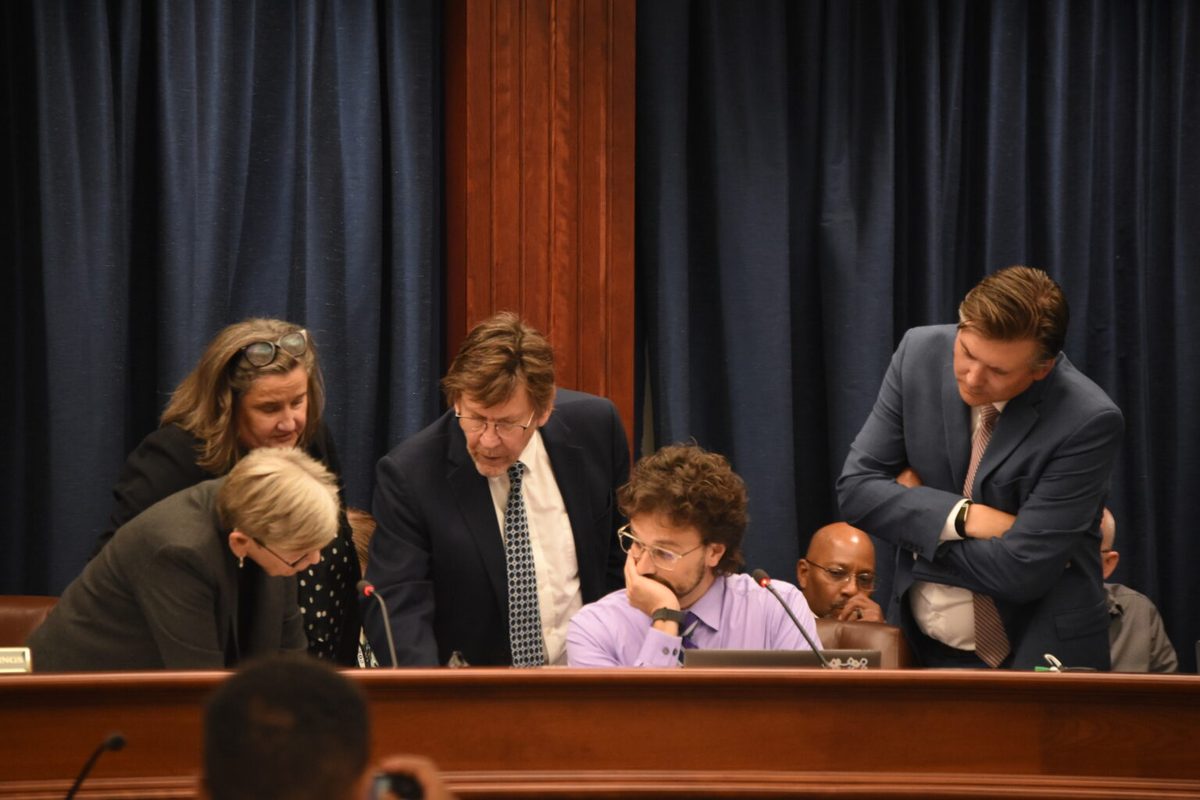
  2. Board of State Canvassers deadlocks 2-2

    Decision

    A random sample finds 626 valid signatures, three short of the 629 needed. The board splits along party lines and fails to certify.

  3. ACV files estimated 750,000 signatures

    Filing

    ACV submits more than 700,000 signatures; 446,198 valid signatures are required to qualify for the ballot.

  4. ACV begins signature collection

    Campaign

    Americans for Citizen Voting launches a statewide signature drive for a ballot measure requiring proof of citizenship to vote.

  5. Michigan House rejects proof-of-citizenship amendment

    Legislative Failure

    State Rep. Bryan Posthumus's constitutional amendment requiring citizenship verification fails along party lines.

  6. Republicans take Michigan House

    Political Shift

    Republicans regain control of the Michigan House; proof-of-citizenship voting becomes a legislative priority.

  7. University of Michigan student allegedly votes without citizenship

    Allegation

    A U of M student is accused of registering and voting without being a U.S. citizen, becoming a catalyst for proof-of-citizenship efforts.

Historical Context

3 moments from history that rhyme with this story — and how they unfolded.

November 2004

Arizona Proposition 200 (2004)

Arizona voters passed Proposition 200, requiring proof of citizenship to register to vote. The measure was enforced for state elections but frozen for federal elections after the U.S. Supreme Court ruled in Arizona v. Inter Tribal Council of Arizona (2013) that states could not add requirements beyond the federal voter registration form.

Then

The law took effect for state elections but was blocked for federal elections pending litigation.

Now

The 2013 ruling established that states cannot impose additional requirements on the federal voter registration form, a precedent that constrains citizenship verification efforts.

Why this matters now

The Michigan measure faces the same tension: states can require citizenship to vote in state elections, but federal law limits how they verify it for federal elections.

2011-2018

Kansas proof-of-citizenship law (2011-2018)

Kansas Secretary of State Kris Kobach pushed through a law requiring proof of citizenship for voter registration. Courts struck it down for federal elections in 2018, and thousands of legitimate Kansas voters had been put on 'suspense' status and denied ballots in state elections.

Then

Thousands of Kansas voters could not vote in state elections while the requirement was in force.

Now

The law was struck down for federal elections; Kobach lost the 2018 governor's race, and the state rolled back the requirement.

Why this matters now

Demonstrates the practical cost of proof-of-citizenship requirements: legitimate voters without documentary proof can be disenfranchised, a pattern opponents cite in the Michigan fight.

2017-2018

Michigan's Promote the Vote initiative (2018)

A citizen initiative in Michigan gathered enough signatures to qualify as Proposal 3 and passed with 67% of the vote, creating automatic voter registration, straight-ticket voting, and expanded absentee voting. The Board of State Canvassers certified it without the controversy now surrounding ACV.

Then

Proposal 3 passed, expanding access to voting in Michigan.

Now

Became a target for Republican-led voting restrictions and established that the citizen initiative process can work when measures clear the signature threshold.

Why this matters now

Shows the signature-verification system is the gateway to ballot access; the ACV measure's failure turns entirely on that gateway.

Sources

(5)