



Pull to refresh
Logo
Teclistamab shows deep remissions in high-risk smoldering myeloma trial

Teclistamab shows deep remissions in high-risk smoldering myeloma trial

New Capabilities

Bispecific antibody beat lenalidomide-dexamethasone in phase 2 ImmunoPRISM trial

Today: Nature Medicine publishes ImmunoPRISM results

Overview

Updated 1 hour ago

Doctors at Dana-Farber Cancer Institute gave teclistamab, a bispecific antibody already approved for advanced myeloma, to 45 patients with high-risk smoldering multiple myeloma. Complete remission followed in 77.8% of them.

None of the 14 patients on standard lenalidomide-dexamethasone reached complete remission. At two years, 92% of teclistamab patients were alive and disease-free, versus 49% on the standard regimen.

The phase 2 ImmunoPRISM results, published in Nature Medicine, are the first randomized evidence that a BCMA-targeted bispecific beats a lenalidomide-based approach in this pre-cancer state. They suggest treating the disease earlier may change its trajectory.

Why it matters

Half of high-risk smoldering myeloma patients progress to active cancer within two years. This treatment kept 92% progression-free and produced undetectable disease in most.

Questions about this story

Free account needed to ask — your question is kept and asked for you right after sign-up. Answers are public.

No questions yet — be the first to ask.

Key Indicators

77.8%
Complete response rate with teclistamab
Versus 0% in the 14 patients who received lenalidomide-dexamethasone.
92%
Two-year progression-free survival with teclistamab
Versus 49% for lenalidomide-dexamethasone at a median follow-up of 24.5 months.
82.2%
MRD-negativity rate at 10^-5
Minimal residual disease undetectable at one cancer cell per 100,000; all such responses ongoing at cutoff.
59
Patients enrolled in ImmunoPRISM
45 randomized to teclistamab, 14 to lenalidomide-dexamethasone, after a six-patient safety run-in.

Voices

Curated perspectives — historical figures and your fellow readers.

Ever wondered what historical figures would say about today's headlines?

Sign up to generate historical perspectives on this story.

People Involved

Organizations Involved

Timeline

October 2022 September 2026

5 events Latest: Today
Tap a bar to jump to that date
  1. Nature Medicine publishes ImmunoPRISM results

    Today Publication

    Peer-reviewed paper confirms deep remissions, 82.2% MRD-negativity and 92% two-year progression-free survival with teclistamab.

  2. ImmunoPRISM results presented at EHA Congress

    Trial Results

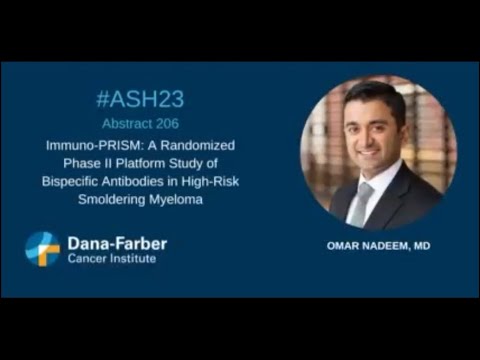
    Omar Nadeem presents data in Stockholm showing 77.8% complete response rate with teclistamab versus 0% with Rd.

  3. MajesTEC-9 shows teclistamab beats standard care at first relapse

    Trial Results

    Phase 3 trial showed teclistamab monotherapy superior to PVd or Kd on progression-free and overall survival in relapsed or refractory myeloma.

  4. Daratumumab approved for high-risk smoldering myeloma

    Regulatory

    First drug approved for high-risk smoldering myeloma, based on the AQUILA trial against active monitoring.

  5. FDA grants accelerated approval to teclistamab

    Regulatory

    Teclistamab (TECVAYLI) approved for relapsed or refractory myeloma patients after at least four prior lines of therapy.

Scenarios

1

FDA approves teclistamab for high-risk smoldering myeloma

Likely Resolves by Q2 2028

Discussed by: Trial investigators; Janssen. Daratumumab's 2025 AQUILA approval set the regulatory precedent.

Janssen files for an FDA indication covering high-risk smoldering myeloma. The 77.8% complete response rate versus 0% on the control arm resembles the gap that won daratumumab approval, though ImmunoPRISM enrolled only 59 patients. A confirmatory phase 3 may be required before a full approval.

2

Durable remissions hold at four years in ImmunoPRISM

Possible Resolves by End of 2028

Discussed by: Investigator team; Nature Medicine paper notes all MRD-negative responses were ongoing at data cutoff.

Follow-up past 48 months shows the majority of MRD-negative patients remain negative and progression-free. That would support treating smoldering myeloma as potentially curable with early immunotherapy, rather than merely delaying progression to active disease.

3

Combination bispecific regimens enter smoldering myeloma testing

Possible Resolves by End of 2027

Discussed by: Johnson & Johnson; inspired by teclistamab-daratumumab combinations showing 83% three-year PFS in relapsed disease.

New trials pair teclistamab with daratumumab or add second agents in smoldering myeloma, aiming to push beyond single-agent response rates. A phase 3 registration trial in this setting would be the clearest signal the field is moving toward combination early interception.

Historical Context

3 moments from history that rhyme with this story — and how they unfolded.

2013

QuiRedex trial (2013)

A Spanish phase 3 trial randomized high-risk smoldering myeloma patients to lenalidomide-dexamethasone or observation and found treatment delayed progression to active disease.

Then

Demonstrated that intervening in smoldering disease helps.

Now

But remissions were not deep, and many patients still progressed; the regimen became a comparator arm in later trials.

Why this matters now

ImmunoPRISM used lenalidomide-dexamethasone as its control arm and showed the bispecific antibody produces far deeper responses.

October 2022

MajesTEC-1 (2022)

Teclistamab in heavily pretreated relapsed or refractory myeloma patients produced a 39.4% complete response rate, 26.7% MRD negativity and median progression-free survival of 11.8 months.

Then

Won FDA accelerated approval for the drug in patients with at least four prior lines of therapy.

Now

Showed the drug works in advanced disease but with limited durability.

Why this matters now

The same drug, given much earlier in smoldering disease, produced nearly double the complete response rate and far higher MRD negativity, suggesting timing may matter as much as the drug.

June 2025

Daratumumab and the AQUILA trial (2025)

Daratumumab became the first drug approved for high-risk smoldering myeloma after the AQUILA trial showed it delayed progression better than active monitoring, which had been the standard for decades.

Then

Regulators accepted early intervention in smoldering myeloma as a legitimate treatment goal.

Now

Set the precedent that pre-cancer states can earn approved indications, opening the door for more potent immune-based therapies.

Why this matters now

ImmunoPRISM tests whether a bispecific antibody can go further than daratumumab in the same disease state.

Sources

(10)